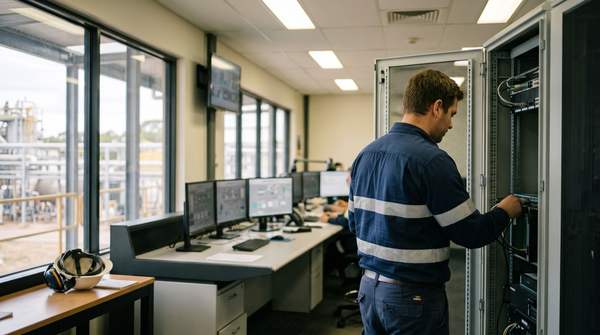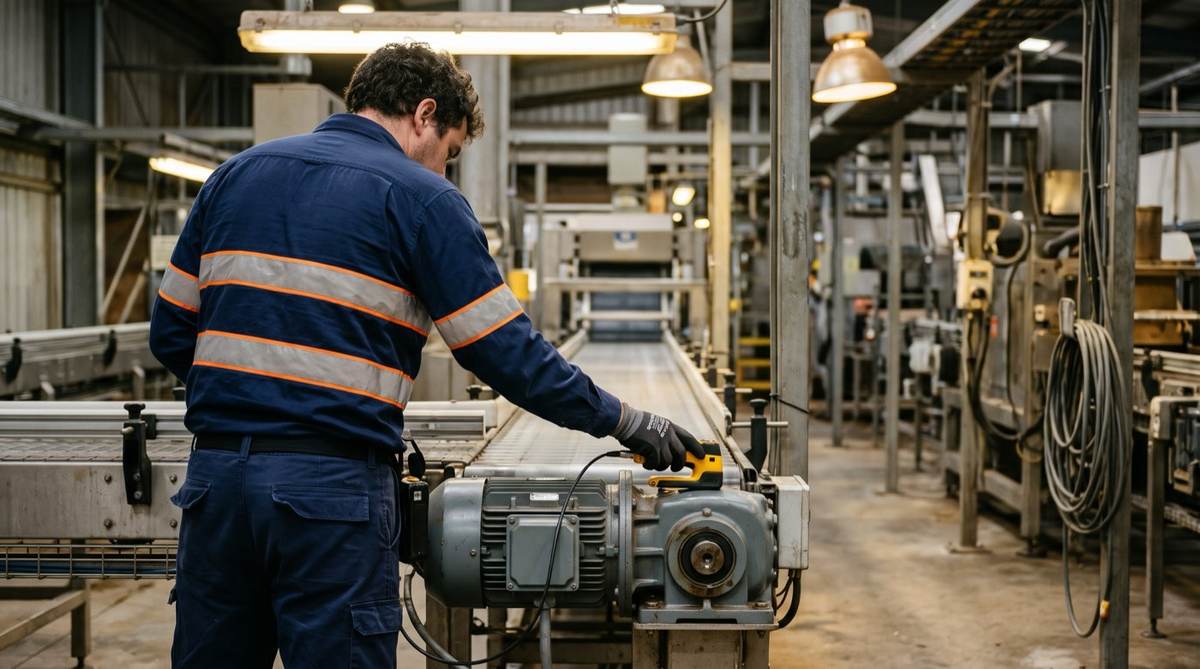
The five manufacturing AI use cases that pay most often in Australian factories are predictive maintenance on critical motors and conveyors, computer vision quality inspection, generative design for parts, supply chain disruption alerts, and safety analytics from existing cameras. Most run best on edge devices at the plant, with only summaries sent to the cloud.
Key takeaways
- Australian manufacturers compete on precision, quality and uptime, so AI that protects uptime and quality pays first.
- Predictive maintenance turns unplanned breakdowns into scheduled repairs.
- Vision inspection checks every unit, not a sample, and never tires late in a shift.
- Run inference at the edge for speed and reliability; keep raw video and sensor data on site.
Why does AI matter for Australian manufacturing?
Australian manufacturing operates with high labour costs, long and fragile supply chains, and strict safety and environmental obligations. Competing with lower-cost regions on volume is rarely viable. Competing on precision, quality and uptime is.
AI in manufacturing is about giving maintenance managers, quality leads and supervisors earlier warning and better information. It works alongside skilled people.
- UptimePredict failures before they stop the line
- QualityInspect every unit at line speed
- DesignLighter, stronger parts faster
- SupplyWarnings before shortages bite
- SafetyTrends from existing cameras
1. How does predictive maintenance work in a factory?
Hypothetical scenario: a critical conveyor motor fails mid-shift. Production stops while parts are expedited, and the cost includes lost throughput, overtime and freight.
The AI approach: vibration and temperature sensors on the motor feed an edge gateway. A model learns the healthy signature. Weeks before failure, the vibration pattern shifts and the system alerts the maintenance planner:
"Asset 4B (crusher motor): bearing wear pattern detected. Recommend inspection at next planned shutdown."
The planner checks the trend, confirms and replaces the bearing in a scheduled window. The breakdown becomes planned work.
Prediction works best on gradual failure modes: bearings, gearboxes, pumps, fans and belts. Sudden electrical faults need different detection. See asset health AI in Australian manufacturing.
2. How does computer vision improve quality control?
Hypothetical scenario: a food packaging line produces tens of thousands of units a shift. Inspectors check samples, but faulty seals still reach customers, risking returns, retailer penalties and recalls.
The AI approach: a camera over the line classifies each pack in real time. Packs below the seal-quality threshold are rejected by a pneumatic arm, and images of rejects are logged for the quality team.
- Coverage: every unit, not a sample.
- Consistency: the same standard on every shift.
- Evidence: images and counts for root cause analysis.
A quality lead reviews borderline cases and tunes thresholds. See our deep dive on AI visual inspection for quality control and manufacturing quality control automation.
3. What is generative design for parts?
Scenario: you need a custom bracket to mount a new sensor. A conventional design is solid and heavy.
The AI approach: in tools such as Autodesk Fusion or nTop, an engineer specifies the connection points, loads and constraints. The software generates many candidate geometries that meet the requirements with less material. The engineer selects, validates and refines the design, which may then be machined or 3D printed in aluminium or titanium.
The engineer stays responsible for validation against loads, fatigue and applicable standards.
4. How does AI warn of supply chain disruption?
Scenario: just-in-time inventory works until an inbound shipment is delayed and a critical input runs short.
The AI approach: an agent connects your ERP with shipping status, supplier lead times and external signals such as port congestion or severe weather. It flags at-risk orders early:
- Insight: "Inbound resin shipment likely delayed by four days. Stock covers two days of planned production."
- Recommendation: "Raise a bridging order with the local supplier at a higher unit cost to avoid a line stoppage."
A buyer approves the order before anything is placed. See supply chain visibility and disruption prediction and AI demand forecasting.
5. How can AI support safety (HSE) monitoring?
Scenario: checking PPE compliance across a large site is a constant, manual task for supervisors.
The AI approach: existing CCTV feeds run through a safety model at the edge. It detects patterns such as people without hard hats in a marked zone and logs events for review.
The purpose is trends, not punishment. "Why do night-shift workers in Zone B keep removing safety glasses? Is the lighting causing glare?" That is a WHS improvement question.
Camera analytics involving workers needs consultation, clear notice and compliance with state workplace surveillance laws and WHS duties, including psychosocial risk. Involve your safety committee and workforce before deployment.
| What it watches | What a person decides | Impact | |
|---|---|---|---|
| Predictive maintenance | Vibration, temperature, current | When to inspect and replace | Planned downtime |
| Vision QA | Every unit on the line | Thresholds and borderline cases | Fewer escapes |
| Generative design | Loads and constraints | Which design to validate | Lighter parts |
| Supply alerts | Orders, shipments, lead times | Whether to place a bridging order | Fewer stoppages |
| Safety analytics | Existing camera feeds | What to change on site | Safer trends |
Why run manufacturing AI at the edge?
For manufacturing, depending on a cloud round trip is often too slow and too fragile. If the internet drops, the line must keep running.
- Training can happen in your cloud environment or on your own servers.
- Inference runs on devices at the plant.
- Data stays local. Only summaries and events, such as "bearing wear detected on 4B", go to central systems. Raw video and high-frequency sensor data stay on site.
That gives speed, reliability and privacy. For plants with existing historians and SCADA, connecting AI to that data is usually the first job; see PI System historian and Power BI reporting and legacy system integration.
Where should a manufacturer start?
What costs your plant most today?
- Unplanned downtime on critical assetsStart with predictive maintenance
- Defects reaching customers or high scrapStart with vision inspection
- Stock-outs stopping linesStart with supply alerts and forecasting
- Recurring safety incidentsStart with safety analytics, after consultation
- Weeks 1-2Pick the asset or lineChoose one costly problem with a clear baseline
- Weeks 3-4Check the dataConfirm sensors, historian tags or camera coverage
- Weeks 5-10Run alongside operationsAlerts reviewed by maintenance or quality, no automatic actions
- Weeks 11-12DecideCompare against baseline, scale or stop
How Solve8 can help
Our consultants have spent their careers in operations systems, including engagements at BHP, Rio Tinto and Schneider Electric, and we build factory AI that runs on your infrastructure, with a person approving every action. See our manufacturing and OT work and custom AI development service, or talk to us.