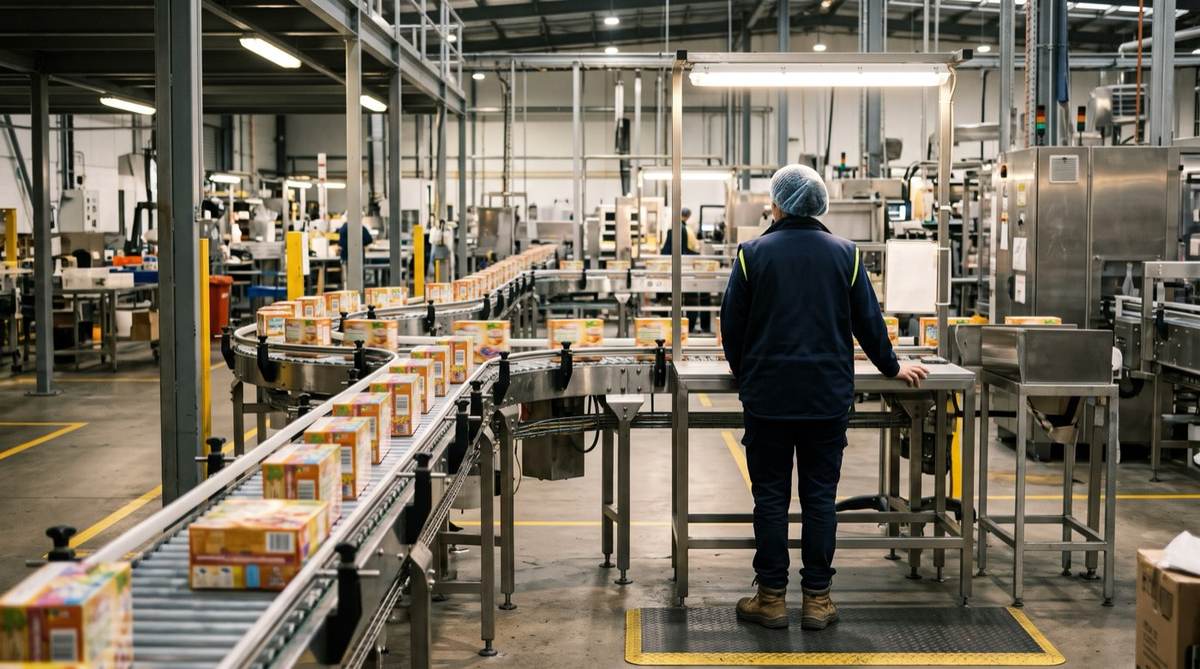
AI visual inspection uses cameras, controlled lighting and a trained computer vision model on the production line to detect defects, sort product and check surface quality at line speed. For Australian manufacturers it is one of the two most mature factory AI use cases, alongside predictive maintenance, and it must sit inside the plant's ISO 9001 quality system with a full audit trail.
Key takeaways
- Two use cases carry most of the proven value: vision-based quality control and predictive maintenance. Four others are situational.
- Physical setup decides vision performance. Lighting, cameras, fixturing and ambient light control matter more than the model.
- Compliance shapes what you can ship. ISO 9001, WHS, FSANZ, TGA, AICIS, AASB S2 and the Privacy Act all apply depending on what you make.
- Control loops stay in OT. Cloud AI is for retraining and reporting. Real-time decisions run at the edge, advisory or trigger-only.
- Audit first, then pilot. A two-month data and OT audit saves rework in the pilot.
Which AI use cases work on the Australian factory floor?
Australian manufacturing runs on thin margins against well-capitalised imports and a persistent skills gap. The question for operations directors is where AI delivers real productivity without betting the plant on technology that does not work reliably in their environment.
These six use cases are ordered by maturity in practice:
| Deployment pattern | What to expect and the key control | |
|---|---|---|
| Visual inspection (defect detection, sorting, surface quality) | Edge computer vision on the line: cameras, lighting, local inference, continuous retraining | Strongest evidence base. Control: ISO 9001 disposition trail, human review of borderline calls, drift detection. |
| Predictive maintenance (vibration, thermal, acoustic) | Sensors on critical assets streaming to a historian; model predicts failure window; CMMS work order trigger | Lead time of days to weeks on rotating equipment. Control: alarm threshold governance, false-positive review, CMMS integration. |
| Process optimisation (set-points, recipes) | Model suggests operating parameters within engineering limits; advisory first | Useful where the process is well instrumented. Control: validated operating envelope, engineering sign-off, functional safety review before any closed loop. |
| Demand forecasting and scheduling | Model overlay on MRP or ERP using history, promotions and seasonality | Decision support for schedulers. Control: people own scheduling decisions. |
| Quality root cause analysis | Correlate SPC, historian and inspection data to downstream defects | Faster investigations where data is clean. Control: engineering judgement on every confirmed driver. |
| Worker safety analytics (PPE, exclusion zones) | Computer vision on existing CCTV, aggregated reporting | Leading indicator for near misses. Control: WHS consultation, APP 5 notice, aggregated output only. |
Process optimisation needs a well-understood, well-instrumented process. Demand forecasting needs clean history. Root cause analysis needs an integrated data layer. Worker safety analytics needs careful WHS and Privacy Act work before a camera points at anyone. See AI pilot project success factors for choosing a starting point.
What compliance obligations apply to AI in Australian manufacturing?
Office AI worries about the Privacy Act and the ACCC. Factory AI adds quality standards, WHS, product regulation, climate disclosure and modern slavery. Which bind first depends on what you make and who you sell to.
| When it applies | What AI must do, who enforces | |
|---|---|---|
| ISO 9001 quality management | AI participates in pass or fail disposition of product | Documented and validated inspection method, change control on model updates, audit trail. Checked by your certification body. |
| ISO 45001 and state WHS laws | AI touches safety: exclusion zones, PPE, robot interaction | Risk assessment, worker consultation, hierarchy of controls. Enforced by state and territory WHS regulators. |
| FSANZ Food Standards Code and state Food Acts | AI in food safety, allergen detection or HACCP-relevant decisions | AI built into the food safety plan, validation evidence, traceability records. |
| TGA (medical devices) | AI in a medical device or in process control for one | Conformity assessment under the Therapeutic Goods (Medical Devices) Regulations 2002; software as a medical device rules where relevant. |
| AICIS (industrial chemicals) | AI supports chemical introduction categorisation | Obligations stay with the introducer; AI evidence supports, never replaces, categorisation. |
| AASB S2 climate disclosure | Group 1 from 1 Jan 2025, Group 2 from 1 Jul 2026, Group 3 from 1 Jul 2027 | AI-derived emissions estimates need auditable method, data lineage and assumptions. Administered by ASIC. |
| Modern Slavery Act 2018 | AI classifies supplier risk for entities with consolidated revenue of at least $100 million | AI output feeds the annual statement; the reporting entity remains responsible. |
| National Measurement Institute trade measurement | AI affects a measurement used in trade, such as weight | AI cannot substitute for a verified, pattern-approved measuring instrument. |
| Privacy Act 1988 and Fair Work Act 2009 | AI processes worker data | APP 5 notification, reasonable use, consultation obligations. |
Worker safety analytics catches plants most often, because it triggers WHS consultation, Privacy Act notification and questions about reasonable surveillance at once. See Fair Work compliance and AI and ACCC consumer guarantees and AI.
ISO/IEC 42001:2023, the AI management system standard, is starting to appear in tender requirements for manufacturers selling into regulated sectors. It is voluntary, but for plants already certified to ISO 9001 and ISO 45001 it is a coherent next step. Our ISO 42001 guide covers it.
How should OT and IT connect for manufacturing AI?
Most Australian plants run legacy operational technology: Siemens, Allen-Bradley or Mitsubishi PLCs; Wonderware, AVEVA or Ignition SCADA; PI System or AVEVA historians. None of it was designed to talk to cloud AI. The integration layer is where factory AI works or fails.
- OT layerPLC, SCADA, sensors, historian. Real-time, deterministic, safety-rated. Segmented from IT.
- Edge gatewayOPC UA or MQTT broker. Protocol translation, one-way data egress where required.
- Edge inferenceVision or predictive model running locally with bounded latency. Advisory or trigger-only.
- Retraining and analyticsYour cloud or your own servers in Australia, for retraining, drift monitoring and group reporting. No control loop here.
- Governance and audit trailModel version, training data and inference logs kept for ISO 9001, WHS review and AASB S2 where relevant.
Three rules follow:
- Closed-loop control belongs in OT. Cloud-hosted AI is fine for analytics, retraining and reporting. It is not fine for real-time control affecting safety or quality. Latency, availability and the IEC 62443 industrial cyber security framework all argue against it. See AWS, Azure and GCP AI services in Australia for the analytics tier.
- Use the right integration standard. OPC UA is the modern default for OT/IT integration. MQTT is common for telemetry. Modbus-only assets need translation at the gateway. Connecting cloud AI straight to PLCs produces brittle, insecure systems.
- Design the audit trail in. Every flagged defect, predicted failure or suggested set-point must be logged to survive an ISO 9001 surveillance audit and, for safety-related AI, a regulator investigation.
What does AI visual inspection take to work in production?
Vision-based quality control is the most cited factory AI use case and the one with the biggest gap between vendor demo and production line.
Physical setup comes first. Lighting geometry (back, dome, dark-field, coaxial), camera choice (global or rolling shutter, resolution, lens), fixturing repeatability and ambient light control set the limit on what any model can learn. Plants that spend on the model and skimp on lighting get poor results and blame the AI.
Class imbalance is the norm. At a 0.5% scrap rate there are 200 good parts for every defective one, and rare defect types may have a handful of examples in months of production. Oversampling, synthetic data, transfer learning and anomaly detection for the rarest defects all help, but need deliberate data engineering.
Drift detection is essential. Models trained on summer production drift in winter, on supplier A's material when supplier B ships, on day shift when night shift runs. In a factory, drift detection is also an ISO 9001 change control trigger. Our post on operating AI agents in production covers drift monitoring.
The ISO 9001 record needs three things:
- The validated method: what is inspected, against which specification, with what acceptance criteria
- Change control on the model: every retraining is a documented change with validation evidence
- The disposition trail: every pass or fail, including where a person overrode the AI
Non-conformances from certification bodies usually trace back to a gap in one of these. Treat any brochure promising near-total scrap elimination with suspicion; results depend on your baseline and imaging setup.
What works in predictive maintenance for manufacturers?
Predictive maintenance pays most in plants with critical rotating equipment: motors, pumps, compressors, gearboxes and conveyors.
- Inputs: vibration and thermal signatures are the most mature. Acoustic analysis is improving. Oil analysis helps where you already collect it.
- The P-F curve: AI pays off when the interval from potential to functional failure is long enough to act on, typically days to weeks for rotating equipment, but early signs are hard for people to see. For failures that develop over hours, AI buys little. For those over months, simpler condition monitoring is often enough.
- False positives erode trust. Two false alarms in a row and the maintenance team ignores the third. Threshold governance with engineering sign-off and a documented false-positive review keep credibility.
- CMMS integration decides value. An alert in a dashboard nobody opens is worthless. A work order raised in Maximo, SAP PM or MEX with the predicted failure mode, recommended inspection and parts list pays back. Design the integration before deployment.
Our asset health AI for manufacturing guide goes deeper.
What does a 12-month manufacturing AI roadmap look like?
- Months 0-2Data and OT auditInventory PLCs, SCADA, historian, MES, ERP. Assess data quality, network and cyber posture (IEC 62443) and compliance scope. No AI yet.
- Months 3-5First pilot, single line, single use caseVision QC on a costly defect type or predictive maintenance on a critical asset. Imaging or sensor stack first, then model. Logging and governance from day one.
- Months 6-8Scale the pilot and add a second use caseExtend to adjacent lines or assets. Add the other pattern. Integrate with CMMS, MES and the QMS. First retraining on production data.
- Months 9-12Governance maturity and board reviewISO/IEC 42001-aligned documentation, AASB S2 data lineage if in scope, AI risks in the WHS register, board paper on controls and next year.
Do not cut the audit phase. Plants that skip it spend the savings on pilot rework. Make the second use case a different pattern from the first so you build capability across both. Our automation business case template and payback period calculator help with funding at month 0 and the board review at month 12.
- Annual cost of scrap, rework and quality escapes on the target lineFrom finance and QMS
- Unplanned downtime hours and cost on the target assetFrom CMMS
- Hardware, integration and change effort for one lineScoped in the audit
- Payback on your numbers, not a vendor'sThe board's question
Which manufacturing AI pilot should you run first?
The right first pilot is rarely the one with the biggest theoretical benefit. It is the one where data is cleanest, the team can absorb the change and the AI's failure mode is bounded.
What is your primary operational KPI and your data starting point?
- Top KPI is scrap or quality escapes, lines are well-lit and parts well-fixtured, ISO 9001 already in placeVision QC pilot on the highest-cost defect type. Strongest evidence base, fits ISO 9001 QMS scope.
- Top KPI is unplanned downtime, critical rotating equipment, vibration or thermal sensors in place or affordablePredictive maintenance pilot on the asset with the highest downtime cost. Honest P-F interval analysis first.
- Top KPI is yield or energy, continuous process, historian with at least 12 months of clean dataProcess optimisation advisory pilot. Stay advisory, engineering sign-off on every change.
- Data is mostly paper or Excel, no historian, no OPC UADo not start with AI. Start with a data and OT foundation project, then revisit.
- Batch line (food, pharma, chemicals) with FSANZ, TGA or AICIS exposureVision QC on inspection points already in your HACCP or quality plan, with regulator-facing validation scoped in.
- You export to the EU under CBAM or AASB S2 applies to your groupPair the operational pilot with an emissions data quality project. The same data foundation supports both.
If the data foundation is missing, no model will save you. If AASB S2 or CBAM applies, the energy and carbon data work is happening anyway, so combine it with operational AI. We built Carbonly.ai, our own ESG product, on that kind of data foundation, and RootCauseAI, our own investigation product, shows the engineering investigation pattern behind quality and reliability AI.
What should plant managers check before starting?
Work through these in order. Any you cannot answer with evidence is your next piece of work.
- What are your top three quality or downtime costs per year, with evidence?
- What is your OT inventory (PLCs, SCADA, historian, MES, ERP, segmentation), and where are the data gaps?
- If ISO 9001 certified, has your certification body been engaged on AI within QMS scope?
- Does your WHS risk register include AI risks such as false negatives, drift and OT cyber?
- For food, medical devices or chemicals, can your FSANZ, TGA or AICIS evidence accommodate AI?
- Does AASB S2 apply to your group, and does the AI produce or consume emissions data?
- Do you export to the EU, and has CBAM been factored in?
- Does any AI involve worker monitoring, and are WHS consultation and APP 5 obligations mapped?
- Do vendors commit in contract to data residency, no training on your data and a sub-processor list?
- Is model change control mapped to ISO 9001 change control?
- Is advisory AI clearly separated from closed-loop control, with functional safety sign-off for any closed loop?
- Who owns the AI program, with what budget and board reporting line?
How Solve8 can help
Our consultants and engineers run the data and OT audit, connect plant systems through OPC UA and your historian, and build vision and maintenance models that run alongside your quality and maintenance teams until they prove accurate. See our manufacturing and resources work, our system integration service, or talk to us.