
Reference tracker, checked 24 October 2026
Australian AI rules and deadlines
Last updated
A dated tracker of the laws, policies and guidance that change what Australian organisations must do with AI, each checked against its official source.
Australia has no standalone AI act
The National AI Plan, released on 2 December 2025, manages AI risk through existing laws and regulators, and the Government has said it will not proceed with mandatory guardrails for high-risk AI at this time.
Obligations come from privacy, safety, financial services and online safety law, plus mandatory policies for government agencies that flow down to their suppliers. Each entry below names the regulator or body that publishes it, which is the authority to rely on.
Upcoming deadlines
| Date | What changes | Who it applies to |
|---|---|---|
| 10 Dec 2026 | Privacy policies must disclose automated decisions that significantly affect people (APP 1.7 to 1.9) | Every APP entity |
| Within 12 months of 15 Dec 2025 | Use case owners, a use case register, staff training and impact assessments under the DTA AI policy v2 | Non-corporate Commonwealth entities |
| 30 Apr 2027 | Existing AI use cases scoped and brought into line with the DTA AI policy v2 | Non-corporate Commonwealth entities |
| 31 Oct 2027 | First signed annual attestation under the NSW AI Operational Policy | NSW Government agencies |
| To be proclaimed | NSW duty to keep algorithms, AI and work allocation systems safe for workers | Every business with NSW workers |
Rules that apply to every Australian business
Automated decisions (APP 1.7 to 1.9)
Privacy and Other Legislation Amendment Act 2024. Royal assent 10 Dec 2024, commences 10 Dec 2026.
Statutory tort for serious invasions of privacy
Commenced 10 Jun 2025. People can sue for serious, intentional or reckless invasions of privacy, including harm caused with AI.
OAIC guidance on commercially available AI products
Published 21 Oct 2024, updated 17 Jan 2025. The Privacy Act applies to personal information going into and coming out of AI tools.
OAIC guidance on training generative AI models
Published 21 Oct 2024, updated 23 Oct 2024. Check training data accuracy and your right to use any personal information in it.
NSW Digital Work Systems Act 2026
Assent 18 Feb 2026. Main duties start on a date to be proclaimed, after SafeWork NSW publishes guidelines.
Guidance for AI Adoption (National AI Centre)
Published 21 Oct 2025. Six voluntary practices, replacing the Voluntary AI Safety Standard of 5 Sep 2024 in practice.
Financial services, health and online services
APRA CPS 230 Operational Risk Management
Commenced 1 Jul 2025, amended version 1 Jul 2026. Control material service providers, including AI vendors.
APRA letter to industry on AI
Published 30 Apr 2026. Board challenge, an AI inventory with owners, people in high-risk decisions and tested plans to move away from critical AI providers.
ASIC REP 798 Beware the gap
Released 29 Oct 2024. Governance must keep pace with AI adoption and be in place before AI is deployed.
TGA: AI and medical device software
Guidance updated 5 Feb 2026. AI intended to diagnose, prevent, monitor, predict or treat disease is a medical device.
eSafety age-restricted material codes
Codes covering generative AI and chatbots in effect from 9 Mar 2026. Services must stop children reaching age-restricted content.
Government agencies, and suppliers who sell to them
DTA Policy for the responsible use of AI in government
v2.0 effective 15 Dec 2025, v2.1 published 21 Oct 2026. Accountable officials, transparency statements, a use case register, training and impact assessments.
DTA technical standard for government's use of AI
Last updated 22 Aug 2025. Lifecycle practices for AI, with an addendum for agentic AI.
NSW AI Operational Policy (Circular DCS-2026-02)
Issued 30 Jul 2026. Assessment platform mandatory from 30 Sep 2026, first annual attestation due 31 Oct 2027.
Queensland AI governance policy and FAIRA
Policy v2.0.0 effective August 2026, FAIRA v2.0.0 effective September 2026. Every AI use assessed against Australia's AI Ethics Principles.
Victorian generative AI guideline
Made 27 Nov 2024. Prefer agency-approved tools, and do not use generative AI to make decisions or carry out assessments.
WA AI Policy and Assurance Framework
Published 5 Mar 2024, last updated 25 Aug 2026. An AI Accountable Officer and a self-assessment for every AI project.
Also in force for government
National framework for the assurance of AI in government
Released 21 Jun 2024. A shared approach that most state policies build on.
South Australia: AI Ethics Policy and generative AI guideline
In force. Agencies apply the national AI Ethics Principles.
Northern Territory: AI policy for public sector officers
In force. AI with a real impact on services or the public is assessed against the NT AI Assurance Framework.
Where the rules are heading
National AI Plan
Released 2 Dec 2025. Existing, largely technology-neutral laws, reviewed as needed, plus an AI Safety Institute.
Mandatory guardrails proposals paper
Consulted Sep to Oct 2024. The Government will not proceed with mandatory guardrails at this time.
AI consumer safety priorities
Announced 20 Jul 2026. Five planned workstreams, including a Digital Duty of Care and a second round of privacy reform.
Australia's AI Safety Institute
Announced 25 Nov 2025 and funded 2 Dec 2025. Tests advanced AI and advises regulators, with no duties on businesses.
Copyright and AI
Announced 26 Oct 2025. No new text and data mining exception for training on Australian works.
Questions
Does Australia have an AI act?
No. Australia regulates AI through existing, largely technology-neutral laws, including privacy, consumer, work health and safety, financial services and online safety law, enforced by the regulators already responsible for them. Government agencies also follow mandatory AI policies, and those obligations reach suppliers through contracts.
What is the next AI-related deadline for Australian businesses?
10 December 2026. From that date, an organisation covered by the Australian Privacy Principles must say in its privacy policy when it uses computer programs to make, or substantially help make, decisions that could significantly affect people (APP 1.7 to 1.9).
Does the NSW Digital Work Systems Act affect AI used at work?
Yes, once its main duties are proclaimed. The Act, which received assent on 18 February 2026, requires businesses with NSW workers to ensure algorithms, AI and work allocation systems do not put workers' health and safety at risk. The duties start after SafeWork NSW publishes guidelines.
Is the Voluntary AI Safety Standard still current?
The Guidance for AI Adoption, published by the National AI Centre on 21 October 2025, has replaced it in practice. It sets out six voluntary practices for organisations adopting AI, and while none is mandatory, it is a useful reference when customers or agencies ask how you govern AI.
Do government AI policies apply to suppliers?
The duties sit with the agency, but agencies pass them on. A supplier selling an AI system to a Commonwealth, NSW, Queensland, Victorian or WA agency should expect to provide what the agency needs for its register, risk assessment and transparency statement.
Can I cite or link to this page?
Yes. Link to https://solve8.com.au/resources/australian-ai-rules/ and quote the date it was last checked. For anything legal or contractual, rely on the official source named in each entry, because regulators update their guidance more often than any tracker.
Related
 Data sovereignty in Australia: a practical guideWhat Australian law requires about where data lives, the sector rules that go further, and how to choose AI vendors with confidence.
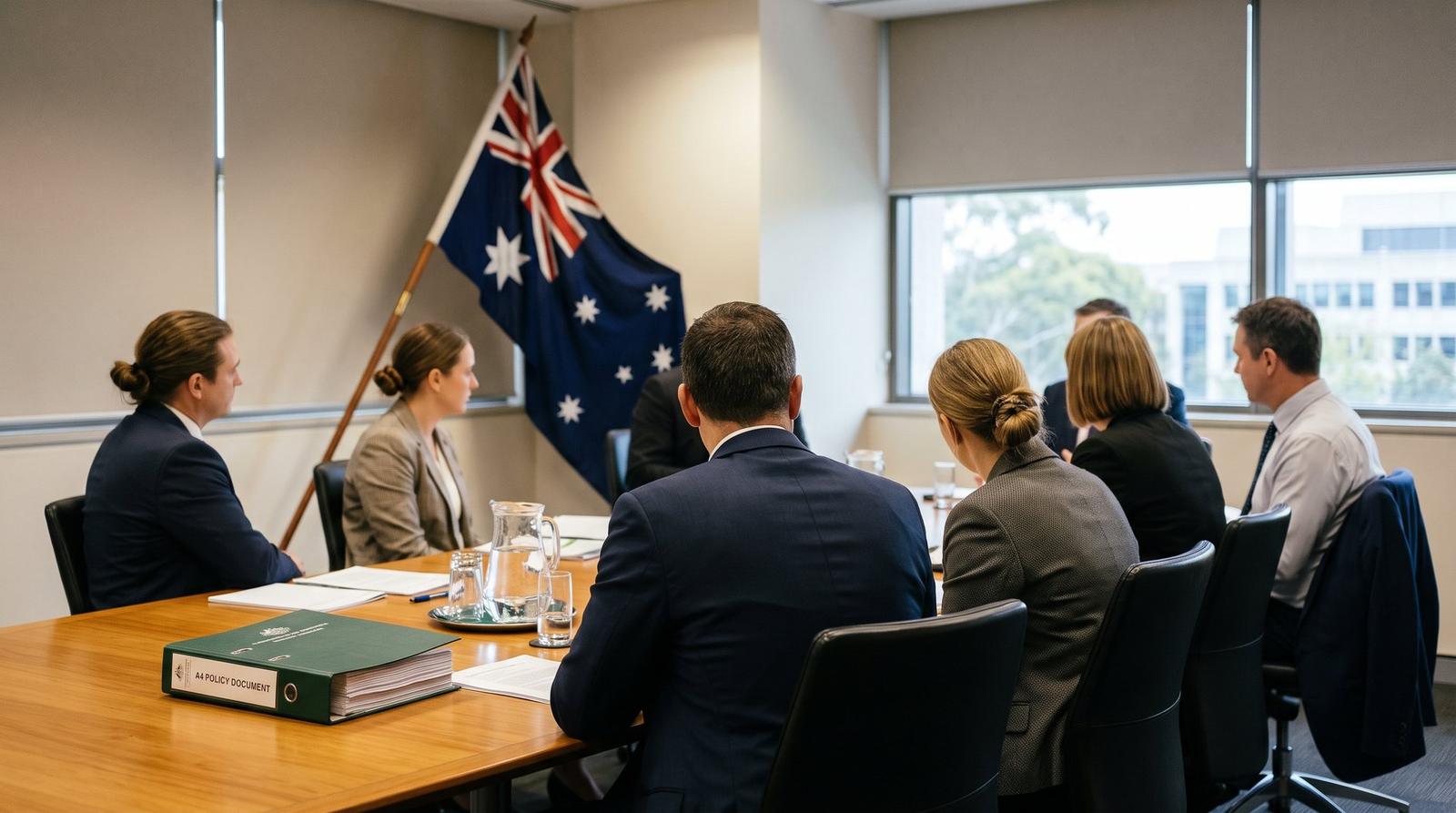 GovernmentGoverned AI with human approval.
 Financial servicesControls, reporting and reconciliations.
 AI strategyWhat to fix first, and the business case.
 SecurityYour data stays in your environment.

Map the rules to your use cases
We can show which obligations each AI use case touches before anything is built.
Fixed-fee phases, agreed before we start. Stop after any phase.