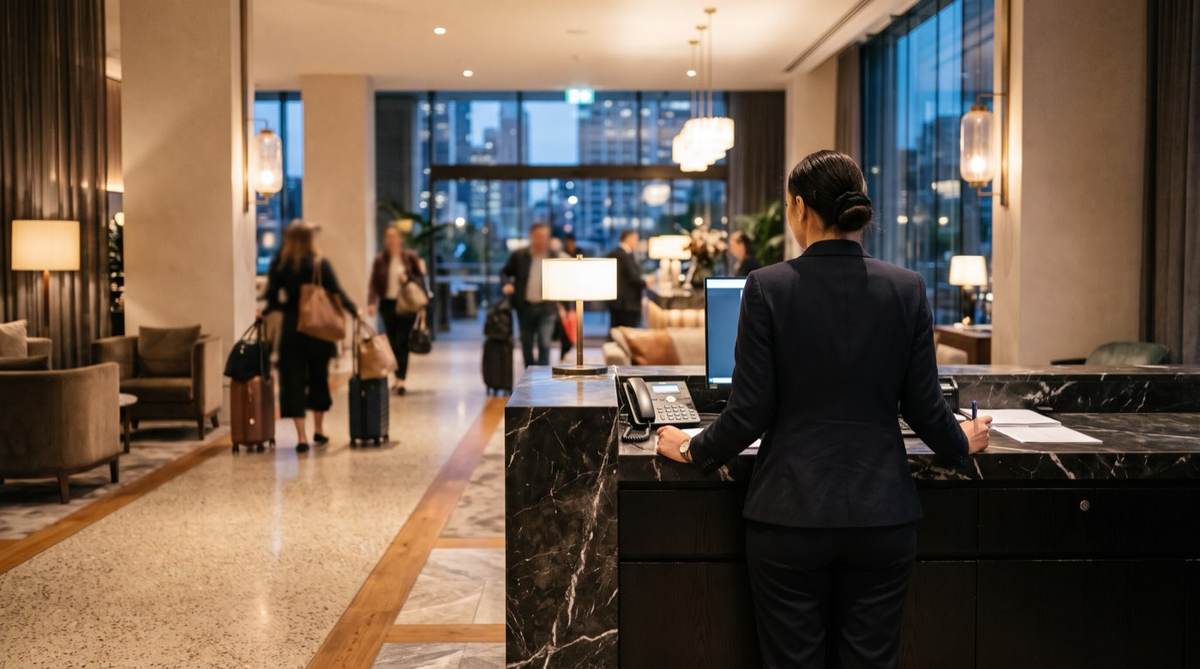
AI hotel operations automation uses software connected to your property management system (PMS) to answer routine guest messages, adjust room rates to demand, draft review responses and plan housekeeping and rosters. For hotel groups and serviced apartment operators in Sydney and across Australia, guest experience automation handles the volume so staff have time for the moments that need a person.
Key takeaways
- Four areas deliver: guest communication, revenue management, review responses and back-of-house operations.
- Start with your PMS. Opera, RMS Cloud, Mews, Cloudbeds and similar platforms often include automation you are not using.
- Escalate sensitive enquiries. Complaints, refunds, accessibility and medical or allergy questions go to staff immediately.
- Local demand patterns matter. School holidays, major events and regional seasons need to be in any pricing model.
- Consumer and privacy law apply. Pricing must not mislead under the Australian Consumer Law, and guest data must be handled under the Privacy Act.
Why are Australian hotel groups turning to AI?
Hotels across Australia continue to face staff shortages while guests expect instant replies across email, web chat, messaging apps and OTA inboxes. Front desk teams answer the same questions hundreds of times a week: check-in times, breakfast, parking, late checkout. Meanwhile, rate optimisation and review responses slip because nobody has time.
Large chains have shown what is possible. Accor, Hilton and Marriott have all publicly described AI programs for guest messaging, operations and energy management. The gap for mid-sized groups is integration: connecting the tools to the PMS and to each other so staff work from one view.
What are the four pillars of hospitality AI?
1. Guest communication automation
Chat and messaging assistants are the most common hospitality AI use case. Platforms such as HiJiffy, Quicktext and Asksuite answer routine questions instantly across web chat, WhatsApp, email and OTA messages, using information from your PMS and property knowledge base.
- Guest EnquiryChat, email, messaging app or OTA inbox
- AI TriageCategorise and assess complexity
- Routine AnswerCheck-in times, breakfast, parking, from approved content
- Sensitive CheckComplaints, refunds, accessibility, medical needs
- Human HandoffEscalate to staff with the full context
Set clear escalation triggers. Any enquiry mentioning a complaint, refund, accessibility, medical needs or allergies should go straight to staff. A guest asking about mobility access for a family member needs detailed knowledge and empathy.
The assistant does not need to close every booking. It needs to reply immediately, gather details and hand over cleanly so a person can finish the job.
2. Dynamic pricing and revenue management
AI revenue management systems such as IDeaS, Duetto and Atomize continuously analyse:
- Competitor rates across OTAs
- Booking pace and search demand by channel
- Local events, such as Vivid Sydney, the Melbourne Cup or State of Origin
- Weather affecting leisure demand
- Flight arrivals and corporate booking trends
Australian demand has distinctive patterns: school holidays that differ by state, sporting calendars, ski seasons and regional festivals. Models trained mainly on overseas markets can miss them, so check how a system learns local events and let revenue managers override recommendations. Our guide to AI demand forecasting explains the forecasting side.
3. Review response automation
Responding to reviews on Google, TripAdvisor and OTAs takes real time across a portfolio. AI tools analyse each review, match your brand voice and draft a reply for a manager to check and publish.
- Positive and straightforward reviews: AI drafts, staff approve quickly.
- One to three-star reviews: AI drafts, but a manager edits and approves before publishing.
- Reviews alleging safety, discrimination or staff misconduct: handled entirely by management.
4. Back-of-house operations
- Housekeeping: prioritise room cleaning from departure times, arrivals and guest requests
- Inventory: forecast linen, amenities and minibar needs
- Rostering: model demand to plan shifts, with award rules applied (see Fair Work compliance automation)
- Energy: adjust HVAC and lighting to occupancy
- Food safety records: for venues with kitchens, digital logs that meet Food Safety Standard 3.2.2A
How does hospitality automation work in Sydney and across Australia?
Sydney CBD hotels face high corporate and event demand, with conference and major event peaks; regional and leisure properties face seasonality; serviced apartment operators juggle long and short stays. The automation pattern is the same, but configuration differs: event calendars, rate rules, escalation contacts and languages offered.
For groups running properties in several cities, the main gain is consistency. One knowledge base, one set of escalation rules, and one reporting view across properties, instead of every property doing it differently.
How should a hotel group implement AI without disrupting guests?
- Weeks 1-2Audit Pain PointsTrack staff time by task, identify automatable work, set baseline metrics
- Weeks 3-4Maximise the Existing PMSTurn on automation already available in your PMS and channel manager
- Months 2-3Add Specialist ToolsIntegrate messaging, revenue management and reputation tools
- OngoingStaff and AI Working TogetherStaff override AI where needed and use freed time for guests
Phase 1: audit your current pain points
Track where staff time goes for two weeks:
| Task category | Hours/week | Automatable? | Priority |
|---|---|---|---|
| Booking and pre-arrival enquiries | Measure | Yes, messaging assistant | High |
| Check-in and checkout | Measure | Partly, online check-in | Medium |
| Rate adjustments | Measure | Yes, revenue management | High |
| Review responses | Measure | Yes, AI drafting with approval | Medium |
| Maintenance coordination | Measure | Partly | Low |
| Guest complaints | Measure | No | N/A |
Phase 2: start with your existing PMS
Opera, RMS Cloud, Mews, Cloudbeds and SiteMinder all offer automation many properties do not use:
- Pre-arrival emails with upsell offers
- Post-stay review requests
- Occupancy-based pricing rules
- Booking confirmations with local information
Maximise the platform you have before adding tools.
Phase 3: add specialist integrations
- Guest messaging: HiJiffy, Quicktext or Asksuite
- Revenue management: IDeaS, Duetto or Atomize
- Reputation: TrustYou or ReviewPro
- Upselling: Oaky or similar
The integration work is usually the critical path: making sure each tool reads and writes the right PMS data and that staff see guest context in one place. See our system integration service.
Phase 4: train staff to work with AI
- When to override pricing recommendations
- How to personalise AI-drafted review responses
- Recognising escalations from the messaging assistant
- Using freed time for guest interaction
- Average first-response time to guest messagesBefore vs after
- Share of routine enquiries answered without staffTrack monthly
- RevPAR and occupancy versus your comp setTrack monthly
- Review response rate and timeBefore vs after
What does AI not do well in hotels yet?
- Complex complaint resolution: disputes involving several service failures need human judgement and authority.
- Luxury personalisation: AI can surface preferences, but recognition must feel human. Over-automation in luxury segments backfires.
- Service recovery in other languages: assistants handle many languages, but cultural nuance in a complaint often needs a native speaker.
- Older PMS platforms without APIs: integration may need a workaround or a planned platform change. See legacy system integration with AI.
Which Australian laws apply to hotel AI?
- Privacy Act 1988: guest data used for personalisation must follow the Australian Privacy Principles. Check vendors' data handling, storage location and no-training terms.
- Australian Consumer Law: dynamic pricing is lawful, but prices must not mislead, and drip pricing, where mandatory fees appear late in booking, is an ACCC enforcement focus.
- Disability Discrimination Act 1992: services must be accessible. A chatbot should never be the only way to reach staff.
How Solve8 can help
Our consultants and engineers connect PMS, messaging, revenue and reporting systems for hotel and serviced apartment groups, so guest data is entered once and staff approve anything sensitive. See our system integration and process automation services, related reading on AI for catering companies and seven AI quick wins, or talk to us.