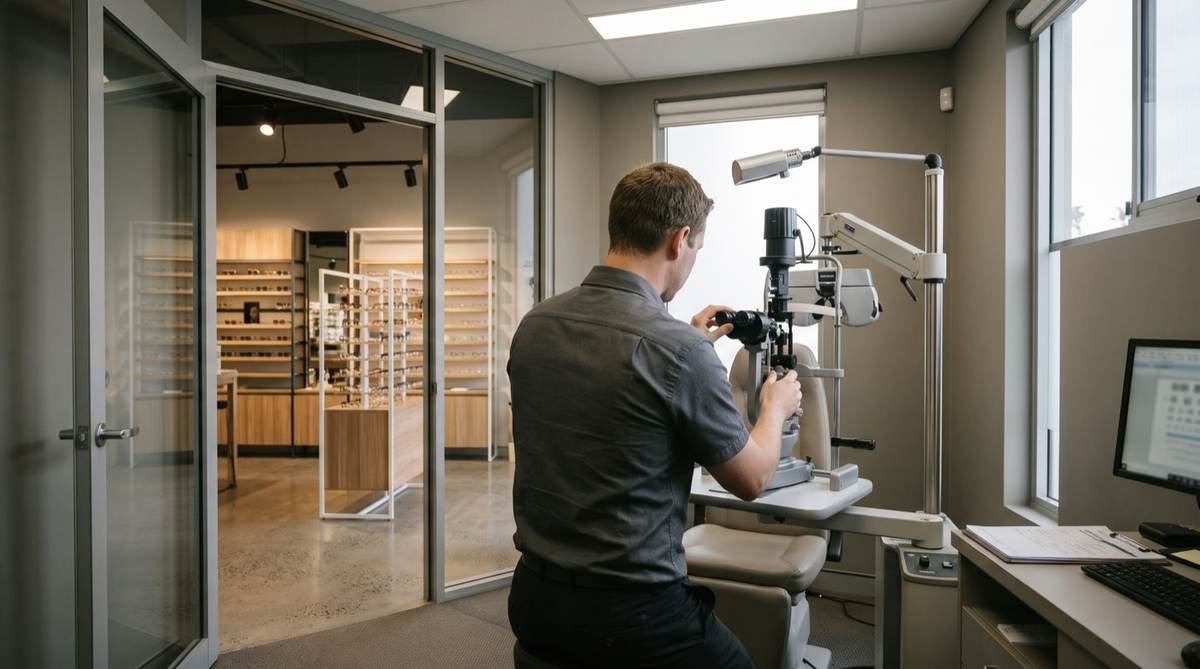
AI in optometry covers two areas: administration and clinical support. Artificial intelligence in optometry already automates recalls, bookings, clinical notes and Medicare and health fund claiming, and assists with OCT and fundus image analysis. For multi-site optometry groups, the best returns come from consistent recalls and documentation across stores, with optometrists making every clinical decision.
Key takeaways
- Start with recalls, reminders and booking automation, then AI scribes, then claiming, and only then diagnostic AI.
- AI scribes produce drafts. Health records must be accurate and reviewed by the optometrist.
- OCT and fundus AI tools act as a second pair of eyes. They do not make diagnoses or referral decisions.
- Frame recommendation AI, such as GlassesUSA's Pairfect Match, is mainly consumer-facing but points to dispensing opportunities.
- Optometry Australia's position is that AI should complement, never replace, clinical judgement.
Why are optometry groups turning to AI?
Picture a busy store in a multi-site optometry group on a Monday morning. Recall patients want to book their exam, contact lens wearers want reorders, others have insurance questions or need to reschedule. Patients wait at the counter while the practice manager is still processing Friday's claims. Multiply that across ten or twenty stores.
The economics are tight. Medicare rebates cover a large share of optometry consultations, and optical retail carries much of the revenue. Every minute staff spend on admin is a minute not spent with patients in the consulting room or at the frame board. For groups, the extra problem is consistency: every store runs recalls and claims slightly differently.
Optometry Australia's position statement on AI says AI should complement, not replace, the clinical judgement of optometrists. That makes practice administration the natural place to start.
- EnquiriesBookings, recalls, queries
- Patient IntakeHistory, insurance details
- ExaminationTests and consultation
- DocumentationClinical notes, reports
- ClaimingMedicare, DVA, health funds
- Follow-upRecalls, communications
How does AI improve patient recalls in optometry?
Many patients do not book their next exam on their own. For a profession where regular exams and monitoring matter, missed recalls are both a care gap and a revenue gap. Systematic, automated recall programs are one of the most reliable improvements a group can make.
- Patients overdue for recall across all storesFrom your PMS
- Current recall return rateMeasure it
- Return rate after automated campaignsTrack monthly
- Value of each additional returning patientExam plus dispensing
Measure the baseline first. For example, a hypothetical group with thousands of overdue patients needs only a modest lift in return rate to add meaningful exam and dispensing revenue.
What can AI do in optometry practices today?
Level 1: Automated scheduling and patient communication
Online booking with automated confirmations, reminders, recall campaigns and waitlists.
Australian platforms: Optomate.Net, widely used across Australia and New Zealand, has introduced an AI assistant with voice-to-text transcription, and integrates with Medicare Web Services, health funds, Xero and equipment from manufacturers such as Topcon, Nidek and Zeiss. Ooptify is a Melbourne-built, cloud-based system for optometrists with AI features.
What automation handles: 24/7 online booking, confirmations and reminders, recall campaigns by SMS and email, and waitlists for cancelled slots.
What it does not handle: scheduling that needs clinical judgement (post-surgical follow-up, urgent cases), patients who prefer to call, and new patients needing detailed history.
What is your primary challenge?
- High enquiry volume across storesOnline booking plus a central team for complex cases
- No-shows and missed recallsAutomated SMS and email campaigns
- After-hours enquiries24/7 web booking widget
- Complex schedulingHybrid: automation for routine, staff for complex
Level 2: AI documentation and clinical scribes
AI that listens to consultations and drafts clinical notes.
Eye care scribes: Doctora and Barti are designed for optometry and eye care, capturing findings such as anterior and posterior segment observations. Australian-built general scribes such as Lyrebird Health are also used.
What it handles: recording via phone, tablet or laptop, converting speech to structured notes, capturing measurements and prescriptions, and drafting patient instructions.
What it does not handle: clinical judgement, diagnosis or anything requiring optometric expertise. It documents. It does not decide.
Important: AHPRA expects health records to be accurate, up to date, factual and legible. Treat AI notes as a first draft the optometrist reviews and approves.
Level 3: AI diagnostic support
AI-assisted interpretation of OCT scans, fundus images and other diagnostics.
Australian research: UNSW Sydney, the Australian Institute for Machine Learning at the University of Adelaide, Menicon and the Brien Holden Vision Institute have worked on AI to support optometrists with diagnosis, management and referral decisions.
Available tools: Altris AI automates selection of pathological OCT scans and detects a wide range of retinal pathologies and biomarkers. Other platforms support fundus screening for diabetic retinopathy, macular degeneration and glaucoma.
What it does not handle: differential diagnosis, emergency triage, or replacing specialist referral decisions. Optometry Australia flags risks including deskilling and reinforcing bias. Where software makes diagnostic claims, TGA medical device rules may apply. See our guide to TGA rules for AI software.
Level 4: Medicare and health fund claiming
Streamlined claiming reduces manual entry and speeds payment. Optomate.Net processes Medicare and DVA claims via Medicare Web Services through PRODA, with private health fund claims processed online. Cutting Edge Software and Zanda Health also offer electronic claiming.
What automation handles: populating claims from consultation records, batch bulk-bill claims, eligibility checks, rejection tracking and resubmission.
What it does not handle: complex claims needing review, PRODA setup, and disputes.
Level 5: Frame and lens recommendation AI (such as Pairfect Match)
Consumer tools such as GlassesUSA's Pairfect Match analyse facial features, including jawline, eye height, cheekbones and nose bridge, and compare facial geometry against frame styles to recommend options. Virtual try-on shows how frames look before a physical fitting.
For practices the opportunity is pre-filtering suitable frames to shorten dispensing, capturing patient preferences for follow-up, and letting undecided patients try frames at home. This remains early in the Australian practice context.
What are the AHPRA and privacy considerations for AI in optometry?
Record keeping
- Every AI-generated note is reviewed and approved by the optometrist.
- Audit trails show who reviewed and approved each record.
- Records can be accessed and corrected.
- State, territory and Commonwealth privacy laws are met.
Recording consultations
- Tell patients recording is happening and obtain consent.
- Store audio and transcripts securely, ideally in Australia.
- Set clear retention and deletion policies.
Optometry Australia recommends aligning with the Australian Alliance for AI in Healthcare's guidance and checking TGA obligations where relevant. See our broader guide to AHPRA's AI guidance for practitioners.
How should an optometry group implement AI?
- Week 1-2Foundation AuditReview systems, data quality and integrations across stores
- Week 3-4Booking AutomationOnline scheduling, SMS reminders, recall campaigns
- Month 2Documentation AIAI scribe trial with one or two optometrists
- Month 3Claiming OptimisationStreamline Medicare and health fund processing
- Month 4+Advanced ToolsDiagnostic AI and frame recommendation, if volume justifies
Phase 1: Foundation audit. Are calendars accurate? Are patient mobile numbers current? Does your practice management system support modern integrations? What share of claims are rejected? If your system cannot integrate, weigh migration first.
Phase 2: Booking and communication. Configure appointment types and durations, set availability rules, add booking to your website and Google Business Profiles, and set up confirmations, reminders with easy rescheduling, and recalls (annual exams, contact lens reviews, condition-specific monitoring). Measure no-shows and after-hours bookings before and after.
Phase 3: Documentation AI. Start with one or two optometrists, configure templates by appointment type, integrate with the practice system, and set a clear review protocol.
Phase 4: Claiming. Keep PRODA current, populate claims from clinical records, batch bulk-bill claims and track rejections.
Phase 5: Advanced tools. Consider diagnostic AI only with enough imaging volume, a settled documentation workflow and clear referral protocols.
What results should optometry groups expect?
| Manual Process | With AI Automation | Impact | |
|---|---|---|---|
| No-show rate | Reminders sent by hand, inconsistently | Automated reminders with easy rescheduling | Fewer no-shows |
| Enquiry volume | Routine bookings by phone | Routine bookings online | Staff freed for patients |
| Documentation time per patient | Typed notes after each exam | AI draft, optometrist reviews | Less after-hours admin |
| Claim rejections | Manual entry errors | Claims populated from records | Fewer resubmissions |
| Recall response | Ad hoc campaigns by store | Consistent group-wide campaigns | More returning patients |
Measure each against your own baseline. Groups that fully adopt the new workflow, rather than running manual processes in parallel indefinitely, see the clearest gains.
What mistakes should optometry groups avoid?
- Starting with diagnostic AI before scheduling and documentation are solid.
- Ignoring patient demographics. Older patients may prefer to call. Support every channel.
- Underestimating change management. Allow time for training and a learning curve at each store.
- Neglecting the dispensary. Optical sales matter. Improve frame selection and lens education too.
- Set and forget. Review performance monthly and refine.
How Solve8 can help
We help multi-site healthcare and allied health groups connect practice management, claiming and reporting systems, and add AI for recalls and documentation with clinicians approving every record. See our healthcare solutions and process automation, or talk to us.
Related reading
- AI for Healthcare Practices: Patient Automation
- AHPRA AI Guidance for Healthcare Practitioners
- TGA Rules for AI Software as a Medical Device
- AI for Veterinary Practices
- AI for Pharmacies
Sources: Optometry Australia position statement on AI; AHPRA health record expectations; Optomate.Net, Ooptify, Altris AI and GlassesUSA product documentation.