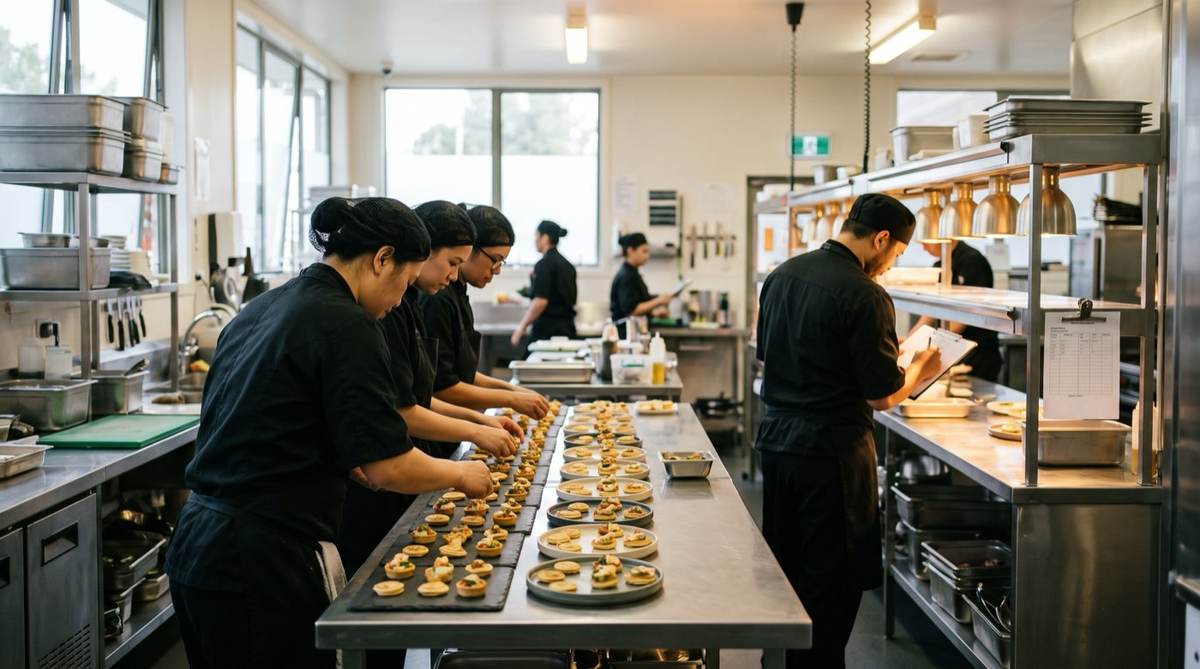
AI for catering companies automates the administration around every function: drafting quotes from the event brief and menu library, carrying dietary requirements from booking to kitchen docket, building award-compliant rosters and consolidating supplier orders across events. For multi-site and contract caterers, it removes the retyping between systems where errors and margin leaks happen.
Key takeaways
- The risk sits in handoffs. Enquiry, quote, dietary list, roster and supplier order often live in different systems, and every retype is a chance to miss something.
- Five areas pay back: quoting, dietary tracking, rostering, supplier ordering and venue logistics.
- Dietary accuracy is a safety issue. A missed allergen can cause serious harm, so it must flow automatically from booking to service.
- Rostering must follow the award. Casual minimum engagement, breaks, penalty rates and certifications such as RSA all apply.
- Start with one area. Quote automation usually shows value first, then dietary tracking and rostering.
This guide is for operations managers, general managers and finance leads at catering groups running central production kitchens, contract catering sites (corporate, healthcare, education, aged care) or high-volume event catering.
Why do catering operations lose margin in admin?
Catering runs on tight margins, rising food and wage costs and unpredictable volumes. Much of the avoidable cost sits in administration and waste.
A typical flow: an enquiry arrives by email; someone keys client details into one system, builds a quote in a spreadsheet, tracks dietary requirements in a separate document, builds a roster in another tool and places orders across several wholesale platforms.
Each handoff creates risk. A dietary requirement is missed between quote and kitchen docket. A staff member without RSA is rostered to a licensed venue. An ingredient order arrives short because nobody consolidated requirements across three events on the same weekend.
- EnquiryEmail arrives, manual entry
- QuoteSpreadsheet, re-keying data
- DietarySeparate document tracking
- RosterAnother system entirely
- OrderMultiple supplier platforms
Food waste adds to it. Over-production because forecasts are rough, and ingredients ordered per event instead of across the week, both show up on the P&L.
Where does AI deliver value for catering companies?
1. How does AI speed up catering quotes?
A corporate client wanting catering for a 400-person conference may need several menu options, pricing tiers and dietary considerations. Built by hand, that proposal takes hours.
Catering platforms such as Caterease, CaterZen, Flex Catering and Puree generate quotes from a menu library with current ingredient costing. An AI layer can read the event brief, suggest menu configurations by event type and guest count, and draft a proposal for a sales coordinator to check. When the client accepts, the kitchen sees quantities, dietary requirements and chef notes without re-entry.
| Manual Process | AI-Assisted | Impact | |
|---|---|---|---|
| Time to generate quote | Hours | A draft in minutes, then review | Faster |
| Pricing accuracy | Based on old costings | Current ingredient costs | Protects margin |
| Quote-to-kitchen handoff | Manual re-entry | Automatic docket creation | No re-keying |
| Client experience | PDF via email | Online acceptance | Faster yes |
2. How should dietary requirements be tracked?
A missed dietary requirement is a potential safety incident and a reputational one. Effective tracking:
- Captures dietary requirements at enquiry or booking
- Flows them into menu suggestions, kitchen dockets and packing lists automatically
- Shows the chef exactly how many gluten-free, vegan or nut-free meals are needed and for whom
- Alerts floor staff before service
Platforms such as Planning Pod maintain searchable dietary notes on every menu item, and Tripleseat lets clients enter requirements during booking. The AI's job is to flag mismatches, such as a nut-free guest assigned a dessert containing almonds, for the chef to resolve.
- CaptureDietary info at booking
- MatchAI flags unsafe menu items
- DocketChef sees all requirements
- ServiceFloor staff have allergy alerts
- VerifyConfirmation before serving
Caterers serving unpackaged, potentially hazardous food are generally Category 1 businesses under Food Safety Standard 3.2.2A, so food safety records matter too. See our guide to Standard 3.2.2A record keeping.
3. How does AI help with event rostering and award compliance?
Event work is irregular, with variable guest counts, a largely casual workforce and different certification needs per venue. Under the Hospitality Industry (General) Award 2020, casual employees must be engaged for a minimum of two consecutive hours each time, and breaks, penalty rates and overtime all apply.
Rostering platforms such as Deputy, Roubler and RosterElf match event requirements against available staff with the right qualifications: RSA for licensed venues, Working With Children Checks for school functions, food handler training for kitchen roles. An AI layer can propose a roster from the event calendar for a rostering lead to approve, checking minimum engagement, breaks and penalty rates. Our post on Fair Work compliance automation covers award rules in more depth.
What's your biggest rostering challenge?
- Compliance with the awardAutomated award interpretation
- Last-minute staff changesSelf-service shift marketplace with manager approval
- Certification trackingQualification-based matching
- Payroll integrationTime capture with export to payroll
4. How can supplier ordering be automated?
Caterers buy across fresh produce, proteins, dairy, dry goods, beverages and equipment hire. Platforms such as Ordermentum and FoodByUs consolidate suppliers into one ordering interface, and catering management systems such as Civica Catering Management offer automated ordering with stock tracking.
AI adds forecasting: it reads the event schedule, menus and past consumption to draft consolidated purchase orders across all events in a period, for a purchasing officer to approve. It can flag suppliers who deliver late and bulk-buy opportunities across events. Our guide to AI inventory and demand forecasting goes deeper.
5. How does AI support venue coordination?
Caterers working across many venues juggle delivery windows, equipment, access arrangements, venue restrictions and staff briefings. Event platforms such as EventPro, Tripleseat and Momentus centralise this. When an event books at a venue, the system fills in access details, kitchen facilities and contacts, produces driver run sheets and tracks equipment.
- Day BeforePrep ConsolidationAll dietary and quantity requirements finalised
- MorningLoad OutEquipment checklist and run sheets generated
- On SiteSetupVenue-specific requirements visible on mobile
- ServiceExecutionStaff briefings with dietary alerts
- Post-EventReconciliationEquipment return and waste tracking
What results should a catering company expect?
Results depend on starting point and data quality, so measure your own baseline.
- Average hours to produce a quoteYour baseline
- Dietary errors or near misses per 100 eventsYour baseline
- Food waste as a share of food purchasedYour baseline
- Admin hours per week across quoting, rostering and orderingYour baseline
Most groups see the first benefit in quoting speed and fewer re-keying errors, followed by better dietary accuracy, and later by reduced waste once forecasting has enough history.
What does a 12-week catering automation rollout look like?
- Weeks 1-2AuditDocument current processes and pain points
- Weeks 3-4Quote SystemImplement quote automation first
- Weeks 5-6Dietary TrackingStandardise dietary capture and flow
- Weeks 7-8RosteringConnect scheduling with the event calendar
- Weeks 9-10Supplier OrderingConsolidate supplier management
- Weeks 11-12IntegrationConnect systems and train the team
- Audit (weeks 1-2): map how an event flows today, where handoffs happen and where errors occur.
- Quotes (weeks 3-4): proposals from your menu library with current costing, connected to Xero, MYOB or your ERP.
- Dietary tracking (weeks 5-6): one capture point flowing to production and service.
- Rostering (weeks 7-8): event calendar linked to rostering with award and certification rules.
- Supplier ordering (weeks 9-10): consolidated ordering across suppliers.
- Integration and training (weeks 11-12): data flows without re-entry, and teams are trained.
What are the common catering automation pitfalls?
- Doing everything at once. Implement one area, prove it, then expand.
- Ignoring integration. A quote system that does not talk to accounting creates double entry; a roster that does not export to payroll creates reconciliation work.
- Messy menus and recipes. Inconsistent item names, unclear costings and missing dietary data get amplified by automation. Clean them first.
- Underestimating change. Plan training and a period running old and new side by side.
How Solve8 can help
Our consultants and engineers connect the quoting, rostering, ordering and finance systems catering groups already use, so event details are entered once and staff approve every output. See our process automation and system integration services, related reading on hospitality AI and event management AI, or talk to us.