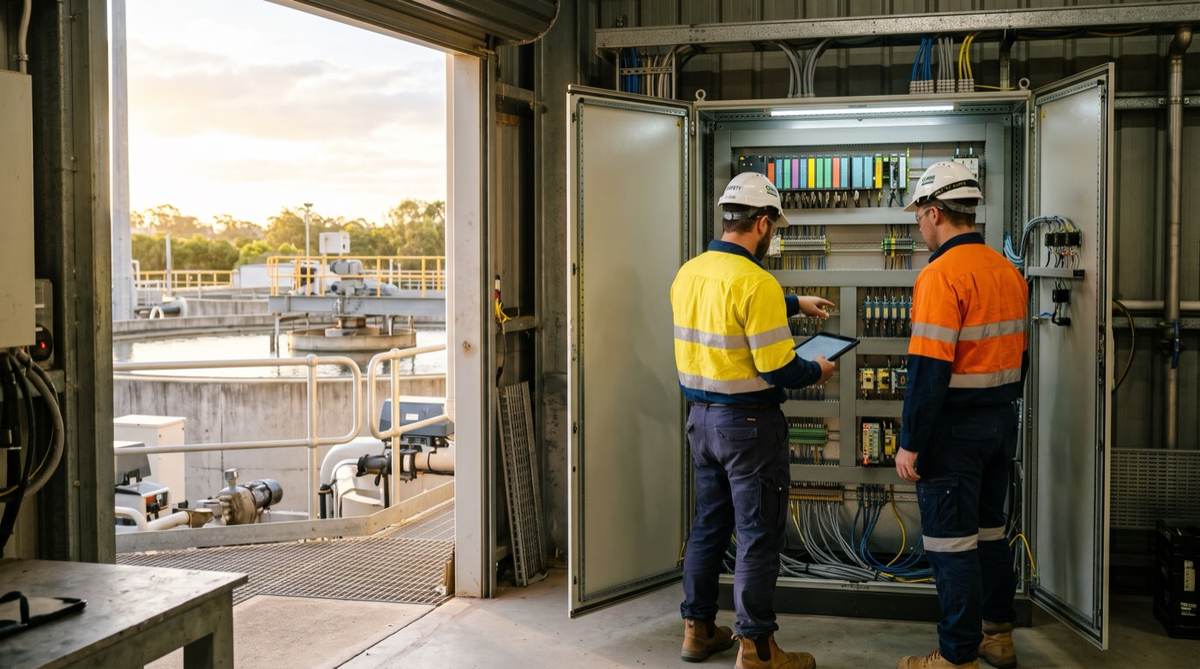
A SCADA upgrade costs far more than the software and hardware on the vendor's quote. Most of the money goes into migration work: remapping every tag, rebuilding drivers to every PLC and instrument, rebuilding and testing graphics, carrying alarms across, and the downtime for cutover. A SCADA system upgrade is scoped honestly by counting those drivers first, then pricing the licence.
This guide is for plant managers, engineering managers, CFOs and executives in Australian and New Zealand plant, utility and resources operations deciding when and how to fund control system upgrades on SCADA or DCS platforms that are ten, fifteen or twenty years past commissioning.
Key takeaways
- Tags, drivers, graphics, alarms and downtime drive SCADA upgrade cost. Licences are usually the smaller part.
- The real comparison is a planned upgrade now against rising maintenance and risk costs followed by a forced upgrade later.
- An audit of the existing system (tag count, driver inventory, graphics, alarms, documentation) is the business case.
- For SOCI Act responsible entities, an unpatchable control system is hard to defend under a risk management program.
- The upgrade is the cheapest moment to fix the plant's data foundation, because every tag is being reconfigured anyway.
Why is control system obsolescence a rising cost?
The instinct is to treat a working control system as a solved problem. It runs the plant, so why spend money on it? Obsolescence works as a slow rise in the cost and risk of keeping the plant running, until a forced upgrade on the vendor's timetable costs far more than a planned one would have.
An unsupported system carries a running cost in several forms at once:
- Spares. Parts move from a catalogue to a grey market, and prices rise as stock dwindles. One failed card can mean a scramble on an auction site.
- Knowledge. The people who understand the configuration retire or leave. If one person holds it all, that is key-person risk on the plant itself.
- Security. An unsupported system stops receiving patches, which matters for anything under the Security of Critical Infrastructure Act 2018.
- Integration. New instruments, analytics and reporting cannot be added because nothing modern can talk to it.
| Deferred until failure | Planned on a lifecycle | Impact | |
|---|---|---|---|
| Timing | Set by a card failure or a vendor cut-off | Set by the business, during a planned outage | Controlled |
| Spares | Grey-market prices, no guarantee of supply | Sourced and staged before cutover | Secured |
| Downtime | Unplanned, during peak if unlucky | Scheduled into a shutdown window | Minimised |
| Data foundation | Carried over as-is, problems and all | Rebuilt clean as part of the project | Improved |
Naming these costs lets you compare the real alternatives. The honest comparison is a planned upgrade now against a rising maintenance and risk bill followed by a forced upgrade later, on worse terms. Once a board sees the second number, the first one stops looking expensive.
Where does the money go in a SCADA upgrade?
The biggest misconception about a SCADA upgrade is that the software and hardware are the cost. On most projects they are a minority of the total. The money goes into migration, and migration effort is driven by the size and state of the existing system.
Tags are the unit that matters. A plant with tens of thousands of tags has tens of thousands of points to identify, map, reconfigure and test.
Drivers and communications to every PLC, instrument, analyser and third-party system have to be rebuilt. Each non-standard or legacy device is its own small project.
Graphics and HMI screens have to be rebuilt and re-tested against the live process, so an operator is not fighting an unfamiliar interface during a start-up.
Alarms have to be carried across. An obsolescence upgrade is the ideal moment to rationalise them instead of copying a bad alarm system into a new one. Our guide to alarm rationalisation with historian data covers how.
- Tag migrationIdentify, map, reconfigure and test every point
- Drivers and commsRebuild every interface to PLCs, instruments and systems
- Graphics and alarmsRebuild HMIs and rationalise alarms, not copy them
- Cutover and downtimeThe scheduled outage and the start-up support
Then there is downtime, often the largest single number and the most sensitive to planning. A cutover done inside an existing shutdown window costs little in lost production. The same cutover forced by a failure, outside a planned outage, is priced at the plant's full production rate for every hour it is down. Much of the difference between a planned and an unplanned upgrade sits in this one line.
How do you scope a SCADA system upgrade honestly?
A credible upgrade starts with a scope that counts the real drivers, before anyone accepts a platform quote. That means an audit of the existing system:
- A full tag count, by area and type.
- An inventory of every driver and interface, including third-party links.
- A review of graphics and alarm configuration.
- An honest assessment of what documentation survives and what must be reverse engineered from the running system.
The audit is also where the nasty surprises hide: undocumented logic in a PLC, a third-party interface nobody remembers building, a safety system entangled with the control system that must be handled with far more care. Finding these before the project is quoted is the difference between a defensible number and a project that doubles once underway. It is the same discipline we apply to connecting modern systems to legacy infrastructure without a rip and replace.
What best describes your control system today?
- Vendor support ended, spares on the grey marketPlan the upgrade now, before a failure forces it
- Supported but the hardware is end-of-saleBudget a lifecycle upgrade in the next outage cycle
- Supported but nobody understands the configDocument and de-risk now, upgrade on a plan
- Modern and supportedUse the stability to fix the data foundation
The audit output is the business case. It turns a vague "the system is old" into a costed list: this many tags, this many drivers, this much graphics work, this much downtime, against the rising maintenance and risk bill if nothing is done. A board can decide on that.
What are the security and compliance obligations?
For a growing number of Australian operations, deferring a control system upgrade is no longer only a maintenance decision. If your plant is a responsible entity under the Security of Critical Infrastructure Act 2018, you carry obligations to manage risk to that asset, including a Critical Infrastructure Risk Management Program (CIRMP) where the rules apply to your sector. An unsupported, unpatchable control system is difficult to defend against those obligations.
Control system security has its own standard, the ISA/IEC 62443 series for industrial automation and control systems. An obsolescence upgrade is the practical moment to move toward it: segment the control network, remove flat architectures where the business network and plant floor share a path, and put in the monitoring an unsupported system cannot support. Our guide to the SOCI Act, CIRMP and AI on critical infrastructure goes deeper.
What opportunity sits inside a control system upgrade?
A control system upgrade is the once-in-fifteen-years moment when every tag, interface and data point is already being reconfigured. That makes it the cheapest time you will ever have to fix the data foundation.
A like-for-like upgrade carries every existing problem into the new system: the same inconsistent tag naming, the same trapped historian data, the same manual scramble to report. An upgrade scoped with the data in mind applies a clean tag naming standard and data model, so the plant's data is usable once the new system is live.
- Phase 1Audit and scopeTag count, driver inventory, graphics and alarm review, risk assessment
- Phase 2DesignNew architecture, clean tag standard, network segmentation, data model
- Phase 3Build and testConfigure offline, test against the live process before cutover
- Phase 4Cutover and enableCut over in a planned outage, then turn on reporting and analytics
Once the foundation is clean, things that were impossible on the old system become straightforward. Historian data can be reported in Power BI without building a second historian. Analytics and AI become viable because the data arriving is reliable by design. Our piece on why agentic AI needs a real data foundation makes the full argument.
- Cutover downtimeInto a planned outage, not a crisis
- Spare parts and support riskRemoved
- Security and SOCI exposureAddressed in the rebuild
- Data foundation for analytics and AIBuilt in, not bolted on
Like-for-like, re-platform or phased: which SCADA upgrade path fits?
Three broad paths follow the audit. The right one depends on the state of your plant.
| Path | Best when | Watch for |
|---|---|---|
| Like-for-like (same vendor, current generation) | The existing system is well understood and documented | Carries old problems forward and deepens vendor lock-in |
| Re-platform (different or more open architecture) | Documentation is poor anyway, or a vendor dependency has become a commercial problem | Higher design and testing effort up front |
| Phased (area by area across several outages) | Large or continuous plants that cannot take one long shutdown | Higher total cost from running two systems in parallel |
Whichever path you take, two rules hold. Keep the safety instrumented system separate and treat it with its own rigour, never entangled with a convenience upgrade. And test the new configuration against the live process before cutover, because an operator meeting an unfamiliar graphic during a start-up is where good upgrades turn into incidents.
How do you take the decision to the board?
Good upgrades get deferred because they are presented as an engineering cost and compared against doing nothing. Framed that way, doing nothing wins until the day it loses badly. Present the real comparison: a planned, scoped upgrade against a rising maintenance bill, a growing security and compliance exposure, and a forced upgrade later on worse terms.
That is a risk and continuity conversation, and it belongs at board level. Our guide to AI advisory for Australian boards covers how to frame it. For ongoing support after go-live, see what a plant system support arrangement should cover. Projects of this kind fail more often from scoping and sequencing than technology, as we examine in why industrial analytics projects fail.
Across our consultants' careers, including control and data platform work in BHP, Rio Tinto and Senex Energy environments, the deferred upgrade has a habit of costing more, because it happens in a crisis instead of on a plan.
How Solve8 can help
Our consultants and engineers audit existing control systems, count the real cost drivers and design upgrades that fix the data foundation, through our system integration work and our mining, energy and manufacturing practice. We work in fixed-fee phases agreed before we start. Contact us to scope your control system risk.