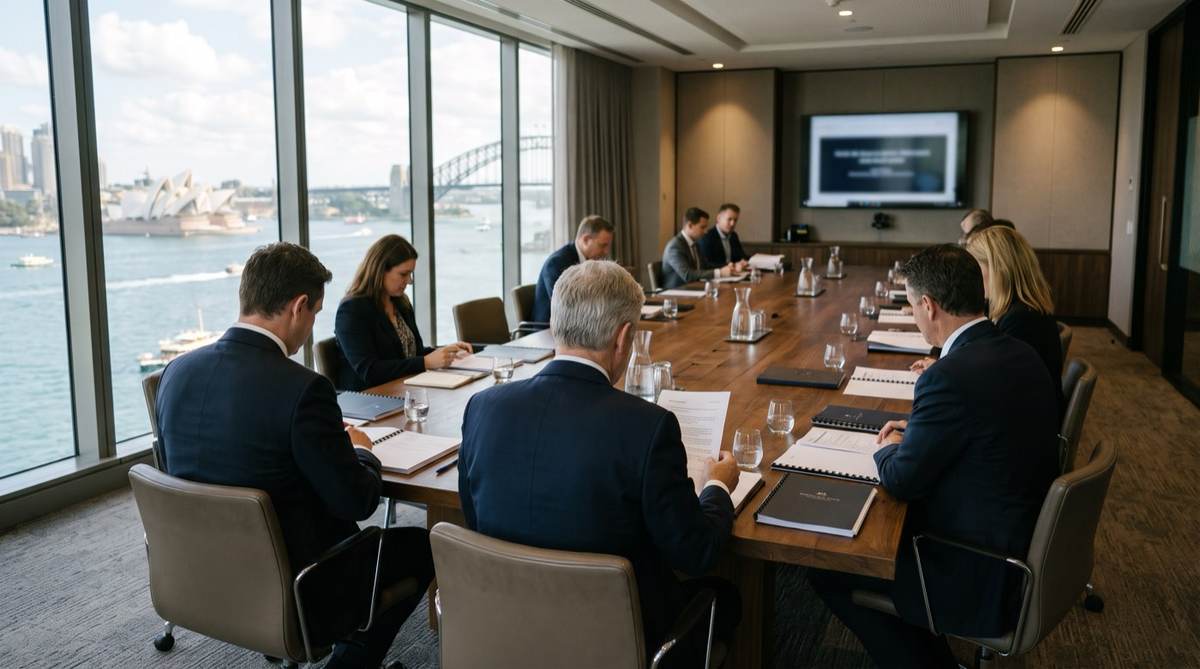
AI advisory services help boards and executives decide where AI should be used, set the organisation's AI risk appetite, and build oversight they can defend to a regulator. AI advisory sits a level above implementation: it shapes strategy and governance, while delivery teams build the systems. Boards in Sydney, Melbourne, Brisbane and across Australia are commissioning it as AI becomes a director-level responsibility.
Key takeaways
- AI now touches customer decisions, employment, pricing and disclosure, so it is a governance matter as well as a technology one.
- Directors' duty of care under section 180 of the Corporations Act applies to AI the same way it applies to any other foreseeable risk.
- AI advisory produces a register, a policy and risk appetite, an oversight structure and a review rhythm.
- Keep advisory and implementation as distinct layers, even if one firm provides both.
- Most boards start with visibility: a current list of where AI is used and who owns each use.
Why has AI become a board responsibility?
For most of the last decade AI sat inside the technology function. IT evaluated it, bought it and ran it, and the board saw it as a capital line. That arrangement no longer holds. AI now influences customer decisions, employment, pricing, disclosure and risk.
The Australian Institute of Company Directors (AICD), working with the Human Technology Institute at the University of Technology Sydney, published director resources in June 2024, including A Director's Introduction to AI and A Director's Guide to AI Governance. The guidance is explicit: directors do not need to become engineers, but they need to oversee AI with the same rigour they apply to financial and safety risk.
What is the difference between AI advisory and AI implementation?
Implementation consulting builds and deploys systems. AI advisory works above that: it helps directors and executives set strategy, establish oversight, understand risk and ask the right questions of the people building.
A board can commission AI advisory and use a separate delivery partner, or use one firm for both with the roles kept distinct. Mixing the layers leaves directors drowning in technical detail, or engineers making governance decisions that belong to the board.
| AI advisory | AI implementation | Impact | |
|---|---|---|---|
| Primary audience | Board and executive | Operations and IT | Level |
| Core question | Should we, and how do we oversee it? | How do we build and run it? | Scope |
| Key output | Strategy, policy, oversight structure | Working, integrated systems | Form |
| Risk focus | Duty, disclosure, reputation | Uptime, accuracy, integration | Lens |
| Success measure | Defensible governance posture | Value delivered in production | Proof |
Why is AI oversight part of a director's duty?
Australian directors owe a duty of care and diligence under section 180 of the Corporations Act 2001. Emerging technology is not exempt. If an AI system causes foreseeable harm to customers, staff or the company, a court or regulator will ask whether the board exercised reasonable oversight.
Regulators have signalled the direction:
- ASIC reported in October 2024 (Report 798, Beware the gap) that governance arrangements at the licensees it reviewed were not keeping pace with AI adoption.
- OAIC enforces the Privacy Act 1988 wherever AI processes personal information. Amendments passed in 2024 add transparency obligations for automated decisions that take effect from 10 December 2026.
- The Department of Industry, Science and Resources published its Guidance for AI Adoption in October 2025, setting out six essential practices that build on the earlier Voluntary AI Safety Standard.
None of this requires directors to write code. It requires them to answer credibly how the organisation decides which AI to deploy, who is accountable when it goes wrong, and what controls sit around it. For the automated decisions changes specifically, see what boards should ask before 10 December.
What three questions should every director be able to answer about AI?
If the answers are shaky, that gap is what AI advisory services close.
1. Where is AI used in our organisation, and who owns each use? Most boards fall down here. Adoption happened team by team and tool by tool, so no current list exists. You cannot govern what you cannot see.
2. What would happen if one of these systems got it wrong? For each material use, directors should understand the plausible failure, who it would affect and what control sits between the failure and the harm. This is ordinary risk thinking applied to a new kind of system.
3. Could we defend our oversight to a regulator or a court? If an AI-made decision were challenged, could the organisation show it assessed the risk, assigned accountability and monitored the outcome? That evidence is built in advance and cannot be assembled after an incident.
What do AI advisory services actually cover?
Good board-level advisory follows a structure. The AICD and HTI guidance organises director oversight of AI into eight elements, spanning roles and accountability, people and culture, strategy and policy, controls, stakeholder impact and ongoing monitoring. A capable advisor uses a framework like this so nothing important is left unexamined.
- AccountabilityOversight and clear ownership
- StrategyPurpose and alignment
- RiskIdentification and management
- LifecycleHow AI systems are managed
- PeopleCulture and capability
- Third partiesVendor and supply chain
In practice an engagement turns that framework into things a board can use:
- An AI policy that sets the organisation's risk appetite.
- A register of where AI is deployed and who owns each use.
- A reporting line so the board hears about AI incidents the way it hears about safety incidents.
- A schedule for reviewing the posture as technology and law change.
Advisory also raises the uncomfortable questions delivery partners are poorly placed to ask. Which current AI uses would we defend publicly? Where do we rely on a third-party model we cannot fully explain? What do we say if a customer asks whether AI dealt with them?
That work rests on a clear ethical position, set out in our AI ethics framework, and a written governance posture, covered in our AI governance framework.
How do sector regulations change the board's AI job?
The baseline duty is the same for every board. The pressure points differ by sector.
Financial services. APRA's CPS 230 Operational Risk Management took effect on 1 July 2025 and requires boards to oversee operational risk, including risks from technology and material service providers. AI systems and the vendors behind them increasingly fall in scope. CPS 234 Information Security adds obligations for protecting information assets.
Health and aged care. Health information carries some of the most sensitive obligations under the Privacy Act 1988, and automated decisions affecting care raise clinical governance questions on top. AI oversight should connect to existing clinical and safety governance.
Consumer-facing organisations. Automated decisions about customers, pricing or eligibility engage the Australian Consumer Law and anti-discrimination law. A board must be able to show such decisions were fair, explainable and free of unlawful bias.
Which pressure is most acute for your organisation?
- APRA-regulated financial entityFrame AI inside CPS 230 operational risk
- Health or aged care providerConnect AI oversight to clinical governance
- Consumer decisions and pricingPrioritise fairness and explainability
- Government supply chainLead with data sovereignty and the DISR practices
Generic AI governance advice only goes part of the way. The oversight structure has to plug into the regulatory framework your organisation already operates under.
What does weak AI oversight cost a board?
The downside is easy to underestimate because it is regulatory and reputational more than a line item.
- Structured advisory engagementBounded and predictable
- Privacy breach involving AIRegulatory, legal and reputational
- Discriminatory automated decisionRemediation plus lost trust
- The board's real questionCan we defend our oversight if challenged?
Advisory cannot remove AI risk. Its purpose is to make oversight defensible. When an AI decision is challenged, the gap between a manageable problem and a serious one is often whether the organisation can show it assessed, assigned and monitored. That is why boards commission advisory before a trigger arrives.
Does your board need AI advisory services?
Not every board needs a standing advisor. Test how confidently your directors could answer a regulator today.
Which statement is closest to true for your board?
- We cannot list where AI is used in our organisationYes, start with a discovery and register
- We use AI but have no board-level AI policyYes, prioritise policy and oversight structure
- We have a policy but never review itAdvisory refresh against current guidance
- We have a governed, reviewed, owned posturePeriodic external assurance only
The first gap is the most common. Adoption has happened bottom-up, so the first job is to make AI use visible to the people accountable for it. If you are building strategy alongside oversight, our guide on how to build an AI strategy pairs with this work, and our AI business case template helps executives take proposals to the board.
What does a board AI uplift look like?
A structured engagement moves a board to a defensible position in weeks.
- Weeks 1-2VisibilityMap where AI is used and who owns each deployment
- Weeks 3-5Policy and risk appetiteSet what the organisation will and will not do with AI
- Weeks 6-8Oversight structureReporting lines, incident escalation and review schedule
- OngoingAssurancePeriodic review against evolving guidance and law
The deliverable is a working oversight structure: directors who can state the AI risk appetite, a register that stays current, an escalation path and a review rhythm. For boards in New South Wales, our guide to AI advisory services in Sydney covers the local market. The underlying obligation is the same wherever the board sits.
What AI oversight mistakes do boards make?
- Delegating governance to the builders. Technical teams should advise on what is possible and where risk sits. The decision on what the organisation is willing to do belongs to the board.
- Treating a policy as the finish line. A policy with no live register and no escalation path is governance theatre.
- Banning AI outright. Staff adopt tools informally anyway, leaving all the risk and none of the visibility. See our guide to shadow AI inventory and policy.
- Ignoring third-party AI. Much exposure arrives through vendors and AI features in software already in use.
- Reviewing once. A posture set in 2025 and never revisited drifts out of alignment as law and capability move.
How Solve8 can help
Our consultants run AI advisory as part of our AI strategy and roadmap service, working with boards and executives on registers, policy, risk appetite and oversight, with a fixed fee per phase. Where you also need delivery, our engineers can build to the same governance. Talk to us about where your board stands today.