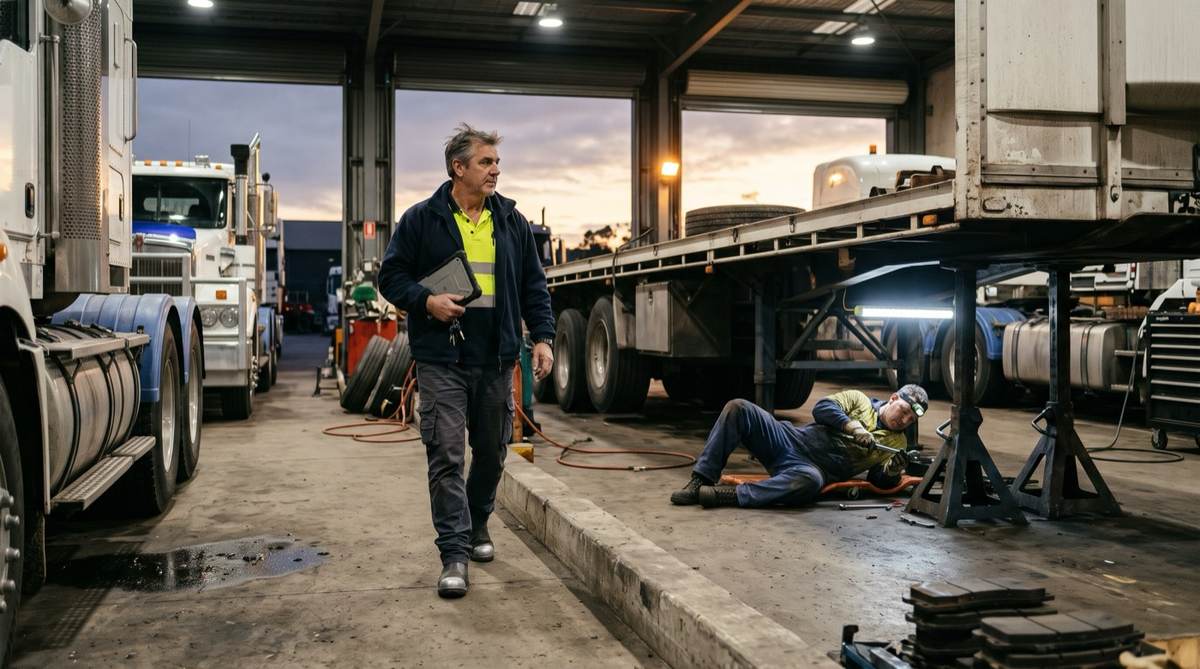
Asset health AI for transport fleets combines telematics, maintenance and in-cab data to flag degradation in engines, brakes, tyres and refrigeration units weeks before failure, then pushes work orders into your fleet maintenance system. For Australian operators it also creates time-stamped Chain of Responsibility evidence under the Heavy Vehicle National Law.
Key takeaways
- Most fleets plan, acquire and operate assets well. The gap is the sense-and-diagnose loop: telemetry sits in siloed dashboards until a driver calls in.
- AI flags degradation trends early with enough explanation that a workshop scheduler acts on it.
- Cold chain fleets carry a higher bar under Food Standards Code 3.2.2A and TGA distribution expectations.
- In-cab AI raises Privacy Act and state workplace surveillance obligations. Separate safety alerting from performance management.
- Integration into the maintenance system, TMS and ERP decides whether anyone uses the alerts.
This post is for fleet managers, operations directors and COOs running heavy vehicle fleets. It is one of four on asset health AI, alongside mining, local councils and manufacturing.
Why does asset health AI matter for Australian fleets?
Consider a hypothetical operator running 100 prime movers, 220 trailers and 40 refrigerated bodies. Every truck emits engine, driveline, brake, tyre, fuel, refrigeration and behavioural telemetry every few seconds. The data exists. The hard part is turning it into safer drivers, fewer breakdowns on the Hume, and clean Chain of Responsibility evidence when the National Heavy Vehicle Regulator asks.
Transport is where regulation, driver privacy and 24/7 uptime collide most sharply.
How does ISO 55001 apply to a transport fleet?
AS/NZS ISO 55001:2024 sets the asset management system for any organisation that owns physical assets. For a fleet it becomes seven repeating steps.
- Strategic PlanService mix, route map, asset policy
- AcquireSpec to ADR, finance, commission
- OperateDispatch, fuel, driver assignment
- SenseTelematics, oil, vibration, in-cab
- DiagnoseML detects degradation early
- InterveneWorkshop work order, driver coach
- ImproveUpdate spec, retire, repeat
Most operators handle steps one to three well, with a transport management system, fleet maintenance system, fuel cards and workshop. The gap is sense and diagnose. Telemetry lands in three or four dashboards and the operations team sees a problem only when a unit fails on a customer site. Asset health AI closes that loop.
What does asset health mean on a heavy vehicle?
A modern prime mover exposes a large number of signals through the J1939 CAN bus, and a refrigerated trailer adds more from the refrigeration plant, door sensors and trailer EBS. Asset health AI fuses these into condition indicators across nine subsystems.
| Subsystem | Primary signals | Common failure modes |
|---|---|---|
| Engine and after-treatment | Coolant temp, oil pressure, DPF soot, AdBlue, EGR | DPF blockage, injector wear, AdBlue dosing |
| Driveline and gearbox | Vibration, oil temp, gear engagement | Clutch glaze, bearing wear, oil degradation |
| Brakes and EBS | Pad wear, ABS events, retarder use | Uneven pad wear, ABS sensor drift |
| Tyres | TPMS pressure, temp, tread depth | Slow leaks, alignment, premature wear |
| Electrical and 24V bus | Alternator output, battery state of health | Battery failure, parasitic drain |
| Refrigeration plant | Setpoint vs return air, defrost cycles, door events | Compressor wear, refrigerant loss, door seal |
| Body and trailer | EBS, suspension air, tail lift | Air leaks, suspension wear |
| Fuel and emissions | Litres per 100km, idle %, harsh acceleration | Injector fouling, driver behaviour |
| Driver and cab | In-cab camera, fatigue indicators | Microsleep, distraction, harsh events |
The goal is to flag a degradation trend weeks before failure, with enough confidence and explanation that a workshop scheduler believes it and a driver accepts the coaching. Predicting an exact failure date is rarely realistic. We treat this as a workflow problem first and a model problem second, through our process automation practice.
Why is cold chain a higher compliance bar?
If your fleet carries frozen, chilled or pharmaceutical product, asset health AI becomes a control. Food cold chain falls under Food Standards Code Standard 3.2.2A and related temperature control requirements. Pharmaceutical cold chain falls under TGA expectations for good distribution of therapeutic goods.
AI adds value in three places:
- Predicting compressor and refrigerant faults from defrost cycle patterns and setpoint deviation before product is loaded.
- Correlating door-open events with temperature excursions so operations can coach specific runs.
- Automating the temperature log evidence pack customers and auditors expect.
A reefer unit throwing repeated weak defrost cycles should be booked for service before it is loaded for the next Sydney to Brisbane overnight.
What privacy rules apply to in-cab driver AI?
In-cab cameras with AI behaviour models (fatigue, distraction, seatbelt, phone use) are now common. They also create privacy and industrial relations issues fleet managers often underestimate.
Three layers apply:
- Privacy Act 1988: obligations on collection, notification and use of personal information, including biometric and behavioural data.
- State surveillance laws: the Workplace Surveillance Act 2005 (NSW), Surveillance Devices Act 1999 (Vic) and Surveillance Devices Act 1998 (WA) impose notification and in some cases consent obligations.
- Fair Work Act 2009: frames how surveillance data can be used in performance management and discipline.
Practical steps for a rollout:
- Publish a written surveillance policy before activation, with at least 14 days notice in NSW.
- Specify retention periods and access controls.
- Separate real-time safety alerting from performance management uses.
- Use edge processing where possible so raw video leaves the cab only when an event triggers upload.
- Document the data flow in your AI governance records, aligned with the Department of Industry, Science and Resources guidance for AI adoption.
Skipping this work is the fastest way to turn a safety investment into a Fair Work dispute.
How does asset health AI support Chain of Responsibility?
Under the HVNL, every party in the supply chain has a primary duty to eliminate or minimise public safety risk. Asset health AI maps onto three CoR risk areas:
- Vehicle standards and roadworthiness: predictive maintenance evidence supports the NHVAS Maintenance Module.
- Mass, dimension and load restraint: axle weight signals and trailer suspension data catch overload early.
- Speed and fatigue: in-cab AI plus telematics supports Basic and Advanced Fatigue Management accreditation under the National Heavy Vehicle Accreditation Scheme.
AI alerts, and the actions taken in response, become documented, time-stamped controls. When an NHVR auditor asks what you knew and when you acted, you have the trail. See also AI and Chain of Responsibility compliance.
Reactive, condition-based or predictive maintenance?
Most fleets mix preventive servicing at fixed kilometres with reactive repair when a driver reports a fault. Condition-based and predictive approaches change the cost curve.
| Reactive plus preventive | Predictive AI | Impact | |
|---|---|---|---|
| Unplanned breakdowns | Found when a driver calls in | Flagged weeks ahead as a trend | Fewer roadside events |
| Vehicle downtime | Unplanned, at the worst time | Scheduled into workshop windows | More available days |
| Callout and parts | Roadside callouts, express parts | Planned work, normal freight | Lower cost per repair |
| Fuel burn | Baseline | Engine health and driver coaching | Measured in pilot |
| Tyre cost per km | Baseline | Pressure and alignment caught early | Measured in pilot |
Your fleet's numbers depend on route profile, age and current practice. The point of a pilot is to measure them against your own baseline.
Where should fleet managers start with asset health AI?
The starting subsystem depends on your pain point and route profile.
What is your biggest cost or risk pressure today?
- Unplanned breakdowns on long-haul routesStart with engine and driveline predictive (J1939 plus oil analysis)
- Product loss or customer claimsStart with refrigeration unit and door event AI
- Insurance premium or serious incidentsStart with in-cab driver behaviour and fatigue AI
- Tyre cost is outpacing budgetStart with TPMS plus alignment and wear ML
- NHVR audit risk or CoR gapsStart with maintenance evidence automation under NHVAS
For regional and interstate operators, engine and driveline plus driver behaviour are usually the strongest starting points. For metro distribution, refrigeration and tyres often win.
How does asset health AI integrate with fleet systems?
AI outputs are only useful inside the systems your workshop, operations and safety teams already use:
- Telematics platform (OEM portal or aftermarket) for raw signals
- Fleet maintenance system for work orders and parts
- Transport management system for dispatch and routes
- ERP such as Pronto Xi, MYOB Advanced, NetSuite or SAP for finance and parts master
- Safety and compliance records for CoR, NHVAS and incidents
- HR and payroll for fatigue rules and driver hours
The AI layer consumes telemetry, runs models and pushes typed events into each system. Get the system integration right and the rest is incremental. Get it wrong and you build a dashboard nobody opens.
Connectivity matters. With 3G networks shut down, legacy 3G telematics units need 4G or 5G replacements. For routes through the Nullarbor, Pilbara or Cape York, satellite backup is now practical to specify on long-haul prime movers.
What does a realistic pilot look like?
A pilot proves the value chain end to end on 15 to 25 vehicles at one depot or on one customer contract.
- Week 1 to 2Scope and consentPick depot, choose prime movers and reefers, agree data sharing with telematics vendor, publish surveillance policy
- Week 3 to 4Data plumbingPull J1939, TPMS, refrigeration and in-cab feeds into Australian-hosted storage, baseline fuel and breakdown rate
- Week 5 to 7Model and rulesTrain degradation models on history, codify rules for fatigue and CoR alerts, set human approval thresholds
- Week 8 to 9Workshop integrationPush predicted work orders to the maintenance system, train schedulers, agree triage rules
- Week 10 to 11Driver and safety rolloutBrief drivers, run in-cab coaching pilot with a delegate, calibrate false positive rate
- Week 12Readout and scale planCompare against baseline, sign off business case, decide depot rollout sequence
The biggest swing factor is whether the scheduler trusts the alert and the driver accepts the coaching. Model accuracy rarely decides it. Our pilot success factors guide and automation business case template cover the governance and finance shape.
What about data ownership and sovereignty?
Telematics data ownership. Many OEM telematics agreements grant the manufacturer broad rights to aggregated telemetry. Switch brands or vendors and you may lose your own history. Ask for raw signal export rights and historical retention in every contract.
Residency. Driver biometric data, route data and customer load data range from commercially sensitive to personal information. Running the AI workload in Australia avoids most cross-border questions under APP 8. See our data sovereignty guide.
Cyber security. A connected fleet is an attack surface. The ACSC Essential Eight is a sensible baseline for any platform touching dispatch and driver data.
What should you ask fleet AI vendors?
Start with our AI vendor selection questions and add:
- Can you export raw J1939 signal history with timestamps?
- Where is my data hosted and processed?
- How do you handle in-cab privacy notification and consent?
- What is your false positive rate for fatigue alerts in Australian light conditions?
- Do alerts arrive in my maintenance system as work orders?
- What does your CoR audit pack contain?
- What happens to my data if I leave?
Can asset health data support NGER and Safeguard reporting?
For fleets above NGER thresholds or contracting to Safeguard Mechanism facilities, scope 1 diesel and refrigerant emissions reporting is a legal obligation. Asset health systems already capture fuel burn and refrigerant top-up data. Done well, they double as your NGER evidence base and remove the spreadsheet scramble before the 31 October deadline.
What are the common failure modes in fleet AI pilots?
- Picking the hardest depot first. Start where the depot manager wants the change.
- Ignoring the workshop scheduler. If the maintenance system does not create the work order, nothing happens.
- Letting in-cab AI drift into performance reviews. Keep safety and performance separate.
- No baseline. Without historical breakdown and fuel data, you cannot prove the return.
- Buying a model instead of a workflow. The win comes from the operational change.
How Solve8 can help
We scope the workshop and safety workflow first and the model second, connect telematics to your maintenance system, TMS and ERP, and keep data on your infrastructure in Australia. See our system integration and managed AI services, or talk to us about a fleet asset health review.