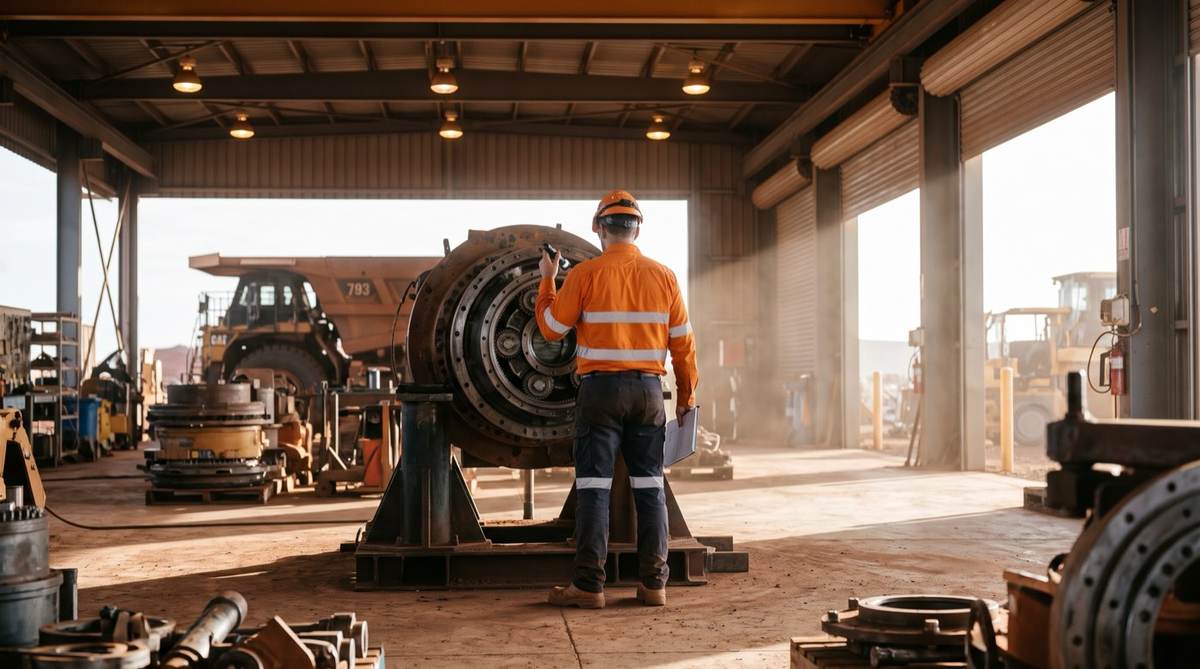
Asset health AI in mining applies machine learning to condition data, such as vibration, oil analysis, thermography and OEM telematics, so equipment failures are predicted, prevented or shortened. For Australian operators and mining services contractors, it works when it is tied to an ISO 55001 asset management plan, verified as a critical control and closed out through work orders in the CMMS.
Key takeaways
- Start from the asset management system. ISO 55001:2024 and your Strategic Asset Management Plan come first. AI plugs into the operate and maintain phases.
- Clean reliability data is the critical path. An asset hierarchy aligned to ISO 14224 failure codes matters more than the choice of model.
- Value lands in the CMMS. A prediction only pays when it becomes a planned work order in Maximo, SAP PM, Pronto or JDE, and the closeout feeds back.
- Safety-critical means auditable. Models that support critical control verification need a human override and an evidence trail an inspector can follow.
- Pilot one asset class on one site. A 16-week pilot on five to ten units ends with a scale or stop decision.
This guide is for asset managers, maintenance managers, reliability engineers and general managers at mid-tier producers, drill and blast contractors, haulage contractors, fixed and mobile plant maintainers and processing operators. It is part of a series on asset health AI, alongside transport fleets, local councils and manufacturing.
Across our consultants' careers, we have worked on OT, ERP and reliability data platforms in environments such as BHP and Rio Tinto. The patterns below come from that work, sized for operators and contractors without a dedicated autonomy program.
Why is asset health the first place mining AI pays back?
For a mining operator or services contractor, the asset register is the balance sheet: haul trucks, shovels, drills, crushers, mills, kilometres of conveyor and the processing plant downstream. Maintenance is one of the largest controllable operating costs, and unplanned downtime on a primary production unit stops the value chain behind it.
That makes asset health the AI use case with the clearest line to production and cost. The prediction either gives a planner a window to act before failure, or it does not, and you can measure which.
How does ISO 55001 frame asset health AI?
Before any sensor is fitted, every mining executive should be able to answer: what is our Strategic Asset Management Plan, and how does asset health AI support it? The framework is the ISO 55000 family, updated in 2024.
- ISO 55000:2024 sets the overview and vocabulary: what an asset is and what value the organisation expects from it.
- ISO 55001:2024 specifies the requirements for an asset management system. This is the auditable standard.
- ISO 55002 gives guidance on application.
The workflow runs top down. Organisational strategy sets objectives. The Strategic Asset Management Plan (SAMP) turns those into asset objectives. Asset Management Plans (AMPs) break the SAMP into asset-class plans across the lifecycle: acquire, operate, maintain and dispose. Underneath sits reliability data, governed by ISO 14224:2016, which standardises equipment taxonomies, failure modes, failure mechanisms and maintenance history.
Asset health AI supplies the data and predictions for evidence-based decisions on renewals, overhauls and capital deferral. An assessor will not be impressed by a clever vibration model. What earns marks is a documented link from the SAMP, through the AMP, to an asset-class decision supported by reliability data that follows ISO 14224.
What does "asset health" mean for mining equipment?
Asset health is a composite indicator built from several condition data streams:
- Vibration analysis: bearing wear, gear mesh issues, misalignment and looseness on motors, gearboxes, pumps and fans
- Thermography: switchboards, transformer windings, hydraulic hot spots and conveyor idlers
- Oil analysis: particle counts, viscosity, water contamination and wear metals
- Ultrasonic detection: early bearing faults, valve leaks and compressed air leaks
- Motor current signature analysis: rotor bar defects, eccentricity and load anomalies on large mill, crusher and pump motors
- OEM telematics: fault codes, duty cycles, payload and derate events from Caterpillar, Komatsu, Liebherr and Hitachi systems
- Process data: throughput, power draw and feed rate from the SCADA or DCS on fixed plant
- Operator and inspection inputs: pre-starts, defect reports and structured inspections
Vibration alone tells you a bearing is failing. Vibration plus oil analysis plus operating context tells you why, how fast and what to do. That is what a planner needs to schedule a parts kit, a crew and a window.
Where does your operation sit on the maintenance maturity curve?
| How it works | What it gives you | Impact | |
|---|---|---|---|
| Reactive (run to failure) | Fix when broken. No data. | Highest unplanned downtime and secondary damage | Baseline |
| Preventive (calendar based) | Fixed-interval services regardless of condition | Fewer surprises, some over-servicing | Some reduction |
| Condition-based monitoring | Thresholds on a single parameter trigger action | Earlier warning, still reactive within the window | Better |
| Predictive (AI-enabled) | ML predicts failure with lead time | Planned interventions, parts ready | Planned work |
| Prescriptive (AI-enabled) | Model recommends the action and timing | Intervention optimised against the production plan | Biggest gain |
Many mid-tier operators sit between condition-based and early predictive maturity. A realistic pilot target is to move one asset class from condition-based to predictive on one site.
How does asset health data flow from sensor to work order?
- SensorsVibration, temp, oil, current, telematics
- Edge ComputeLocal inference, filter noise, alert on severity
- ConnectivityPrivate LTE, LPWAN, satellite
- ML ModelPattern recognition, lead-time prediction
- Critical Control CheckVerification evidence, human override
- CMMS Work OrderRaised in Maximo, SAP PM, Pronto, JDE
- Maintenance ActionPlanned intervention with parts and crew
Skip any layer and the pilot becomes a science project that does not survive contact with operations.
Heavy mobile equipment
For haul trucks, dozers, drills and excavators, OEM telematics provide a baseline: fault codes, fluid temperatures, engine load, payload and ground speed. The usual gap is higher-frequency vibration on driveline and final drives, plus oil condition. Aftermarket sensors install during planned services and connect through the CAN bus or a parallel telematics gateway.
Fixed plant
Crushers, mills, conveyors and screens usually have SCADA-level instrumentation: power draw, bearing temperatures, lube pressures and throughput. The gap is high-frequency vibration on critical drives such as mill pinions, crusher eccentrics and conveyor head pulleys, and acoustic emission on slow-rotating bearings. Wireless battery-powered triaxial vibration sensors are now common.
Edge processing in remote pits
Connectivity in the Pilbara, Bowen Basin, Goldfields or Hunter Valley ranges from private LTE near the run-of-mine area to drill rigs far from any infrastructure. Three patterns work:
- Private LTE or 5G on larger sites with consistent vehicle density
- LPWAN such as LoRaWAN for low-bandwidth vibration and temperature data from fixed plant
- Satellite as a fallback for remote rigs and camps
Where links are intermittent, the edge device scores asset health locally and sends only summaries and exceptions to the central platform.
How does asset health AI support critical control management?
Australian mining regulators have moved towards critical control verification for fatal and serious harm risks. ICMM's critical control management guidance sets out the lifecycle: identify material unwanted events, design critical controls, set performance requirements, verify they work and act on deviations.
Asset health AI maps onto verification. If haul truck braking integrity is a critical control for a vehicle-pedestrian event, continuous monitoring of brake system health becomes verification evidence. Resources Safety and Health Queensland, WorkSafe WA and the NSW Resources Regulator expect site senior executives to show controls are working.
The legislative anchors include Queensland's Coal Mining Safety and Health Act 1999 and Mining and Quarrying Safety and Health Act 1999, Western Australia's Work Health and Safety Act 2020 with its mines regulations, and the NSW Work Health and Safety (Mines and Petroleum Sites) Act 2013. ISO 45001 for safety management and ISO 31000 for risk management sit alongside. Coal and gas operations must also meet hazardous-area requirements under the AS/NZS 60079 series, which constrain where electronics can be installed.
Any model influencing a safety-critical decision must be auditable, have a documented human override and produce evidence an inspector can follow. That matches the Department of Industry, Science and Resources Guidance for AI Adoption (October 2025), which lists maintaining human control as an essential practice.
Why is CMMS integration where the value lands?
A prediction nobody acts on is worthless. The loop closes between the asset health platform and the CMMS or EAM: commonly IBM Maximo, SAP Plant Maintenance, JDE, Pronto Xi or IFS in Australian mining.
The minimum viable integration:
- The platform raises an event when a model crosses a severity threshold.
- The event carries the asset ID (matching the CMMS hierarchy), failure mode (matching ISO 14224), severity, predicted lead time and recommended action.
- The CMMS creates a notification or work request in the right backlog with the right priority.
- The planner schedules it against parts, crew and the production plan.
- Work order closeout writes back to the platform, so the model learns what was found and done.
It sounds simple and is not, especially when the CMMS hierarchy was built a decade or more ago and is incomplete. Cleansing the asset register, aligning taxonomies to ISO 14224 and building one source of truth across OT and IT is usually the critical path. That is where our system integration work typically starts, before any machine learning.
Which asset class should you instrument first?
Where is the largest current source of unplanned downtime and OPEX?
- Haul truck fleet is your bottleneck (truck availability drives production)Start with mobile fleet: vibration on driveline, oil telemetry, OEM telematics integration
- Fixed plant downtime kills throughput (crusher, mill, or conveyor)Start with fixed plant: vibration on critical drives, motor current signature analysis
- Conveyor system has frequent idler and pulley failuresStart with conveyors: thermal imaging plus acoustic emission on pulleys
- Energy cost is rising fast (diesel or grid power)Start with energy: power-quality monitoring, sub-metering, anomaly detection on draw
For contractors with mobile-asset revenue, start where the trucks are. For processing-heavy operations, start with fixed plant. "All of the above" in year one is the wrong answer.
What does a realistic 16-week asset health pilot look like?
Pilots that drift for a year without a go or no-go decision are a common reason mining AI stalls. A 16-week pilot on one asset class, one site and five to ten units is the right unit of investment. See AI pilot project success factors for the framework.
- Weeks 1 to 2Mobilise and alignConfirm SAMP linkage, asset hierarchy, ISO 14224 codes, success metrics, and human-override governance.
- Weeks 3 to 5Baseline and instrumentAudit existing OEM telematics, install vibration and oil sensors on 5 to 10 priority assets, set up edge gateways and connectivity.
- Weeks 6 to 9Data collection and labellingStream condition data, align with historical failure records, label known failure modes from CMMS history.
- Weeks 10 to 12Model training and validationTrain initial models, validate on held-out failures, set severity thresholds, define CMMS integration.
- Weeks 13 to 14CMMS integration, running alongside plannersConnect to Maximo, SAP, Pronto, or JDE. The model predicts, planners compare, no automatic work orders yet.
- Weeks 15 to 16Go live and measureEnable work order creation for chosen failure modes with planner approval. Measure precision, lead time and cost avoided. Decide on scale.
The week-16 deliverable is a decision-grade business case: scale to the fleet, add a second asset class, or stop. Our automation business case template helps frame it for the executive team.
How should you measure asset health ROI?
Returns depend on baseline maturity, asset mix and execution discipline, so build the case on your own numbers.
- Unplanned downtime hours on the pilot asset classFrom CMMS history
- Cost per hour of lost production on that assetFrom finance
- Secondary damage and expedited freight per failureFrom work orders
- Prediction precision and lead time achievedMeasured in pilot
BHP, Rio Tinto and Anglo American have each publicly reported benefits from remote operations and predictive maintenance programs. Those were multi-year efforts by majors, but they show the direction. A contractor can get a credible answer for one asset class in 16 weeks.
How do you govern model drift and human override?
Dust, heat, vibration, voltage transients and patchy connectivity degrade sensor data and model accuracy over time. Plan for drift from day one:
- Human override always available. The planner can dismiss or downgrade any output. The model never books an asset out of service without a planner's decision.
- Continuous validation. Every prediction is recorded against the outcome, and false positives and negatives are reviewed monthly by reliability engineering.
- Documented retraining. Quarterly performance review, and retraining after major asset modifications or operating changes.
- Audit trail for safety-critical decisions. What the model said, who acted and what happened.
Contractors serving majors often find these requirements written into contracts. See AI vendor selection questions and how managed AI services keep models healthy after go-live.
Who owns mining asset health data, and where should it live?
OEM telematics data is usually subject to the OEM's licence terms, which can restrict third-party access. Negotiate access at procurement. Your asset register, failure history and model outputs should be unambiguously yours.
For operations serving critical infrastructure or government-linked customers, Australian-hosted storage and inference is increasingly expected. Make that the default and deviate only for a clear reason. See our data sovereignty guide and comparison of AWS, Azure and GCP AI services in Australia.
How does asset health data support NGER and Safeguard reporting?
The telematics behind predictive maintenance, such as engine hours, fuel burn, idle time and payload, also gives granular fuel data per asset for Scope 1 reporting under the National Greenhouse and Energy Reporting scheme. It identifies idle reduction and payload improvements that cut fuel and reportable emissions. Facilities above the Safeguard Mechanism threshold of 100,000 tonnes CO2-e of covered Scope 1 emissions face declining baselines, and contractors to those facilities are being asked for verifiable data.
How Solve8 can help
Our consultants and engineers clean asset hierarchies, connect condition data to your CMMS and build asset health models that run alongside your planners until they prove accurate. See our work for mining, resources and manufacturing, our system integration service, the mining services AI guide, or talk to us.