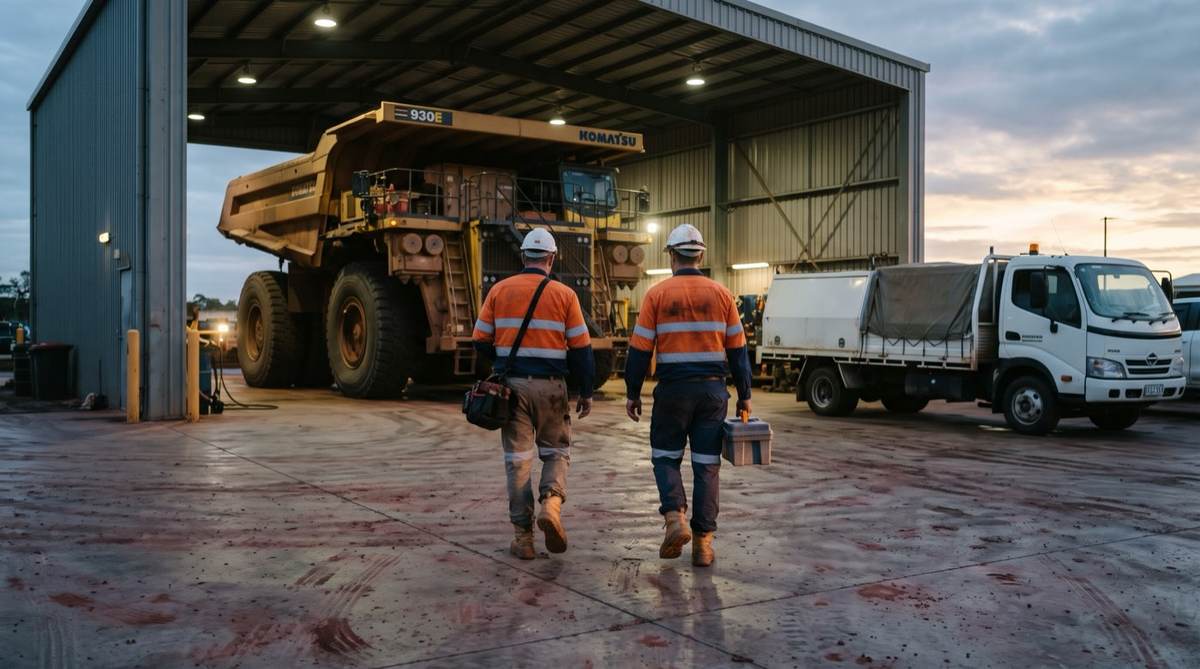
AI for mining services in Australia mostly means predictive maintenance and safety monitoring. IoT sensors on haul trucks, drills and fixed plant measure vibration, temperature, oil condition, acoustics and pressure. Edge computers on site run machine learning models that flag likely failures days or weeks ahead, and the alert becomes a work order in your maintenance system for a planner to approve.
This guide is for operations leaders, maintenance managers and general managers at Australian mining services contractors: drill and blast, mobile and fixed plant maintenance, haulage, bulk earthworks, geotechnical and environmental services. It is sized for contractors running a fleet across two or three sites, well below the scale of a major's autonomy program.
Key takeaways
- Predictive maintenance in mining has five layers: sensors, edge compute, connectivity, ML models and integration with your CMMS (Pronto Xi, SAP PM, JDE or IFS).
- Edge inference is essential at remote sites, because the system must keep working when the link drops.
- Alerts only create value when they generate work orders planners actually use.
- Cabin fatigue monitoring collects biometric information and needs a Privacy Impact Assessment and workforce consultation.
- Start with a 12-week pilot on three to five critical assets, measured against your own downtime history.
Why are mining services contractors looking at AI now?
Three pressures are converging on Australian mining services.
Safety regulation. Mining remains a high-consequence industry in Safe Work Australia's fatality data. Resources Safety and Health Queensland, WorkSafe WA and the NSW Resources Regulator all focus on critical control management, fatigue and vehicle interaction.
Cost and skills. Diesel fitters and electricians are hard to find and keep, especially on fly-in fly-out rosters. Every unplanned failure on a remote site pulls scarce people into reactive work and expensive freight.
Emissions reporting. The Safeguard Mechanism reforms from 1 July 2023 require facilities emitting more than 100,000 tonnes CO2-e of scope 1 emissions a year to reduce against declining baselines, with reporting under the NGER Scheme. Contractors increasingly get asked by host mines for verifiable fuel and equipment-hour data, which makes telemetry a commercial requirement.
| Driver | 2026 reality | Implication for contractors |
|---|---|---|
| Skilled technician scarcity | Diesel fitters and electricians hard to recruit | AI reduces specialist dependence for routine diagnostics |
| Equipment capital cost | Major mobile assets are multi-million dollar items | Extending economic life matters |
| Unplanned downtime | Primary production units are costly when stopped | Lead-time predictions enable planned interventions |
| Safety regulation | Critical control verification under state mining WHS laws | AI provides continuous evidence and early warning |
| Emissions reporting | NGER and Safeguard Mechanism scope 1 obligations | Telemetry feeds verifiable emissions calculations |
What does run-to-failure really cost a mining contractor?
Run-to-failure costs rarely show up cleanly in the maintenance ledger. A failed bearing often damages surrounding components. Emergency parts to remote sites attract freight premiums. Production losses on primary units are large. Overtime and call-outs pile on top. Contractual availability targets slip, and with them the relationship with the host mine.
| Reactive (run to failure) | Predictive with AI | Impact | |
|---|---|---|---|
| Failure discovery | When the asset stops | Days or weeks ahead, from sensor trends | Earlier |
| Repair planning | Emergency call-out | Planned into a maintenance window | Scheduled |
| Parts | Expedited freight to site | Ordered ahead with lead time | Lower premium |
| Secondary damage | Common | Reduced by early intervention | Less |
| Safety exposure | Breakdowns in the pit, rushed repairs | Repairs in controlled conditions | Lower |
How much your operation gains depends on baseline maturity, asset mix and data quality. Measure your own downtime history before quoting any figure to the board.
How does IoT predictive maintenance work in mining?
A practical system has five connected layers: sensing, edge processing, connectivity, central ML and integration into the work management system.
- SensorsVibration, temperature, oil, acoustic, pressure
- Edge computeLocal inference, filtering, alerting
- ML modelPattern recognition, failure prediction
- AlertSeverity, lead time, recommended action
- CMMS work orderDrafted in Pronto, SAP or JDE for a planner to approve
What do mining equipment sensors measure?
- Vibration. Bearing wear, gear mesh issues and structural defects produce characteristic frequency signatures that often change well before failure.
- Temperature. Overheating in motors, gearboxes and hydraulics signals lubrication breakdown or load issues.
- Oil condition. Particle counts, viscosity and contamination reveal internal wear early. Oil analysis labs in Perth, Brisbane and Mackay are well established, and inline sensors are increasingly practical.
- Acoustic and ultrasonic signatures. Early bearing damage and air leaks become detectable before they are audible.
- Pressure. Hydraulic pump wear, valve degradation and line restrictions show up as subtle pattern shifts.
Why does edge computing matter at remote mines?
Connectivity at Australian mine sites is hard. Many operations are hundreds of kilometres from major centres, and even with private LTE or 5G, the pit face often has radio shadows. Geostationary satellite adds a round-trip delay of roughly 600 milliseconds, too slow for real-time alerting.
Edge AI runs inference locally on the asset or a site gateway. Only meaningful events and aggregated telemetry go to the central platform, which cuts bandwidth and keeps the system working through outages. Typical stacks use ruggedised industrial PCs running containerised models trained centrally and deployed to site. Telemetry and models stay on infrastructure in Australia, a point our data sovereignty guide covers.
What safety risks can AI monitor on mine sites?
AI-enabled safety monitoring on mining assets has matured considerably. Five risk categories are now addressable in near real time:
| Safety concern | Detection method | Response |
|---|---|---|
| Vehicle interaction | Radar, lidar, GPS fusion, vehicle-to-vehicle mesh | Immediate operator warning |
| Operator fatigue | Cabin camera (eye tracking, head pose), steering patterns | Real-time alerts |
| Exclusion zone breach | Geofencing with vehicle interlock | Immediate stop signal |
| Structural and ground movement | Vibration, strain, slope radar | Hours to days of lead time |
| Air quality and gas | Methane, CO, SO2, particulate sensors | Real-time alarms |
Should contractors pursue autonomy?
The majors have run autonomous haulage in the Pilbara for years and have published safety and productivity results in their annual reports. For services contractors, full autonomy is rarely the right entry point. Operator-assist systems (proximity warning, fatigue alerts, geofenced speed limiting) deliver much of the safety value at far lower capital cost.
How does the Privacy Act apply to fatigue monitoring?
In-cabin cameras that track eye movement, blink rate, head pose and yawning are effective. They also collect biometric information about identifiable workers, which is sensitive information under the Privacy Act 1988. Contractors deploying cabin monitoring should:
- Complete a Privacy Impact Assessment before rollout.
- Consult the workforce and check enterprise agreement obligations.
- Keep data only as long as operationally necessary.
- Document the basis for collection, including WHS obligations.
- Restrict access to fatigue data on a need-to-know basis.
DISR's Voluntary AI Safety Standard offers useful guidance on transparency and human oversight that maps well to fatigue monitoring.
What connectivity does mining AI need?
There is no single answer. A practical stack combines layers:
- Private LTE or 5G for the main operating area
- LPWAN (LoRaWAN, NB-IoT, Cat-M1) for low-bandwidth fixed sensors
- Mesh radio at the pit face where LTE struggles with radio shadows
- Satellite, low earth orbit or geostationary, for backhaul where terrestrial coverage is missing
- Edge inference for routine decisions, so bandwidth becomes a sync problem instead of a real-time one
Contractors on a host's site are often limited to what the mine operator provides. Negotiate data export rights and bandwidth allocation in the contract.
Which standards apply to AI in mining?
- ISO 45001 for occupational health and safety management. AI safety monitoring should plug into existing OHS controls.
- ISO 55001 for asset management. Predictive maintenance is a textbook ISO 55001 use case, and aligned CMMS workflows make the deployment easier to audit.
- ICMM Critical Control Management guidance. Vehicle interaction, ground control and uncontrolled motion are consistently top critical risks, and AI monitoring supports control verification.
- DISR Voluntary AI Safety Standard. Human oversight, transparency, contestability and accountability belong in the design from day one.
State regimes add their own requirements: Western Australia's Work Health and Safety Act 2020 and WHS (Mines) Regulations, Queensland's Coal Mining Safety and Health Act 1999 and Mining and Quarrying Safety and Health Act 1999, and New South Wales' Work Health and Safety (Mines and Petroleum Sites) Act 2013. AI systems must support statutory roles and safety management systems, never sidestep them.
What does a 12-week mining predictive maintenance pilot look like?
Start with a focused pilot on three to five critical assets, prove the economics on your own data, then scale.
- Week 1-2Asset and failure auditCatalogue critical assets, review 24 months of failures, pick the top candidates by downtime cost
- Week 3-4Connectivity and integration assessmentSurvey site coverage, map SCADA, fleet management and CMMS integration points
- Week 5-6Sensor and edge deploymentInstall vibration, temperature, oil and acoustic sensors, deploy the edge gateway, establish a baseline
- Week 7-9Model training and calibrationTrain initial models, tune alert thresholds, connect alerts to CMMS work orders
- Week 10-11Validation against real eventsCompare predictions with maintenance findings, reduce false positives, confirm lead times
- Week 12Decision pointMeasure results, document lessons, scale, adjust or stop
Set your success criteria before the pilot starts: the share of real failures predicted, the minimum useful lead time and an acceptable false-positive rate. If the pilot does not reach them, tune before scaling.
Why do mining AI pilots fail?
- Connectivity underestimated. Surveys often miss dead zones. Budget for mesh extension or satellite backhaul.
- Sensors in the wrong place. A vibration sensor on the wrong housing cannot see bearing wear. Involve OEM service partners or a condition monitoring specialist.
- Alerts that go nowhere. If alerts do not create work orders in the CMMS planners use, the system becomes shelfware.
- Model drift. Equipment ages and conditions change. Plan regular retraining and accuracy reviews.
- No human override path. Statutory officials and planners must be able to override, contest and audit AI recommendations.
How should contractors measure the return?
The economics for a contractor are more modest than a major's autonomy program, and they depend on your contract. Some savings may pass to the host mine under your commercial arrangement. Record these before Phase 1 ends.
- Unplanned downtime hours per asset, last 24 monthsYour history
- Cost per hour of downtime on primary unitsYour contract terms
- Emergency freight and call-out spendYour ledger
- Secondary damage eventsYour work orders
- Availability against contract targetsYour KPI
Where should a mining services contractor start with AI?
What is your biggest pain right now?
- High unplanned mobile fleet downtimePredictive maintenance on the top critical assets
- Vehicle interaction incidents or near missesProximity detection and collision avoidance
- Fatigue-related incidents on long shiftsCabin fatigue monitoring, with Privacy Act steps
- Host mine asking for scope 1 emissions dataTelemetry and NGER-aligned reporting
- Manual inspection burden across fixed plantAcoustic and thermal monitoring on critical fixed assets
Pick the use case with the cleanest baseline data, the strongest internal sponsor and the most measurable outcome. Win one, then expand. Our automation business case template helps structure the case, and asset health AI for mining covers condition monitoring on fixed plant.
Why do data quality and sovereignty matter for mining AI?
Data quality. Sensor data that is poorly calibrated, inconsistently tagged or missing context (asset ID, location, operating mode) cannot train useful models. Run a data quality and AI readiness assessment first. Consistent tag naming helps too: see our guide to OT tag naming and data standards.
Data sovereignty. Mining telemetry includes commercially sensitive production data, biometric data from cabin monitoring and emissions data that may be audited under NGER. Keeping training data, models and inference in Australia is increasingly a contractual expectation from host mines and government customers. Our comparison of AWS, Azure and Google Cloud AI services in Australia covers region selection.
What governance does safety-critical mining AI need?
- Critical control management. AI monitoring supports critical control verification. Statutory officials stay accountable.
- Human override. Operators, planners and statutory positions must be able to override, contest and audit AI outputs.
- Revalidation. Track false positives and false negatives over time and retrain on a schedule.
- Cyber security. Edge gateways and OT networks are targets. Our 50-point AI security checklist covers OT considerations.
- Privacy. Cabin monitoring and worker tracking require Privacy Act compliance, consultation and minimal retention.
How Solve8 can help
Our consultants and engineers have worked on ERP, OT and systems integration in environments such as BHP and Rio Tinto across their careers. We help mining services contractors scope, build and run predictive maintenance and safety AI on their own infrastructure, connected to their CMMS, as fixed-fee phases. See our work with mining and manufacturing operators and our custom AI development service, or talk to us.