Asset health AI for Australian local councils adds a cheaper, more frequent condition data layer under the asset management framework councils already run: vehicle-mounted pavement vision, drone bridge imagery, CCTV pipe classification, canopy monitoring and customer request triage. A qualified engineer reviews every output before it reaches the asset register, the long term asset management plan or an AASB 116 revaluation.
Key takeaways
- Councils already run mature, audited asset management under ISO 55001, IPWEA NAMS+ practice notes and state local government legislation. AI extends the data layer; it does not replace the framework.
- The strongest business case is condition data that updates continuously, supporting renewal forecasts, rolling AASB 116 revaluations and grant applications.
- Customer request triage and vehicle-mounted pavement vision are the safest first pilots: abundant data, recoverable mistakes.
- Engineer review is non-negotiable. Statutory inspection sign-off stays with qualified people.
- Privacy, state records retention and data residency need to be designed in from day one, with public communication about any sensor deployment.
Why councils are ready for asset health AI
Australian councils manage some of the most varied asset portfolios in the country: sealed and unsealed roads, bridges and culverts, stormwater, often water and sewer, parks and sporting fields, community buildings, depots, fleet and the ICT that ties it together. Each class sits inside a maturity framework most councils have refined for more than a decade.
That maturity changes the conversation. Strategic asset management plans, the Long Term Financial Plan, long term asset management plans and class plans are statutory, audited and tabled in council meetings. The right framing is extending the condition data those plans rely on. Better data, captured more often at lower marginal cost, improves renewal forecasts, revaluations, customer request triage, capital works prioritisation and grant applications.
This guide is part of our asset health series, alongside mining operations, transport fleets and manufacturing plant.
The council asset management framework AI has to fit
Every AI investment either feeds the existing framework or gets rejected by it. The hierarchy in most councils:
- Strategic Asset Management Plan under ISO 55001, setting levels of service, risk appetite and the link to the Community Strategic Plan.
- Long Term Financial Plan, typically ten years, required in most jurisdictions.
- Long term and class asset management plans following IPWEA NAMS+ practice notes.
- Resourcing plans translating asset plans into budgets and crew schedules.
- The CMMS or asset register holding hierarchy, condition, maintenance history and work orders.
Each state's Local Government Act layers on planning and reporting duties. NSW councils work with Office of Local Government guidance; Victorian councils report under the Local Government Performance Reporting Framework.
On the accounting side, condition data feeds AASB 116 fair value measurement, with AASB 13 governing the valuation hierarchy. Defensible condition data is audit evidence for balance sheet values that can run into billions. Risk management sits across this under AS/NZS ISO 31000, with class-specific standards such as AS 5488 for subsurface utility information and ISO 14224 for reliability data.
Anyone offering AI to councils without naming this stack deserves caution.
Where does AI fit each council asset class?
Roads and pavements
The largest class by value and community visibility. Formal condition assessment runs on multi-year cycles using visual surveys, profilometry and deflection testing. Between cycles, councils rely on customer requests and crew observation.
- Vehicle-mounted pavement vision. Cameras on routine council fleet with models that classify cracking, rutting, ravelling and potholes, producing near-continuous data. Pavement condition updates can move from every few years towards annual or better.
- Accelerometer roughness from utility vehicles as cheap supplementary data.
- LiDAR change detection on high-value corridors for shoulder deformation and subsidence.
- Customer request triage, covered below.
Bridges and major structures
Bridge management follows Austroads guidance with Level 1, 2 and 3 inspections.
- Drone imagery with vision models for Level 1 and supporting Level 2 work: cracking, spalling, corrosion staining and scour at piers. Output supports the bridge engineer; it is not the inspection.
- Vibration and strain monitoring on flagged structures.
AI output on bridges stays advisory. Statutory sign-off rests with qualified engineers.
Drainage, stormwater, water and sewer
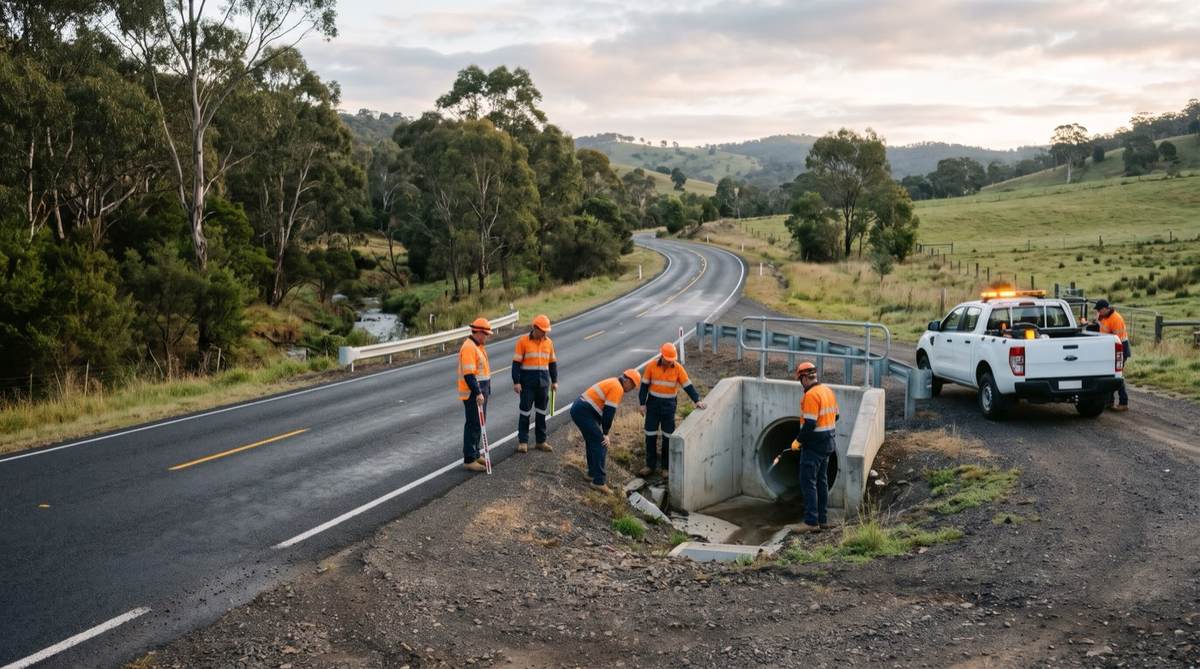
- CCTV pipe condition classification: cracks, root intrusion, displaced joints and infiltration.
- Blockage and overflow prediction combining rainfall radar, incident history and canopy data.
- Acoustic leak detection where councils retain water responsibility.
- Pipe failure probability from age, material, soil, pressure and break history, supporting renewal prioritisation.
Parks, trees, open space and buildings
- Tree health screening from satellite vegetation indices, with drone follow-up, for canopy decline, storm risk and bushfire interface fuel loads.
- Playground inspection scheduling weighted by usage and age.
- HVAC condition and energy benchmarking on council buildings.
- Roof and envelope condition from drone imagery.
Fleet
Council fleets mix passenger vehicles, light commercials, heavy plant and waste trucks. See our transport fleets guide.
The council asset condition data flow with AI
- CaptureSensor, drone, vehicle camera, formal inspection
- Customer requestsSnap Send Solve, CSR portal, phone
- AI triageClassify, deduplicate, severity rank
- Engineer reviewSign off, override, escalate
- CMMS work orderAsset register, schedule, crew
- AMP and revaluationCondition feeds LTAMP and AASB 116
Two parts deserve attention. First, engineer review: AI output enters the CMMS only after a qualified person accepts it, because model confidence on edge cases is uneven and councils carry liability for condition decisions. Second, the feedback loop: condition data arriving continuously lets councils move towards rolling revaluation with stronger audit evidence, a business case vendor pitches often miss.
Customer request triage: the safest first use case
Councils receive requests through Snap Send Solve, CRM portals, web forms and phone. AI triage adds value quickly because the task is constrained and data is abundant:
- Classification to asset class and work type, with confidence scores.
- Deduplication of nearby reports of the same defect.
- Severity ranking so safety-critical reports get same-shift response.
- Routing to the right team in the CMMS.
It sits in front of the CMMS, upstream of nothing statutory. A misclassification means a re-route.
How do inspection-cycle and AI-augmented assessment compare?
| Inspection-cycle | AI-augmented | Impact | |
|---|---|---|---|
| Update frequency | Every few years | Continuous or annual | More current |
| Network coverage | Sampled corridors | Whole network | Full coverage |
| Marginal cost of data | High per survey | Low once fleet-mounted | Lower |
| Revaluation evidence | Periodic snapshot | Rolling dataset | Audit defensible |
| Customer request response | Days to weeks | Hours to same shift | Faster |
| Engineer time | Spread across all segments | Triaged exceptions only | Focused |
Many councils already use risk-based assessment. AI keeps that logic and lowers the marginal cost of data, so risk-based attention can cover more of the network.
Which asset class should a council pilot first?
Choose by data abundance, decision clarity and reversibility of mistakes, not asset value.
What does the council have most of, and where are mistakes most recoverable?
- High customer request volume, mature CRMCustomer request AI triage
- Large sealed road network, regular fleet movementsVehicle-mounted pavement vision
- Mature CCTV pipe inspection programPipe condition vision classifier
- Mature tree register, fire interface zonesCanopy and tree health screening
- Recent bridge inspection backlogDrone-assisted Level 1 inspection
See also AI pilot project success factors.
A 16-week pilot aligned to council planning cycles
- Weeks 1 to 2Discovery and scopingAsset class selection, data audit, governance scoping
- Weeks 3 to 4Council policy alignmentMap to existing AI policy, privacy assessment, committee paper
- Weeks 5 to 8Build and integrateData pipeline, model, CMMS integration, dashboard
- Weeks 9 to 12Engineer-in-the-loop pilotLive operation with human review on every output
- Weeks 13 to 14Validation and tuningModel performance review against engineer overrides
- Weeks 15 to 16Report and decisionFindings paper to executive and council, scale decision
The committee paper in weeks 3 to 4 often decides whether a council AI project survives. Councillors increasingly ask about AI use, so treat the pilot as transparent from day one.
The engineer-in-the-loop period is essential. Generic models struggle on local conditions such as gravel road signatures, local aggregates and native tree species. Engineer overrides become the most useful training signal the council produces.
Governance, privacy and community trust
AI policy
The Australian Government's Voluntary AI Safety Standard (2024) sets out ten guardrails that map well to council use, and many councils also reference the Digital Transformation Agency's policy for responsible AI use in government. Each initiative should have an AI use register entry covering purpose, data sources, model type, decision impact, human override, monitoring and review. Our AI governance framework guide scales to council scope.
Privacy and surveillance
Fleet cameras, drone imagery and pipe CCTV touch the Privacy Act 1988 and state privacy laws. Blur identifiable people, vehicles and private property at the point of processing and keep only what the asset purpose needs. Tell residents about sensor deployment. State records legislation applies to AI-generated condition data: it is council record material.
Data sovereignty
Address residency explicitly: where inference runs, where training data is stored and what happens to data when a contract ends. See the data sovereignty guide.
Procurement and contract terms
Useful clauses include council ownership of council-generated training data, performance metrics tied to engineer override rates, exit and data portability obligations, and disclosure of subprocessors. Our AI government contracts guide covers more.
How to build the business case
Build it from your own data. The main benefit lines are usually:
- Lower cost of condition data on roads and pavementsInspection savings
- Less manual triage of customer requestsOfficer time back
- Earlier intervention before renewal costs climbDeferred renewal smoothing
- Stronger condition evidence in grant applicationsGrant defensibility
- Fewer unplanned reactive drainage and water worksReactive cost avoided
Renewal cost rises sharply as condition deteriorates, so catching degradation earlier shifts work into cheaper intervention bands. Grant programs such as Roads to Recovery reward councils that can evidence condition. The automation business case template gives a starting structure.
Common implementation pitfalls
- Buying ahead of policy. Policy first, pilot second, procurement third.
- Underestimating CMMS integration. Whether the council runs TechnologyOne, Civica, Brightly, Assetic or another platform, integration is often the largest share of effort. See our system integration service.
- Treating AI as one-off capital. Models drift and data sources change. Plan for ongoing monitoring through managed AI services or an internal owner.
- Skipping community communication. Quiet deployment of vision systems is politically costly. Brief residents and councillors.
- Confusing model confidence with engineering confidence. A crack classified at high confidence is not a structural assessment.
How Solve8 can help
Our team connects condition data, customer request systems and the CMMS, builds the triage and vision models, and keeps an engineer approving every output before it reaches the asset register. AI runs on your infrastructure in Australia. See our AI strategy and process automation services, or talk to our team.