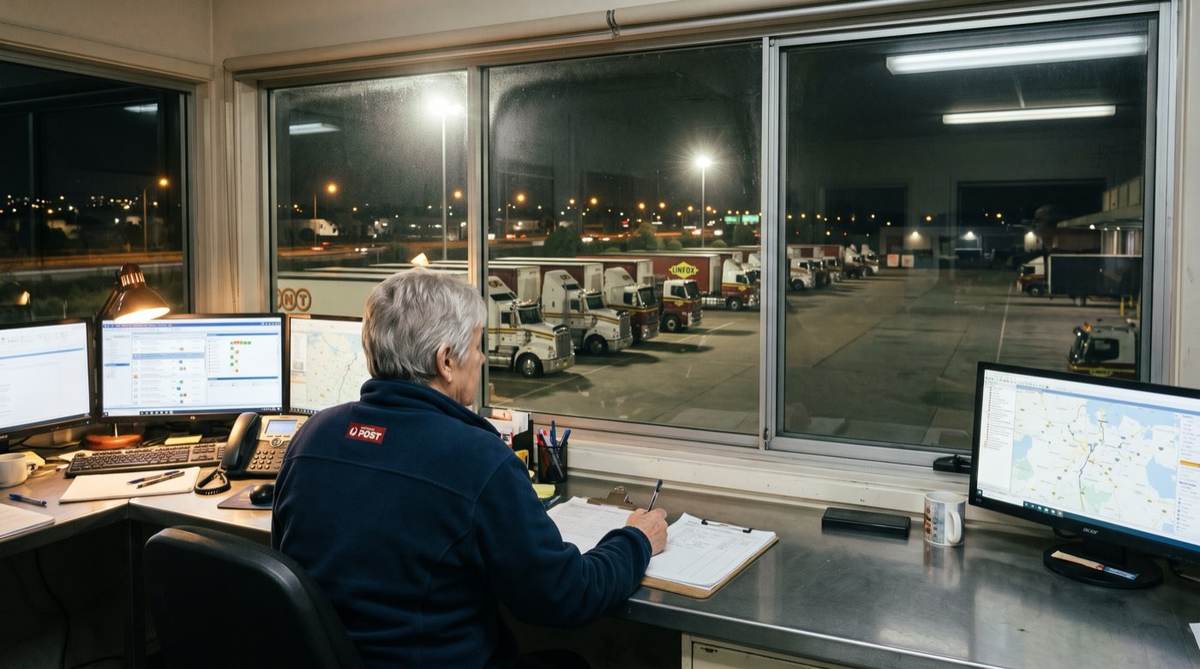
The software that helps Australian transport operators meet Chain of Responsibility obligations connects telematics, electronic work diaries, rosters, loading and maintenance records, then flags fatigue, speed and mass exceptions for a person to act on and logs the decision. AI strengthens the evidence for the HVNL primary duty and executive due diligence. It never discharges the duty itself.
Key takeaways
- Under the Heavy Vehicle National Law, Chain of Responsibility makes every party that influences a heavy vehicle journey responsible for its safety: operators, schedulers, consignors, consignees, loaders and packers.
- Each party has a primary duty to ensure safety so far as is reasonably practicable. Executives carry a separate, personal due diligence duty.
- The hardest part is evidence: showing what you knew and what you did, when records are spread across systems and paper.
- Chain of Responsibility software earns its place by joining up data, surfacing exceptions before dispatch and keeping a standing decision trail.
- Connect the data first, add AI exception detection second, and keep decisions with people.
What is Chain of Responsibility under the HVNL?
Chain of Responsibility (CoR) is often misunderstood as a rule about drivers. Under the Heavy Vehicle National Law, it extends accountability for the safety of a heavy vehicle, its driver and its load to every party whose actions, inactions or demands influence the journey. If your decisions shape how a truck moves, the law treats you as responsible for the safety consequences.
Each party must ensure, so far as is reasonably practicable, the safety of its transport activities. Above that sits a personal executive due diligence duty. The most serious breaches are Category 1 offences, with maximum penalties originally set at $300,000 for an individual and $3 million for a corporation, indexed over time, and possible imprisonment.
For a transport operator, distributor or large consignor, the uncomfortable question is how you demonstrate, after an incident, that you took all reasonably practicable steps across fatigue, speed, mass, loading and maintenance, when evidence is spread across telematics units, spreadsheets, paper run sheets and memory.
Why is the primary duty hard to evidence?
The primary duty gives you no checklist. It asks whether you eliminated or minimised risks so far as reasonably practicable, weighing likelihood and severity of harm against the cost and difficulty of controlling it.
Reasonably practicable is judged on what you knew or ought to have known and what you did. After a fatigue-related crash, an investigator will ask whether your schedule allowed lawful rest, whether you could see accumulated hours, whether speed and route data showed pressure, and whether someone acted on warning signs. If that information lived in systems nobody read together, the gap between policy and reality becomes the case against you.
| Disconnected Systems | Connected, Monitored | Impact | |
|---|---|---|---|
| Fatigue and work hours | Paper logs reconciled weekly | Continuous monitoring against limits | Live |
| Speed and route data | Reviewed only after an incident | Exception alerts in near real time | Proactive |
| Mass and loading | Trust the consignor's figures | Cross-checked against capacity rules | Verified |
| Maintenance defects | Logged in a separate system | Linked to the vehicle and trip record | Joined up |
| Evidence for an audit | Manual reconstruction after the fact | Standing record on demand | Defensible |
What does executive due diligence require?
An executive of a business that is a party in the chain must exercise due diligence to ensure the business complies with its primary duty. It is a direct, personal obligation on directors and senior managers.
In substance, an executive must understand the business's transport activities and their risks, ensure it has and uses the resources and processes to control them, and ensure information about hazards, risks and incidents is received, considered and acted on promptly. An executive who can show a live risk view, documented escalation and timely action on alerts is demonstrating due diligence.
Which role best describes your business?
- You schedule trips or set delivery timesScheduler duty: timetabling must allow lawful rest
- You operate or own the vehiclesOperator duty: the broadest primary duty exposure
- You consign or receive the freightConsignor or consignee duty: demands must not induce breaches
- You load or pack the vehicleLoader or packer duty: mass, dimension and restraint
- You are a director or senior managerExecutive duty: personal due diligence obligation
What software helps transport operators meet Chain of Responsibility obligations?
Most operators already run several relevant systems: telematics, an electronic work diary, a transport management or rostering system, and a maintenance system. Chain of Responsibility software is usually the layer that joins them up. It should do five things:
- Join the records for each driver, vehicle and trip across telematics, work diaries, rosters, loading and defects.
- Check plans before dispatch against work and rest limits, mass and dimension rules.
- Surface exceptions as a ranked queue for a person to judge.
- Record the decision and the reason, every time.
- Produce evidence on demand for an audit, investigation or board report.
Where AI does real work in CoR
Fatigue and work-hours monitoring. Reconciling electronic work diary data, telematics and rostering lets a system flag where a planned schedule would push a driver towards a breach before the trip is dispatched. The scheduler sees the conflict and changes the plan.
Exception detection across speed, route and behaviour. Telematics produces more data than a compliance officer can read. Models that learn normal patterns and surface meaningful exceptions, such as sustained speeding on a corridor or a timetable that implies unrealistic speeds, turn a data lake into a manageable stream of decisions. It is the same exception-based approach as asset-health AI for transport fleets, pointed at safety.
Documentation and audit readiness. AI extracts and structures information from run sheets, defect reports, induction records and incident notes into one queryable trail, the same principle as automated compliance reporting.
- IngestTelematics, work diaries, rosters and defects
- AnalyseModels flag fatigue, speed and mass exceptions
- SurfaceA ranked queue of risks for a human to judge
- ActScheduler or manager intervenes and records why
- EvidenceDecision logged to the due diligence trail
What AI cannot do in Chain of Responsibility
AI cannot make a schedule that breaches rest limits acceptable. It cannot substitute for a manager weighing commercial pressure against safety. It cannot explain a decision in court; a person does that. A model producing alerts nobody reviews is worse than no model, because it creates evidence you were warned and did nothing.
The system informs, a person decides, and the decision is recorded. That principle runs through our AI governance framework guide.
The Master Code and the direction of travel
The NHVR's Master Code is a registered industry code of practice, first registered in 2018 and since updated through industry consultation. Registered industry codes do not create new legal obligations. They describe ways parties can meet the primary duty they already hold, which makes them a useful benchmark for what reasonably practicable looks like and a structure to align monitoring and evidence against. Check the current version on the NHVR website.
- Category 1 penalty exposure for the corporationMillions of dollars
- Personal exposure under the executive dutyDirector liability
- Incidents avoided through earlier interventionSafety outcome
- Defensible primary duty evidence on demandAudit ready
A sequencing plan for operators
- Phase 1Map and ownIdentify your CoR roles, name an executive owner, and map where fatigue, speed, mass and maintenance data currently lives
- Phase 2Connect the dataIntegrate telematics, work diaries and rostering so the records can be read together
- Phase 3Add exception detectionLayer AI monitoring to flag fatigue and speed exceptions for human review before dispatch
- Phase 4Close the evidence loopLog every intervention to a standing due diligence trail aligned to the Master Code
Phase 1 is the one operators skip and regret. A tool bought on top of fragmented data inherits its blind spots. Phase 2 is unglamorous integration work, and it is what turns isolated systems into joined-up evidence.
Fatigue: where AI earns its keep
Fatigue regulation under the HVNL is prescriptive, with defined work and rest limits and record-keeping requirements. The rules are the easy part. The challenge is a live, accurate picture of where every driver sits against them across a week, with inputs from multiple vehicles, depots and shifts.
A scheduler on a static roster cannot see, when assigning a job, that a driver is close to a rest threshold. By the time a paper diary is reconciled, the trip has happened. Reconciling work diary data, telematics and the proposed schedule moves the warning before dispatch, when work can still be reassigned.
A fatigue conflict surfaced before dispatch, plus a documented decision to reschedule, is close to a textbook demonstration of both the primary duty and executive due diligence. The same roster data touches award obligations, covered in our Fair Work compliance automation guide.
How CoR connects to the rest of your operation
The decisions that drive fatigue risk also drive service performance. Operators investing in dispatch automation should design safety constraints into the same system. Supply chain visibility work intersects at the roster too. Treat these as one connected system.
How Solve8 can help
We connect telematics, work diaries, rostering and maintenance systems into one evidence trail and add exception monitoring that a scheduler reviews before dispatch, running on your infrastructure in Australia. See our system integration and process automation services, our field service and facilities work, or talk to our team.
This article is general information, not legal advice. Confirm obligations with the NHVR and qualified advisers.