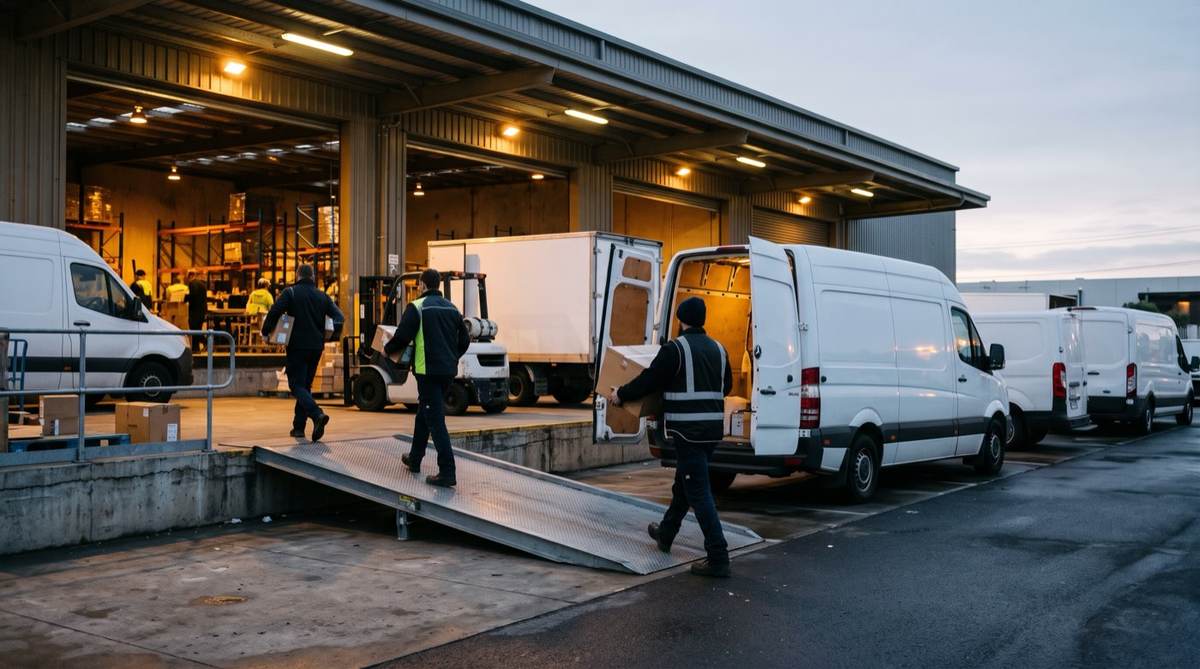
AI reduces failed deliveries for courier services in four ways: dispatch that allocates jobs by location, load, time window and driver hours; routes that re-plan as traffic and availability change; electronic proof of delivery that removes paperwork and disputes; and automatic customer updates that cut "where is my parcel" calls. Address data quality underpins all four.
Key takeaways
- Every failed delivery costs a redelivery run, a customer service contact and some customer goodwill.
- AI dispatch and dynamic routing help new drivers perform closer to experienced ones.
- ePOD with GPS, photo and signature speeds invoicing and settles disputes.
- Proactive notifications at three or four meaningful moments cut inbound enquiries without annoying customers.
Why do courier operators need AI now?
E-commerce volumes keep rising, customers expect same-day or next-day delivery with live tracking, and fuel and labour costs are volatile. For a multi-depot courier or last-mile operator, small inefficiencies multiply across thousands of drops a day.
Driver shortages make it worse. Experienced drivers carry route knowledge in their heads ("if Sam leaves we're stuffed"), and new drivers take months to learn it. AI dispatch and routing capture much of that knowledge in the system.
| A Few Years Ago | Today | Impact | |
|---|---|---|---|
| Delivery window | Two to five business days | Same day or next day | Faster |
| Tracking updates | Daily status | Live tracking | Constant |
| Notification | Email on dispatch | SMS at key stages | Proactive |
| Redelivery tolerance | Accepted as normal | A reason to switch carrier | Low tolerance |
| Delay response | Call the depot, wait on hold | Self-service tracking | Instant |
What are the five AI applications that matter for couriers?
1. AI dispatch optimisation
Manual dispatch by postcode or availability creates crossing routes and uneven workloads. AI dispatch weighs many variables at once:
- Driver location and current load
- Delivery windows and customer preferences
- Traffic patterns and predicted congestion
- Vehicle capacity and type
- Driver work and rest hours, relevant to heavy vehicle fatigue rules
- Historical performance on similar runs
- Order IntakeJobs from all channels combined
- OptimiseWeighs location, load, windows, hours
- AssignAllocation in seconds
- Re-optimiseAdjusts for real-time changes
A dispatcher reviews and overrides allocations. Route optimisation vendors such as Dispatch Science and NextBillion.ai publish fuel and productivity gains; test any claim against your own baseline.
2. Real-time route optimisation
Static plans fail the moment conditions change. Dynamic systems watch live traffic, weather, driver progress and customer availability, then push revised routes to devices.
Local factors matter: school zones at set times, Melbourne hook turns, Brisbane river crossings and Sydney toll roads. Mature platforms account for them.
3. Electronic proof of delivery (ePOD)
Paper POD delays invoicing and gives weak evidence in disputes. ePOD captures:
- GPS-verified location
- Timestamped photos
- Electronic signature
- Contactless confirmation
- Automatic attachment to customer records and invoices
- Driver ArrivesGPS confirms location
- Capture EvidencePhoto, signature, notes
- SyncUploaded immediately
- Customer NotifiedAutomatic confirmation
- Invoice ReadySame-day billing
For operators that receive POD documents from subcontractors or customers, AI document extraction can match and attach them automatically, with exceptions routed to a person. ePOD is usually included in modern transport management systems.
4. Customer notification automation
"Where is my parcel?" (WISMO) is usually the largest inbound enquiry type. Proactive updates prevent most of them.
| Trigger | Channel | Content |
|---|---|---|
| Order confirmed | Email and SMS | Tracking link, expected window |
| Out for delivery | SMS | Narrowed delivery window |
| Driver nearby | SMS | Live tracking link |
| Attempt failed | SMS | Photo, safe place or redelivery options |
| Delivered | SMS and email | Confirmation with POD photo |
Australian messaging providers include Notifyre, Sinch MessageMedia and Kudosity. For remaining enquiries, an AI assistant can look up status in your TMS and answer, handing complex cases to staff.
5. E-commerce and customer system integration
Couriers serving retailers on Shopify, WooCommerce, BigCommerce and marketplaces need orders imported automatically, labels generated, tracking pushed back, and returns handled.
- Online OrderCustomer purchases
- Auto-ImportOrder flows to courier system
- Label GeneratedReady for dispatch
- Tracking SyncedCustomer sees live status
Platforms such as Shippit, Interparcel and Easyship handle multi-carrier integration. B2B shippers often need EDI or API connections into their ERP, which is custom system integration work.
Which courier software platforms should you consider?
| Platform | Typical Fit | Impact | |
|---|---|---|---|
| TransVirtual | Australian TMS: dispatch, routing, tracking, billing, ePOD | Courier and freight fleets wanting one local platform | Local |
| Shippit | Multi-carrier, e-commerce focused | Couriers and 3PLs serving retailers | E-commerce |
| Dispatch Science | Cloud TMS with route optimisation | High-volume last-mile operations | Routing |
| Onfleet | Delivery management, fast rollout | Operations wanting quick implementation | Speed |
Ask each vendor: Does it handle Australian address formats? Which integrations exist for your finance system and customers' platforms? Where is data hosted? What is the driver app like? Demo with your own data.
How should a courier operator implement AI?
- Weeks 1-2Measure the baselineMap workflows, measure current performance, identify pain points
- Weeks 3-4Select platformDemo two or three platforms with your data
- Weeks 5-6Core setupConfigure dispatch, import customers and zones, connect integrations
- Weeks 7-8Driver rolloutMobile app rollout, run alongside the old process, collect feedback
- Weeks 9-12Optimise and expandAdd notifications and automation, tune, measure
Baseline metrics: deliveries per driver per day, first-attempt success rate, fuel cost per delivery, enquiries per 100 deliveries, order-to-dispatch time and delivery-to-invoice time.
Setup priorities: customer and location import, zones and windows, notification templates, platform connections and ePOD rules. Address validation will surface data problems early.
Driver adoption: position the change as less admin and fewer calls from dispatch. Run in parallel for at least two weeks. Involve drivers in selection.
How do you calculate the return?
- Fuel per deliveryFrom routing efficiency
- Deliveries per driver per dayCapacity without new vans
- Failed delivery rateFewer redelivery runs
- Inbound enquiriesFewer WISMO contacts
- Delivery-to-invoice timeFaster cash
Put a dollar value on each from your own baseline, then subtract platform and integration cost. Our ROI calculator helps.
What mistakes should couriers avoid?
What causes most of your delivery pain?
- Failed deliveries from bad addressesFix address validation and data quality first
- Drivers crossing routes, uneven workloadsStart with AI dispatch and routing
- Phones swamped with where-is-my-parcel callsStart with proactive notifications
- Slow invoicing and POD disputesStart with ePOD and document matching
- Ignoring address quality. Dispatch is only as good as the addresses. Validate at order entry and clean the customer database.
- Over-notifying. Seven messages per delivery drives opt-outs. Keep it to three or four that matter.
- No baseline. Without measurements before go-live, you cannot prove value.
- Rushing drivers. Drivers who feel ambushed find workarounds. Train properly and listen.
Also check chain of responsibility obligations for heavy vehicles. See AI and chain of responsibility compliance.
How Solve8 can help
We connect courier platforms to your finance, ERP and customer systems and build automation for POD matching, enquiries and reporting that runs on your infrastructure in Australia, with staff approving exceptions. See our field service and logistics work and process automation service, or talk to us.