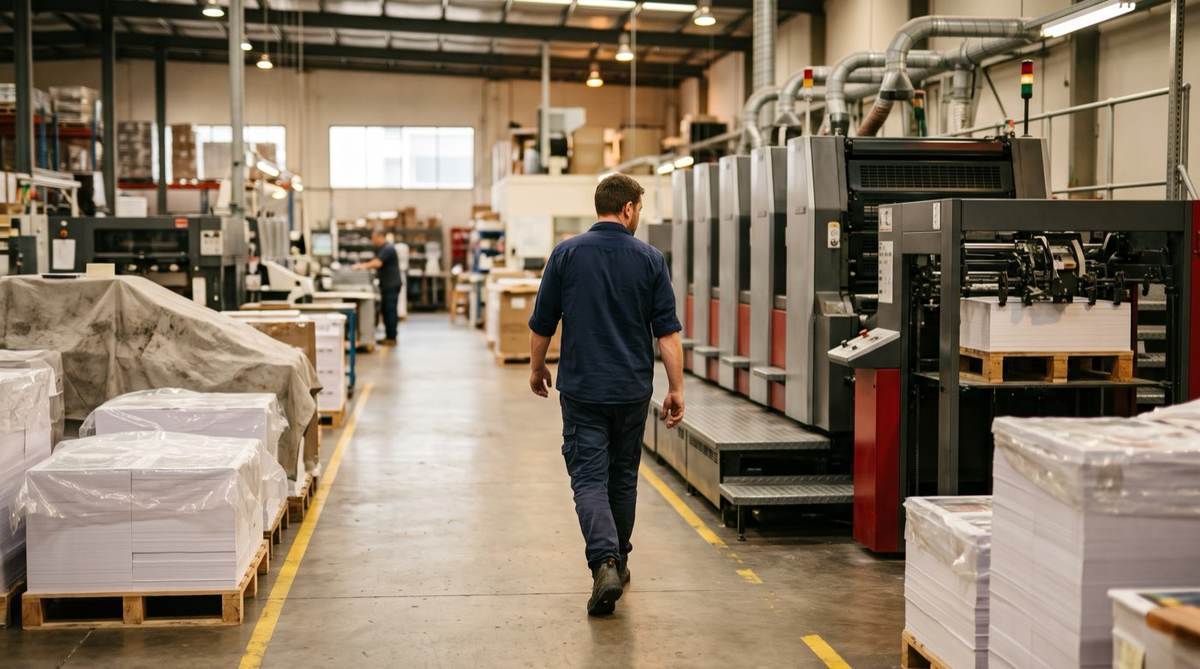
AI printing solutions help printing companies quote faster, schedule production around real machine capacity, automate proofing and pre-flight checks, forecast ink and substrate stock, and inspect output with vision systems. Most of these capabilities now sit inside or alongside a print MIS. Mid-sized Australian printers get the quickest wins from automated quoting for standard jobs and AI-optimised scheduling.
This guide is for owners, general managers and production managers at mid-sized, enterprise and multi-site commercial, packaging, label and signage printers in Australia and New Zealand. It covers the six areas where AI pays, the MIS foundation underneath them and a phased rollout.
Key takeaways
- Automated quoting gives the fastest return on standard, repeatable jobs. Keep estimators on complex custom work.
- AI scheduling often reveals spare capacity hidden by manual sequencing.
- Online proofing with AI pre-flight removes days of back-and-forth from many jobs.
- Vision inspection matters most for packaging and labels, where a missed defect can trigger a recall.
- A capable print MIS with clean job history is the foundation. AI cannot learn from data you do not have.
Why does a 10-minute quote take two hours?
A familiar scenario in Australian print businesses: a customer emails asking for 500 A4 brochures, 200 business cards and 50 banners for a trade show. The estimator spends 45 minutes gathering specifications, checking stock, calculating machine time, adding finishing and factoring in the deadline. Then another 30 minutes formatting and sending the quote. By then the customer may already have quotes from competitors with automated systems.
Research from PRINTING United Alliance found that manually registering an order or ticket takes around 10 minutes each, and those minutes compound across hundreds of jobs. A PRINTING United Alliance and NAPCO Research survey (2025) found 62 per cent of print businesses are already using AI-powered solutions or planning to within a year, and Gelato's 2025 industry analysis reported that 80 per cent of print professionals consider AI-driven automation essential to improving workflows.
IBISWorld valued the Australian printing market at $7.1 billion in 2025. It faces high labour costs, skills shortages and competition from online print services.
Why can't Australian printers afford to wait on AI?
Labour shortages and costs. Skilled print workers are scarce across Australia and New Zealand, and fewer young people are entering the trade. That limits capacity and pushes wages up.
Shift to digital and short runs. Demand keeps moving toward digital, short-run and personalised work, which multiplies the number of jobs, quotes and proofs per dollar of revenue.
Customer expectations. Online print services have trained buyers to expect instant quotes, real-time tracking and fast turnaround. A printer that takes two days to quote struggles against one that responds in minutes.
Margin compression. Material, energy and freight costs squeeze margins. Operational efficiency is the sustainable response.
PrintPLANR reports that a mid-size signage company using its AI scheduling reduced average turnaround by 30 per cent within three months, freeing capacity without hiring. Automated quoting improves conversion for a simple reason: you respond while competitors are still calculating.
What are the six areas where AI printing solutions pay off?
AI opportunities in print fall into six categories, each with different complexity, payback and integration needs with your print Management Information System (MIS).
- Quote requestEmail, web portal or phone enquiry
- AI estimationPricing and time from specs and history
- Proof approvalOnline proofing with pre-flight
- SchedulingAI-optimised job sequencing
- Quality controlVision-based defect detection
- DeliveryTracking and invoicing
1. How does AI quote automation work for printers?
Modern print MIS platforms can read natural-language job requests from emails or portals and turn them into job tickets. PrintPLANR's documentation describes auto-capturing job details from emails or portals and suggesting pricing and turnaround from past jobs. A request like "50 booklets with glossy covers by Friday" is matched against similar historical jobs.
printIQ, developed in Australia, evaluates manufacturing options across digital, flexo, offset and wide format when pricing, so sales staff can prepare estimates that protect margin.
The honest reality. Automated quoting works very well for standard jobs: business cards, brochures, flyers and banners with common specifications. It struggles with unusual substrates, complex finishing and multi-component packaging. The aim is to automate the routine majority so estimators focus on complex, high-value work, with an estimator approving anything unusual before it goes out.
2. How does AI production scheduling work in print?
Traditional scheduling relies on a production manager juggling deadlines, machine availability and job requirements. AI scheduling tools calculate production plans in seconds that would take a person hours. An AI scheduler weighs:
- Machine capabilities and current load
- Job specifications and dependencies
- Deadlines and rush priorities
- Staff availability and skills
- Substrate availability and drying times
- Finishing equipment sequencing
Print-specific schedulers such as MaxScheduler use machine learning to improve delivery date estimates over time.
The capacity gain. With better sequencing, many printers find more capacity than they realised. Jobs that seemed to need overtime can be sequenced more efficiently, and rush orders fit without disrupting everything else.
3. How does AI help with proofing and approvals?
The proof cycle is one of the biggest hidden time sinks: emails back and forth, unclear feedback, several revision rounds and uncertainty about who approved what.
Online proofing platforms such as Ziflow consolidate feedback and route proofs through internal review and client sign-off in order. Features that matter:
- Automated reminders. PageProof and similar tools chase pending approvals automatically.
- Version control. ManageArtworks and others track every change.
- AI pre-flight. PrintPLANR can catch missing fonts, low-resolution images and bleed errors before production.
ManageArtworks reports one implementation achieved a 40 per cent reduction in workflow delays. Where proof delays routinely add days to completion, that is a real advantage. The best proofing tools connect to your MIS. Ordant's proofing module, for example, emails every approver when a proof is ready along with its due date.
4. How does AI manage ink and substrate inventory?
Ink is one of a printer's largest consumable costs. Running out mid-job stops production, while overstocking ties up cash and risks expiry.
Fiery InkWise, launched in 2025, uses historical consumption to forecast when ink stocks will run low and suggests reorder quantities and timing. Comprehensive inventory automation also covers paper and substrates, laminates and binding supplies, spare parts and packaging. Systems such as PrintXpand and GelatoConnect support automatic replenishment rules and usage insights.
5. How does AI vision quality control work for print?
Human inspectors cannot examine every item at line speed, and fatigue affects consistency. AI vision systems inspect output in real time at production speed, checking:
- Colour consistency across runs
- Registration accuracy
- Text clarity and font rendering
- Image resolution and banding
- Finishing quality (trimming, folding, binding)
- Label placement and barcode readability
For packaging and label printers the stakes are higher. Vision inspection verifies placement, font integrity and micro-defects. On pharmaceutical labels or food packaging, a missed defect can mean a recall. Our guides to AI quality control in manufacturing and visual inspection cover how these systems are set up.
6. How does AI automate customer communication?
What works well: job status updates at key milestones, delivery notifications, invoice generation and follow-up, reorder reminders from order history and proof deadline reminders.
What still needs people: complaints and service recovery, complex project discussions, technical consultations and key account relationships.
How do AI printing solutions fit print manufacturing systems?
Before adding specialist AI tools, you need a capable print MIS: the system connecting quoting, production, inventory and accounting.
What is your monthly production volume?
- Up to a few hundred jobs a month, one siteCloud MIS with automated quoting and proofing
- Hundreds to a thousand jobs a monthMid-market MIS with AI scheduling and inventory
- 1,000+ jobs across multiple sitesEnterprise MIS with multi-site scheduling and integration
Which print MIS options suit Australian printers?
printIQ (Australian-developed): cloud-based with local support, covering digital, flexo, offset, packaging, signage and wide format, with a strong integration ecosystem.
PrintSmith Vision and Nubium (ePS): quick deployment, with AI-enhanced workflows for quoting, reorders and reporting.
PrintPLANR: AI features across modules, digital print estimating and accounting integration.
PressWise: combined MIS and workflow automation covering estimating, storefronts, job management and shipping.
What should your print MIS integrate with?
- Accounting: MYOB, Xero or your ERP
- Prepress: Enfocus Switch and Adobe workflows
- Equipment: JDF/JMF connectivity to digital presses
- Proofing: online approval platforms
- Shipping: Australia Post, StarTrack and couriers
Where the MIS stops short, for example reading unstructured quote requests from email or reconciling job costs into a group ERP, a custom AI step can sit alongside it and write back through its API.
What is a practical AI rollout plan for a printing company?
The biggest risk is trying to do everything at once.
- Month 1Audit and foundationAnalyse current workflows, select or upgrade the MIS, clean job history
- Month 2-3Quote automationConfigure automated estimating for standard job types
- Month 3-4Production schedulingAI-optimised scheduling and job tracking
- Month 4-5Proofing and customer portalOnline proofing and customer communication
- Month 5-6Quality and inventoryVision inspection and predictive inventory where volume justifies it
Month 1: Audit and foundation
Time tracking: how long each quote takes (standard vs custom), weekly hours on scheduling and rescheduling, the share of jobs delayed by proof revisions, and how often stock-outs stop production.
Technology assessment: your current MIS and unused features, where data is transferred by hand, and which equipment accepts digital job tickets.
Baseline metrics: quote-to-order conversion, turnaround by job type, defect and reprint rate, and customer satisfaction. You cannot show improvement without a starting point.
Month 2-3: Quote automation
Start with the highest-volume, most standardised products: business cards, flyers and brochures (A4, A5, DL), posters and banners in standard widths, and stickers and labels in common shapes. Configure the MIS to calculate pricing from specifications, apply markup rules, price finishing options and produce branded quotes. Success measure: a large cut in quoting time for standard jobs.
Month 3-4: Production scheduling
Connect jobs to machine schedules, set capacity constraints and lead-time rules, configure rush handling and expose job status to the customer portal. AI scheduling works best with clear rules: which jobs can be batched, minimum lead times per product, and when overtime triggers versus moving a deadline.
Month 4-5: Proofing and communication
Deploy a customer proofing portal with automated reminders, AI pre-flight and timestamped digital sign-off. Add notifications for job accepted, proof ready, production started, shipped and invoiced with payment links.
Month 5-6: Quality and inventory
Add vision inspection where volume justifies it, predictive inventory for key materials and performance dashboards.
What does print automation cost?
Costs vary widely by vendor, users and modules, so get current quotes. The cost lines to plan for:
| Single-site printer | Multi-site or high-volume printer | Impact | |
|---|---|---|---|
| Print MIS platform | Monthly subscription | Higher tier, more users and sites | Foundation |
| Online proofing | Often bundled or low monthly fee | Advanced workflows and pre-flight | Fewer proof delays |
| AI scheduling | Often included | Add-on or enterprise module | Shorter turnaround |
| Vision quality inspection | Usually manual | Capital investment per line | Inspects every item |
| Implementation and integration | Vendor onboarding | Vendor plus integration partner | Faster time to value |
What return can a printing company expect from AI?
Measure your own baseline and track these lines.
- Estimator hours on standard quotesYour time study
- Turnaround time by job typeYour MIS data
- Reprints and wasteYour job costing
- Quote-to-order conversionYour CRM or MIS
- Jobs per production shiftMeasured after rollout
The honest caveats:
- Returns depend on your starting point. Already efficient printers see smaller gains.
- Implementation takes longer than vendors suggest. Allow three to six months before full productivity.
- Training is critical. Technology without adoption delivers nothing.
- Buy what you will use. Not every feature fits every operation.
What can go wrong with print automation?
Not enough data for AI
AI quoting and scheduling learn from history. If job history is poorly categorised, incomplete or locked in an old system, there is nothing to learn from. Fix: clean and categorise historical job data before migrating. A couple of weeks of preparation saves months of poor results.
Automating custom work too early
Some printers try to automate highly custom work that genuinely needs an estimator. Fix: start with the most standardised job types, prove value, then expand.
Ignoring integration
An MIS that cannot connect to accounting, prepress or shipping creates more manual work. Fix: map integration requirements before selecting software. Our guide to legacy system integration helps.
Underestimating change management
Estimators with decades of experience may distrust AI suggestions, and production managers may not trust automated schedules. Fix: involve key staff in selection and configuration, run the new process alongside the old during transition, and address concerns early. See our guide to AI change management.
How do you get started with AI in a print business?
- Audit quoting. For two weeks, track how long each quote takes and how many are routine.
- Review your MIS. Many printers pay for AI features they have never switched on.
- Request demonstrations using your actual job specifications.
- Record baseline metrics: turnaround, conversion and reprint rates.
How Solve8 can help
Our engineers connect print MIS platforms with accounting, ERP and shipping systems, and build AI steps for quote intake and job costing where off-the-shelf tools stop short, with a person approving outputs. See our manufacturing and system integration pages, or talk to us.