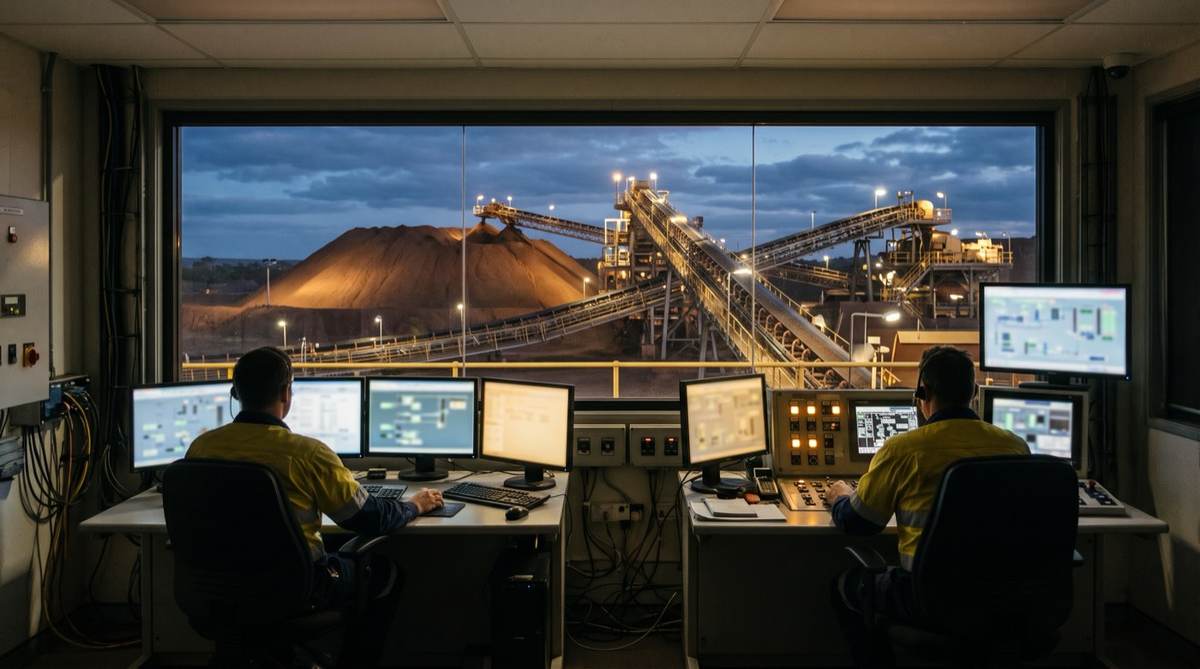
ISA-95 integration without an MES means using the ISA-95 (IEC 62264) reference model to define exactly which Level 3 operations functions your plant needs, then connecting SCADA, the historian and the ERP through a small set of defined data exchanges. You build only the exchanges the business feels most, one at a time, instead of buying a full MES platform.
Most Australian plants have a control system at the bottom and an ERP at the top, and almost nothing deliberate in between. The SCADA or DCS runs the process. SAP, Pronto, MYOB Advanced or Dynamics runs the business. The gap between them was meant to be filled by a Manufacturing Execution System, and on many sites that MES was never bought, never finished, or faded out after the person who understood it left.
Key takeaways
- ISA-95 is a reference model and vocabulary, not a product. Its value is helping you name the specific Level 3 functions and data exchanges you need.
- Level 3 (manufacturing operations management) is the layer most plants without an MES are missing.
- Map your site against the five levels first. The list of manual exchanges becomes both the brief and the business case.
- Build one exchange at a time, starting with the one causing the most pain, usually production reporting to the ERP.
- Analytics and AI only work once the Level 3 to Level 4 exchanges are clean.
How does the missing layer show up?
The gap rarely announces itself. It shows up as a production number finance types into a spreadsheet off a printout, a quality result in a lab database no other system can read, and a maintenance backlog nobody can line up against the asset register. Everyone assumes a system is doing this work. Usually a person is doing it, by hand, at month end.
This guide is for plant managers, operations leaders, and the finance and IT people who keep asking why the plant cannot produce a clean number without a three-day scramble. Across our consultants' careers on enterprise-to-plant data systems, including work in BHP, Rio Tinto and Senex Energy environments, the pattern is consistent: sites that struggle are rarely short of systems. They are short of the integration layer nobody put a purchase order against.
What is ISA-95?
ISA-95 is the ANSI/ISA-95 Enterprise-Control System Integration standard, published internationally as IEC 62264. It is a shared model of how a manufacturing or processing business is layered, from the physical process to the business systems, plus a common vocabulary for the information that moves between layers.
The model describes five levels:
| Level | What it covers | Typical systems |
|---|---|---|
| 0 | The physical process | Valves, motors, material |
| 1 | Sensing and actuation | Instruments, final control elements |
| 2 | Monitoring and control | SCADA, PLCs, DCS, historian |
| 3 | Manufacturing operations management | Scheduling, dispatching, quality, maintenance, performance (MES territory) |
| 4 | Business planning and logistics | ERP, planning and financial systems |
For a site with no MES, Level 3 is exactly the missing layer. ISA-95 does not tell you to buy an MES. It gives you a precise way to describe which Level 3 functions you need, so you build or integrate only those instead of buying a platform that does forty things when you need six.
- Level 0 to 2Process, instruments, SCADA and DCS running the plant
- Level 3Operations management: scheduling, quality, maintenance, performance
- Level 4ERP, planning and financial systems running the business
- The integrationDefined data exchanges between each level, not one monolith
The standard also describes the information that crosses the Level 3 to Level 4 boundary: production schedules going down, production performance coming back up, and definitions of products, resources and capability. This is the part people skip. They argue about which MES to buy before writing down what information needs to move, in what shape and how often. ISA-95 Part 3 provides the activity model to do that first, and the work is useful whatever you end up buying or building.
Why does the MES gap persist?
It accumulates. A site commissions a control system from one vendor and an ERP from another, years apart, chosen by different parts of the business. The control vendor assumes the business will buy their MES module. The ERP vendor assumes the plant will feed it clean data. Neither holds, and the integration becomes nobody's job.
Then the spreadsheets arrive. A production accountant builds a workbook that pulls numbers off the historian and reconciles them to the ERP. It becomes load-bearing. Eventually the most important operating figures run through a file on one person's laptop, and that person is a single point of failure under the number the board trusts.
| Full MES programme | Targeted ISA-95 integration | Impact | |
|---|---|---|---|
| Scope | Vendor platform covering all Level 3 functions | Only the Level 3 functions the business needs | Scoped |
| Timeline | Long programme with value arriving at go-live | Delivered in phases, each one usable | Phased |
| Dependency | Tied to one vendor's roadmap and licensing | Standards-based interfaces you can maintain | Portable |
| Risk | Large cutover | Incremental, each piece validated before the next | Lower |
This is not an argument against buying an MES. Large, complex sites with genuine needs across scheduling, genealogy, quality and maintenance may be right to buy one. The argument is against buying one by reflex, before using the model to work out which functions you actually need. Many sites that think they need a full MES need three or four of its functions and a clean set of interfaces.
How do you map your own site to the ISA-95 model?
The first real work is a mapping exercise, and it is cheaper and more useful than any software evaluation. Take each level and write down honestly what fills it today and what information crosses each boundary.
- Level 2: list every control system and historian, with tags, scan rates and the real owner.
- Level 4: list the ERP modules that touch production: inventory, costing, maintenance, planning.
- Level 3: write down what is actually there. On many sites it is spreadsheets, a lab system that talks to nothing, an ERP maintenance module nobody updates from the floor, and a scheduling whiteboard.
The gap becomes a list. Each item is a specific Level 3 function and data exchange done by hand or not at all. That list is the brief, and once you cost the manual effort and error exposure against it, it is the business case.
Which problem is costing you the most right now?
- Production numbers do not reconcile across systemsBuild the Level 3 to 4 production reporting interface first
- Quality results trapped in a lab systemIntegrate quality data, not a full MES
- Maintenance disconnected from plant conditionConnect historian condition data to the ERP asset register
- No visibility of schedule adherenceStart with scheduling and performance, defer the rest
The model forces you to name the specific exchange rather than the general ambition. "We need better visibility" is not a brief. "The historian sends a validated, reconciled daily production total to the ERP in this shape by 6am" is. You can build, test and prove that before spending on the next piece. Production numbers that disagree across SCADA, the historian and the ERP almost always trace back to a missing or poorly defined Level 3 to Level 4 exchange.
How do you build ISA-95 integration without a monolith?
Build in the order the business feels most, one exchange at a time. ISA-95 defines the shape of the common exchanges (and the B2MML schemas implement them in XML), so you are implementing a well-described data contract, not inventing one.
- Production reporting interface: takes historian time-series data, applies the same reconciliation logic every time, and delivers one defensible number to the ERP on a schedule.
- Quality interface: attaches lab results to the production record so a batch can be released or held without rekeying a certificate.
- Maintenance interface: takes condition data from the plant and raises or closes work orders in the ERP against the real asset.
Each is a small, testable piece of software with a defined input, output and owner. None requires replacing a working control system. Our guide to connecting modern tools to legacy systems without rip and replace covers the same principle.
- Weeks 1 to 3Map and scopeDocument each level, name every exchange, cost the manual effort
- Weeks 4 to 8First interfaceBuild the exchange the business feels most, usually production reporting
- Weeks 9 to 16Add functionsQuality, maintenance or scheduling, one validated piece at a time
- OngoingMaintain and extendStandards-based interfaces you or a partner can support
Every phase ships something that works. If the budget pauses after phase one, you still have a working production reporting interface. Industrial analytics projects tend to fail on scope and sequencing more than technology, and an exchange-by-exchange build answers that directly.
Where do AI and analytics fit?
Everyone wants the dashboard, the forecast and the anomaly alert. None of it works on a plant with no Level 3 layer, because the data reaching Level 4 is unreliable, late and inconsistent. A model built on that produces confident answers from bad numbers.
ISA-95 is, in effect, the data foundation analytics and AI need. Once the exchanges are clean, month-end production reporting becomes a query, and historian data can be reported in Power BI without building a second historian. Only then does it make sense to add analytics or an agent. We make the full argument in agentic AI needs a real data foundation.
- Month-end production reportingA query, not a scramble
- Single point of failure on a spreadsheetRemoved
- Data quality for analytics and AIDefined by design
- Dependency on one vendor's MES roadmapAvoided
For organisations consolidating several sites into a central control room, the same discipline underpins what a remote operations centre needs. You cannot run operations from a distance on data you do not trust.
Why should the board care about ISA-95 integration?
In many Australian manufacturing and processing businesses, the most important operating number (how much was made, and whether it reconciles to what was sold) depends on an undocumented spreadsheet maintained by one person. That is an operational, reporting and audit risk in plain sight.
Framing the integration as risk reduction changes who pays attention. A board that would not fund a vague MES project will often fund removing a single point of failure on production reporting once the exposure is named. Our guide to AI advisory for Australian boards sets out the same conversation for directors.
How Solve8 can help
Our consultants and engineers map your site against ISA-95, name the exchanges that matter, and build the integration layer in fixed-fee phases, telling you honestly whether you need a handful of interfaces or a genuine MES. See our system integration service and our work across mining, energy and manufacturing, or talk to us about the gap in your own plant.