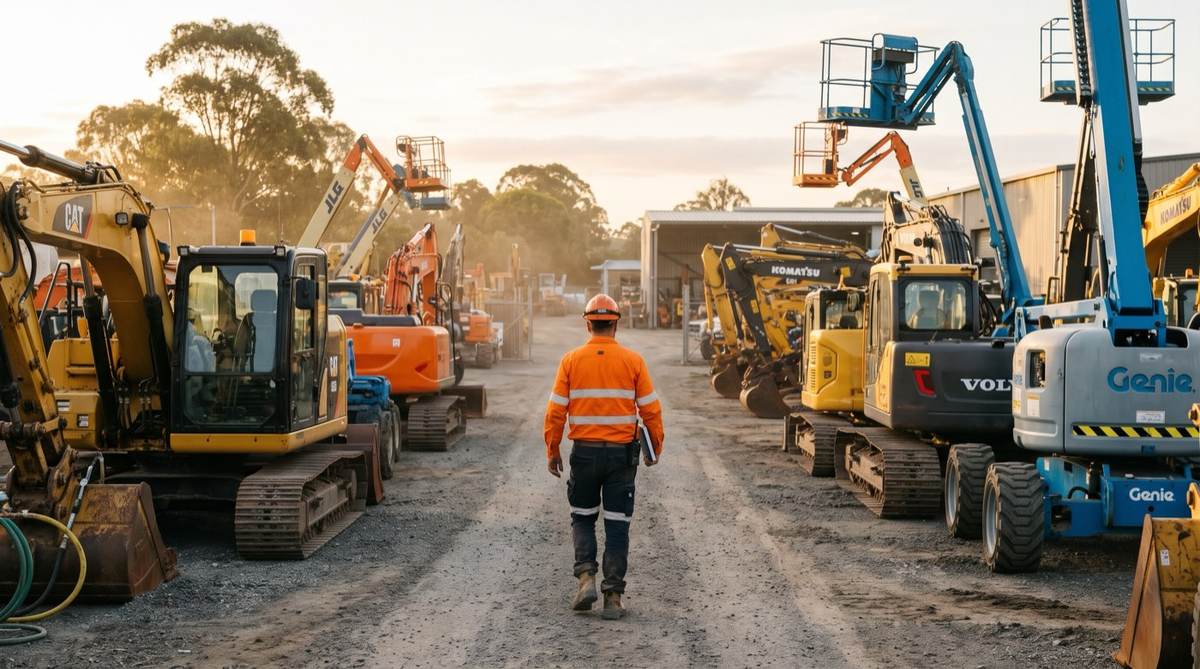
AI helps equipment hire companies in four practical ways: forecasting demand by branch and moving fleet to where it will earn, predicting breakdowns on high-value assets from telematics, handling availability checks and simple bookings around the clock, and recommending rates by season and demand. The common foundation is one connected view of every asset across branches.
Key takeaways
- Idle equipment in one yard while another branch turns customers away is a visibility problem first.
- Predictive maintenance pays on high-value, high-use assets such as excavators, generators and access equipment.
- AI can answer availability questions and take simple bookings after hours; complex quotes and disputes stay with staff.
- Clean asset, booking and maintenance data is the prerequisite. Audit it before buying tools.
Why does fleet utilisation matter so much in equipment hire?
Every idle asset is capital earning nothing. In a multi-branch hire business, the pattern is familiar: the business feels busy, yet mini excavators sit idle in one yard while another branch tells customers "we don't have any available".
The cause is usually visibility. What is available, where, and when it is due back lives in branch managers' heads and in disconnected systems. When that manager is away, decisions get worse ("if Sam leaves we're stuffed").
Demand is strong from infrastructure, renewable energy and construction work, and skilled staff are hard to find. Hire companies need more from the same fleet and team.
What are the four AI applications that work for hire companies?
1. Fleet utilisation and branch rebalancing
AI analyses booking history, seasonality, weather and local project activity to forecast demand by branch and category. Recommendations look like:
- "Move three scissor lifts from Dandenong to Geelong next week. A civil project starts Monday."
- "Compactor utilisation in this region has stayed low for a year. Consider disposal or transfer."
A fleet manager approves each move.
Public example: Telstra has published a case study on Kennards Hire's EasyTRAK platform, which brings vehicle, plant and sensor data across its branch network into one view for branch staff, call centres and customers. The lesson: unified asset visibility comes before optimisation.
- ConnectHire system, telematics, maintenance and finance data
- ForecastDemand by branch, category and week
- RecommendTransfers, disposals and purchases
- ApproveFleet manager decides
2. Predictive maintenance
A generator fails on a customer's site at 6am. You swap it out, lose the day's revenue and damage the relationship.
Telematics and sensors track vibration, temperature, pressure, fault codes and runtime hours. Models learn what healthy looks like and flag anomalies early, so service happens between hires. Accuracy improves as the system learns your specific equipment.
Focus sensor investment on the assets that earn most. For low-value, low-use items, scheduled servicing by hours or days is usually enough. See asset health AI for transport fleets for a related pattern.
3. Automated booking and customer service
A customer needs a telehandler for Monday and asks at 5:30pm on Friday. Your staff have gone home.
An AI assistant on your website or in your customer portal can:
- Answer specification questions: "What is the lifting capacity of your 3-tonne excavator?"
- Check availability: "Is a 12m boom lift free next Tuesday?"
- Take simple bookings for account customers, for staff to confirm.
- Route complex enquiries to the right branch for the morning.
Keep with staff: project consultations, non-standard pricing, damage disputes and insurance claims, and equipment advice for unusual applications.
4. Dynamic pricing and demand forecasting
Flat rates year-round leave money on the table at peak and lose bookings in quiet periods. AI can recommend rates from booking history, local events, weather and demand, and suggest longer-term discounts when forecasts show spare capacity.
The risk is customer trust. Aggressive automated price rises can feel exploitative to long-standing trade accounts. Keep pricing recommendations under human approval, with guardrails for account customers.
| Manual | AI-Assisted | Impact | |
|---|---|---|---|
| Availability | Phone around branches | One live view across branches | Faster answers |
| Fleet moves | Gut feel and favours | Forecast-based recommendations | Higher utilisation |
| Maintenance | Fixed intervals or breakdowns | Condition-based alerts | Fewer on-site failures |
| After-hours enquiries | Voicemail, lost to competitors | Answered, booked for confirmation | More bookings |
| Pricing | Static rate cards | Recommended by demand, approved by staff | Better yield |
What implementation challenges should hire companies expect?
Data quality
If equipment records are split across spreadsheets, an old hire system and a maintenance manager's notebook, AI insights will be unreliable. Minimum requirements:
- A unique identifier for every asset
- Digital booking records with at least 12 to 24 months of history
- Maintenance logs with date, type, cost and duration
- Customer records in a CRM or the hire system
Staff buy-in
A yard manager with 20 years of knowledge will resist being "optimised". Involve experienced staff in designing the recommendations, show them where the system is wrong, and let them improve it. Frame it as removing admin.
Integration
Most Australian hire companies run HirePOS, Hire HQ, Prism or similar, plus separate telematics, finance and CRM. Check that any AI tool can read from and write back to your core hire system before buying. That is usually system integration work.
Which software options exist for Australian hire companies?
- HirePOS: long-established Australian hire software across builder, landscape, scaffolding, party and access equipment.
- Hire HQ: Australian platform adding AI features, including document processing.
- International platforms: InTempo, Point of Rental and Quipli offer AI features but may need local implementation support.
- Telematics: OEM telematics and third-party IoT platforms feed condition and location data. Larger operators sometimes build custom platforms.
How should a hire company get started?
What hurts most today?
- Turning customers away while stock sits idle elsewhereStart with fleet visibility and rebalancing
- Breakdowns on customer sitesStart with predictive maintenance on top-earning assets
- Missed after-hours enquiriesStart with an availability and booking assistant
- Margins squeezed at peakStart with demand forecasting and pricing recommendations
- Months 1-3FoundationAudit data, identify the assets that earn most, choose one problem
- Months 4-6PilotStart with a subset of assets or one region, measure the baseline, track weekly
- Months 7-12ScaleExpand what works, drop what does not, connect systems
Foundation. Can you produce a report of every asset, its utilisation and maintenance history? Which equipment earns most of your revenue? Pick one problem.
Pilot. For predictive maintenance, instrument a subset of high-value assets. For rebalancing, start with one region. Measure utilisation, maintenance cost per asset and booking conversion before you start.
Scale. Expand what works, drop what does not, and connect the hire system, finance and AI tools so data flows once.
- Time utilisation by category and branchWeekly
- Missed rentals (turned away)Weekly
- On-site breakdownsPer month
- After-hours enquiries convertedPer month
- Revenue per assetThe number that pays
How Solve8 can help
We connect hire systems, telematics and finance into one asset view and build forecasting, maintenance and booking automation that runs on your infrastructure in Australia, with your team approving decisions. See our field service and equipment work and data, BI and analytics service, or talk to us.