The main AI business opportunities in the Australian wine industry sit in six places: vineyard monitoring and harvest prediction, fermentation monitoring, barrel and tank tracking, cellar door and direct-to-consumer sales, wine club automation, and WET and excise reporting. For wine groups and craft brewers, the fastest returns usually come from connecting sales, inventory and compliance data.
Key takeaways
- AI in Australian viticulture now covers remote ripeness monitoring, frost and heat prediction, and irrigation timing, with value growing with vineyard scale.
- Fermentation sensors and alerts replace manual walk-throughs and paper logs, catching problems earlier.
- Barrel and tank tracking with QR or RFID tags gives full history for every vessel and cleaner compliance records.
- Direct-to-consumer channels (cellar door, wine club, online) benefit most from connected POS, CRM and inventory.
- WET reporting on the BAS (labels 1C and 1D) is a natural candidate for automated, auditable calculation.
Why is AI a business opportunity for Australian wine and beer producers?
Wine and craft beer producers juggle vintage or brewing schedules, cellar door operations, club shipments, WET or excise, export documentation and tight labour markets. Jobs and Skills Australia's occupation shortage analysis has reported continuing difficulty filling many agricultural and production roles. Much of the work is still on whiteboards and spreadsheets.
For a wine group with several brands, vineyards and cellar doors, or a brewer with multiple venues, the opportunity is less about robots and more about connecting data that already exists in separate systems.
- VineyardWeather and harvest prediction
- ProductionFermentation monitoring
- CellarBarrel and tank tracking
- Cellar doorPOS and bookings
- Wine clubMember automation
- ComplianceWET and excise
What are the AI opportunities in Australian viticulture?
Vineyard monitoring and harvest prediction
Platforms such as Deep Planet's VineSignal use satellite imagery, weather data and soil moisture to estimate grape maturity remotely, reducing the need to walk blocks collecting berry samples. Machine learning models combine historical weather with live sensor data to predict frost events, heat spikes and irrigation windows.
Wine grapes are highly weather-sensitive, so better prediction supports harvest logistics, labour planning and fruit quality. Australian events such as WineTech in Adelaide have showcased vineyard robotics and analytics.
These platforms pay back best at scale. Operations managing many blocks or multiple vineyard sites gain the most. Models trained on overseas data need calibration for Australian conditions.
How can AI help wine and beer production?
Fermentation monitoring and quality control
Sensors monitor temperature, sugar levels and activity continuously. Comparing current ferments with past vintages or batches, software alerts winemakers and brewers when a ferment drifts from its expected curve. In brewing, wireless CO2 monitoring has also simplified safety monitoring in fermentation areas.
| Manual process | AI-assisted | Impact | |
|---|---|---|---|
| Fermentation checks | Several walk-throughs a day | Continuous readings with alerts | Around the clock |
| Temperature logging | Paper records | Automated digital logs | Audit-ready |
| Batch consistency | Winemaker judgement only | Data plus expertise | Less variation |
| Early problem detection | Hours to days | Minutes | Fewer losses |
AI supports winemaking decisions. Palate, style and blending stay with the winemaker.
Barrel and tank tracking
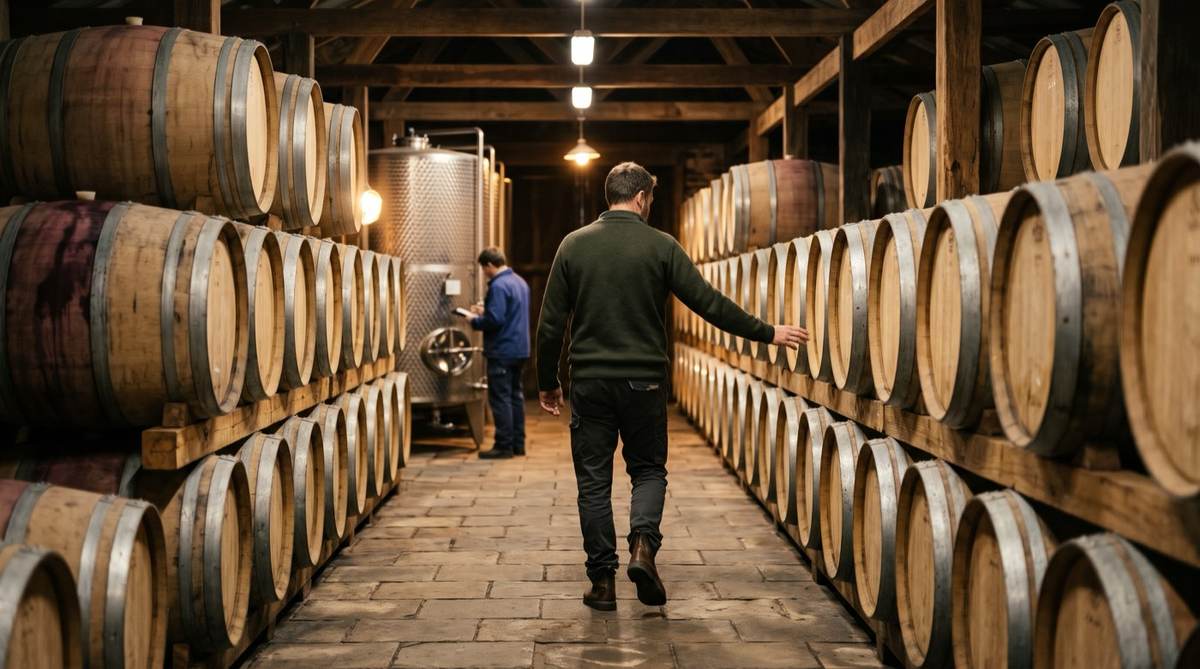
Wineries with hundreds or thousands of barrels lose cellar hand time to chalk marks and spreadsheets. QR or RFID tags on each barrel, scanned at each fill or empty, give full history: vintage, variety, cooperage, toast, and every wine it has held. Production platforms such as InnoVint and others support this. Larger operations use RFID for faster location queries and bottle-level traceability.
Tag the cellar in the off-season when barrels are accessible.
How can AI improve cellar door and direct-to-consumer sales?
Cellar door booking and POS
Direct-to-consumer sales typically carry the best margins. Australian platforms such as WithWine, vinCreative, Impos and OrderMate offer cellar door POS, bookings, club pricing and CRM. When a tasting is booked online, a connected system updates availability, sends confirmation and loads the visitor profile at check-in.
What is your primary requirement?
- Wine club and POS integrationA DTC platform with club, POS and CRM in one
- Restaurant or events focusA hospitality POS with winery features
- Multiple brands, cellar doors or warehousesAn enterprise DTC platform with multi-warehouse stock
- Shopify-based ecommerceShopify wine club apps connected to payments and email
Wine club automation
Wine clubs are the highest-value customer relationships for many wineries. Automation handles:
- Shipment scheduling by member preference
- Failed payment retries before cancellation
- Re-engagement for lapsed members
- Birthday and anniversary offers
- Stock reservation for club allocations
AI adds churn prediction (which members are likely to cancel), personalised selections from purchase history, and draft communications for the marketing team to approve.
Customer relationship management
A single customer profile across cellar door, online and events supports segmentation by variety preference, purchase frequency and spend, and automated sequences triggered by behaviour. Under the Privacy Act and the Spam Act, members must consent to marketing and be able to unsubscribe.
How can automation help with WET and excise compliance?
The Wine Equalisation Tax is 29 percent of the wholesale value of wine, reported on the BAS. According to the ATO:
- WET payable is reported at label 1C and WET refundable at label 1D, separately, without netting off
- WET can apply to cellar door sales and tastings where there has been no wholesale sale
- Producer rebate eligibility must be tracked
- Errors are corrected on later activity statements, within time limits
Winery management software can calculate WET on each transaction, track rebate eligibility, keep audit-ready records and produce BAS-ready figures for the finance team to review. Breweries face excise based on alcohol content and volume. The same principle applies: calculate from production and sales records, with a person reviewing before lodgement.
What is a realistic implementation roadmap?
Timing matters. Do not disrupt vintage or peak cellar door season.
- Off-seasonAudit and planMap processes, measure time spent, choose priorities
- Pre-vintageCore systemsPOS, inventory and wine club automation
- Post-vintageProduction toolsFermentation monitoring and barrel tracking
- Year 2Advanced analyticsYield prediction, demand forecasting, churn models
Phase 1: audit. Track two weeks of time across club processing, bookings, inventory reconciliation, WET calculations, marketing and barrel tracking.
Phase 2: core systems. Implement POS and booking integration in your quietest months, which for many Australian regions is winter. Move club members to automated billing before the next allocation, testing with a small group first. Connect POS to inventory so sales update stock.
Phase 3: production tools. Install and calibrate fermentation sensors after vintage. Tag barrels while they are accessible.
Phase 4: analytics. Yield prediction and demand forecasting need clean historical data, so they come after a year or two of good capture. See inventory automation and AI demand forecasting.
What should wine groups measure?
- Admin hours on club processing and bookingsMeasure before and after
- Inventory accuracy across cellar doors and warehousesFewer stock errors
- Fermentation issues caught earlyFewer batch losses
- WET and excise figures ready for reviewLess month-end effort
Capture a baseline first, then compare after each phase.
What does not work yet?
- Too many point solutions. Smaller producers do better with one integrated platform than several best-of-breed tools.
- Autonomous winemaking. AI surfaces data and recommendations. The craft stays human.
- Untuned harvest models. Models built on Californian or European data need Australian calibration.
- Legacy systems. Older winery software may lack APIs, so plan integration or migration.
- AI sommeliers. Consumer recommendation apps are marketing tools. They do not replace trained cellar door staff.
How Solve8 can help
We connect DTC, production, inventory and finance systems for multi-brand wine groups and brewers, so sales, stock and WET figures come from one source. See our manufacturing and production data work and system integration, or talk to us. Related reading: manufacturing AI use cases in Australia and AI on the Australian farm.