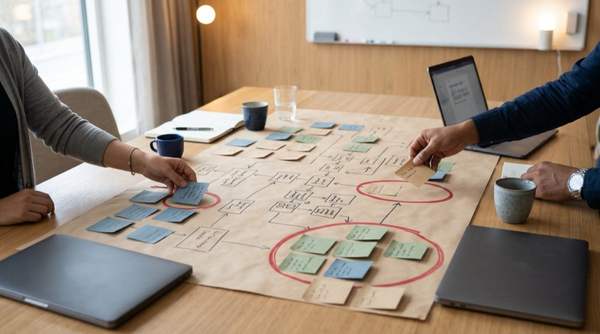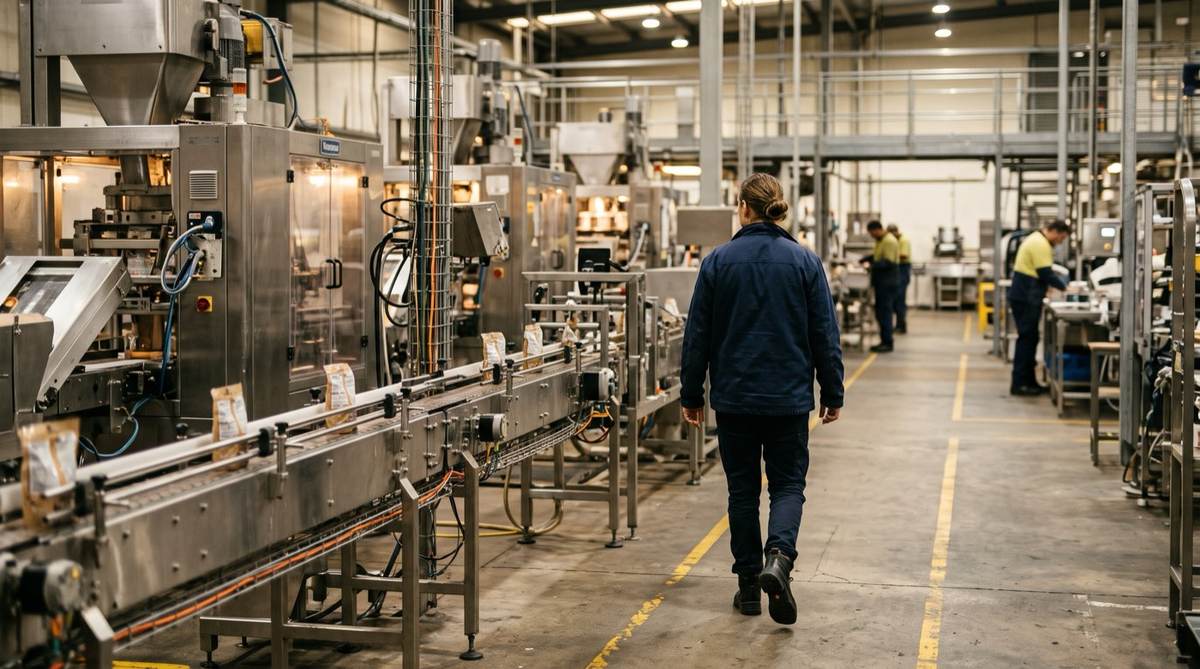
AI consulting for Australian manufacturers works when the consultant starts with your costliest, most repeatable production problem, audits your data before building anything, and commits to moving a production metric such as scrap, uptime or delivery in full on time. This guide shows operations leaders and general managers how to choose a partner that fits the factory floor.
Key takeaways
- Start with a costly, measurable problem. Quality, uptime, demand forecasting and production admin are the four most common first wins.
- A consulting partner fits AI to your process and integrates it with ERP and MES. A product reseller starts from its feature list.
- Data readiness is the first phase of the work. Skipping it is the most common reason manufacturing AI stalls.
- Run one well-scoped pilot measured against your own records before funding the next.
Why are Australian manufacturers looking for AI consulting now?
For most mid-sized and enterprise Australian manufacturers, the question has moved from "should we" to "where do we start, and who helps". Boards are asking directly. The Productivity Commission's 2025 interim report on harnessing data and digital technology estimated AI could add more than $116 billion to Australian economic activity over the coming decade.
The gap between that headline and value on your floor is wide. Manufacturing has integrations, safety obligations, thin margins and a workforce that has heard big technology promises before. That is why the choice of partner matters more here than in a light-touch office setting.
Why generic AI advice fails on the factory floor Most AI guidance assumes knowledge work: emails, documents, spreadsheets. Manufacturing runs on machines, materials, shifts and physical constraints. A consultant who cannot connect an AI idea to a downtime event, a scrap rate or a DIFOT number is selling theory.
Where does AI pay off in Australian manufacturing?
Start with a costly, repeatable problem and ask whether AI is the right tool. Four areas consistently reward that discipline.
- QualityVisual inspection catches defects earlier
- UptimeAsset data flags failures before breakdown
- DemandForecasts sharpen stock and production
- AdminQuotes, orders and reporting automated
Quality control. Camera-based inspection backed by machine learning flags surface defects, misalignment or contamination more consistently than a tired eye late in a shift. Our guide to AI visual inspection for quality control covers where it fits and where a person still makes the call.
Asset health and predictive maintenance. Most plants already generate more sensor and maintenance data than anyone reads. An early warning that a motor or pump is trending toward failure turns an unplanned outage into a scheduled one. See asset health AI in Australian manufacturing.
Demand forecasting. For distributors and make-to-stock manufacturers this is often the highest-value use. Better forecasts tie up less capital in the wrong stock. See AI demand forecasting for manufacturers and distributors.
Production admin. Quoting, order entry, supplier chasing, compliance paperwork and reporting all consume skilled time. This is the least glamorous area and often the quickest to deliver. Our overview of manufacturing AI use cases in Australia covers the full spread.
What separates an AI consultant from a product vendor?
Manufacturers are used to buying equipment, so it is natural to treat AI the same way. AI in an operational setting is closer to commissioning a machine: fitted to your process, tuned to your data and maintained as conditions change.
| Product reseller | Consulting partner | Impact | |
|---|---|---|---|
| Starting point | Their product's features | Your costliest process | Fit |
| Data handling | Assumes it is ready | Audits it first | Realistic |
| Integration | Out of scope | Into ERP and MES | Usable |
| Success measure | Software installed | A production metric moved | Accountable |
| After go-live | Support ticket queue | Ongoing tuning | Durable |
A capable partner asks about your ERP, your MES if you run one, and how data is captured today. For many plants the honest answer is "inconsistently", and that shapes what is achievable in year one.
The most reliable filter is how they talk about measurement. "The model is deployed" is a vendor's answer. "Scrap on line three drops by an agreed target, verified against your own records" is a partner's answer. If a consultant will not commit to a business metric, that tells you plenty.
Why does data readiness come first?
Most stalled manufacturing AI projects share one cause: the data was not ready. Models learn from history. If yours is scattered across spreadsheets, handwritten logs, an ageing ERP and the memory of a leading hand about to retire, no algorithm will rescue it.
A good engagement maps where operational data lives, how trustworthy it is, and what needs tidying or instrumenting first. Sometimes the most useful early output is a clear picture of your data foundation and a short list of sensors, integrations or process changes. Manufacturers who skip this tend to fund a proof of concept that works in a demo and fails in production.
Build governance in from the start, so who can access what data and how a model's outputs are checked is settled before anything reaches the floor.
Why is data sovereignty an operations issue for manufacturers?
Design files, production methods, supplier terms and customer specifications are among the most commercially sensitive things a manufacturer owns. Feeding them into an AI service without knowing where they land, who can see them and which laws apply is a risk to understand before deployment.
Manufacturers in defence, critical infrastructure and government supply chains feel this most, which is why advanced manufacturing clusters such as Adelaide's defence and industrial base treat onshore data handling as a baseline. Ask any partner to explain exactly where data is processed and which sub-processors touch it.
The Department of Industry, Science and Resources published its Guidance for AI Adoption in October 2025, setting out six essential practices and building on the earlier Voluntary AI Safety Standard. Larger customers increasingly expect suppliers to work within it. Our AI governance framework guide sets out what a defensible written position looks like.
What does a sensible first AI engagement look like?
Successful manufacturers start with a contained, measurable project and expand from proof.
- Weeks 1-2DiscoveryMap processes, costs and where data actually lives
- Weeks 3-4Data readinessAudit quality, fix gaps, agree the success metric
- Weeks 5-8PilotBuild on one line or process, measure against records
- Weeks 9-12Prove and planVerify the result, then scope the next use case
Timing varies by plant and problem, but the shape holds. Discovery grounds the work in real cost. Data readiness prevents the most common failure. A contained pilot proves the idea against your numbers. A deliberate review decides whether to scale, adjust or stop. Our walkthrough of an AI strategy consulting engagement expands on each phase.
Resist running five pilots at once. Spreading a stretched operations team across parallel experiments usually ends the year with five half-built systems and no clear win.
What can a first year realistically return?
Returns depend on the process chosen, the state of the data and the discipline of the rollout. The framing below is illustrative, for a manufacturer carrying recurring rework and unplanned downtime costs.
- Reduced rework from earlier defect detectionLower scrap cost
- Fewer unplanned outages via predictive maintenanceRecovered uptime
- Admin hours returned to skilled staffReclaimed capacity
- Better forecasts reducing excess inventoryFreed working capital
Avoid a headline percentage lifted from a vendor case study in another country. A serious partner builds a bottom-up estimate from your own costs during discovery, so the business case rests on your numbers. Our ROI calculator is a useful starting point.
How should AI projects handle the workforce?
Australian manufacturing already contends with skills shortages and an experienced, ageing workforce. A project that lands as a threat to jobs will be quietly resisted until it fails.
The strongest early use cases remove tasks nobody wants: repetitive final inspection, the after-hours callout to a machine that failed without warning, manual data entry that keeps a supervisor off the floor. A leading hand who has watched a line for years usually knows which recurring problem is worth solving first.
A good partner involves operators in discovery, designs human oversight deliberately so a person stays accountable for decisions that matter, and plans the training and handover that lets your team run the system after the consultants leave. The Productivity Commission's 2025 work similarly favoured adapting existing regulation and keeping people accountable for consequential decisions.
How do you choose the right AI consulting partner?
Use this quick filter when you meet a prospective partner.
What does the partner lead with?
- Your costliest process and a business metricStrong signal, keep talking
- Their product's feature listReseller, proceed with caution
- Data readiness before any modelRealistic, worth trusting
- A fixed answer before discoveryWalk carefully
The best partners will tell you when AI is the wrong answer. If a process is low-volume, poorly understood or better fixed by a simpler change, an honest consultant says so. For a national view on evaluating providers, see our AI consulting buyer's guide for Australia and how to choose an AI consultancy.
How Solve8 can help
Our consultants have spent their careers in operations systems, including engagements at BHP, Rio Tinto and Schneider Electric, and we run AI on your infrastructure in Australia with a person approving outputs until accuracy is proven. See our manufacturing and OT work and AI strategy service, or talk to us about your first use case.