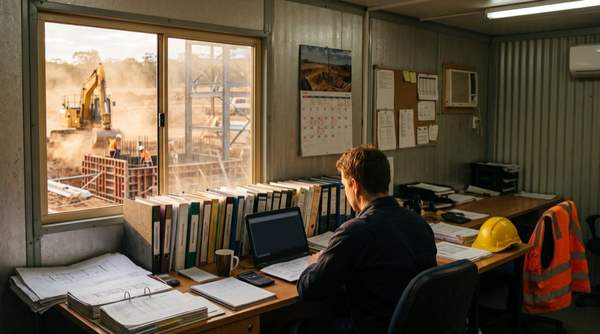
AI for strata managers automates the rule-bound administration that fills a strata manager's week: generating levy notices, matching payments to lots, running staged arrears reminders, triaging maintenance requests, drafting AGM papers and minutes, and answering routine owner questions from scheme records. The manager stays in control of disputes, debt recovery decisions and anything that needs judgement.
Key takeaways
- Levy collection is the best starting point: notice generation, payment matching and arrears workflows are repetitive and rule-based.
- Arrears steps, penalty interest and discounts are set by each state's strata legislation and the scheme's resolutions, so configure rules per state.
- Maintenance triage, contractor credential tracking and owner status updates cut interruptions and phone tag.
- AGM preparation, proxies, voting and minutes can be largely templated, with the manager checking every document.
- Clean owner, lot entitlement and contractor data first, run automation in parallel, then scale across the portfolio.
Why do strata management firms need automation?
Picture a strata management firm with a few hundred schemes and thousands of lots across several offices. The phones start early with maintenance enquiries. Owners email for levy statements. Several AGMs need minutes finalised. And somewhere in the queue, a burst pipe needs emergency contractor coordination.
MRI Software's Voice of the Strata Manager research has found that most strata managers work beyond a standard week and name workload management as their biggest challenge, with a large share of time going to administration, financial tasks and owner communication.
The scale of Australian strata UNSW's Australasian Strata Insights 2024 counts roughly 370,000 strata schemes and around 3.2 million lots in Australia, with more than four million people living in strata.
The work is high-volume, deadline-driven and governed by state legislation, which makes it well suited to automation with a manager approving the outputs.
What can strata managers automate?
- Levy CollectionAutomated billing and arrears
- MaintenanceRequest tracking and dispatch
- AGM & MeetingsMinutes and voting automation
- InsuranceClaims coordination
- ContractorsCommon area management
How does levy collection automation work?
Levy collection is the financial backbone of every body corporate or owners corporation. When owners fall behind, maintenance gets deferred, budgets strain and managers spend hours chasing payments.
What are the manual pain points?
Manual levy collection means generating notices, matching payments to lots across trust accounts, identifying arrears, sending reminders and escalating to debt recovery. For a large portfolio, that cycle repeats every quarter across hundreds of schemes, with each state's rules on timing, interest and recovery steps.
What does automation change?
Notice generation: levy notices are bulk-generated with amounts calculated from lot entitlements, special levies and credits.
Payment matching: integration with trust accounts matches payments to lots, including partial payments and wrong references, with unmatched items flagged for a person.
Staged arrears workflows: reminder sequences trigger automatically based on rules you configure for each state and scheme. Decisions to start debt recovery stay with the manager and committee.
Early warning: payment history patterns can flag owners likely to fall behind, so the manager can reach out early.
| Manual Process | AI-Automated | Impact | |
|---|---|---|---|
| Notice generation | Hours per quarter per batch | Generated and checked in one pass | Large time saving |
| Payment reconciliation | Days of matching | Continuous, exceptions flagged | Near real time |
| Arrears follow-up | Depends on who has time | Consistent, rule-based | Compliance |
| Debt recovery initiation | Often delayed | Flagged at threshold for approval | Cash flow |
What about compliance?
Penalty interest on overdue levies, early-payment discounts and recovery steps are set by state legislation and scheme resolutions, and they differ between states. Automation applies the configured rules consistently and keeps a record that supports any later legal action. Have the rules checked against current legislation in each state you operate in.
How can AI help with strata maintenance and contractor dispatch?
A blocked drain in one lot can damage units below. A faulty fire panel affects building-wide compliance. Every delay risks escalation.
- Request ReceivedOwner logs issue via portal or email
- AI TriageCategorise and prioritise
- DispatchAssign qualified contractor
- CompleteClose and document
Triage: AI categorises requests by urgency, type and location. A leak affecting several units escalates immediately; a squeaky door joins the standard queue.
Contractor matching: the system keeps preferred contractors with specialties, availability, insurance status and rates, and proposes the right one for the manager to confirm.
Status updates: owners receive automatic updates as requests progress, which reduces "where is my repair?" calls.
Building systems: for larger schemes, data from building management systems (HVAC, lifts, fire systems, common-area energy) can support predictive maintenance. Our guide to facilities management predictive maintenance covers this.
How does AGM and meeting automation work?
AGMs are mandatory, rule-bound events: notice, agenda, motions, proxies, attendance, voting, minutes and actions. Notice periods and required agenda items differ by state.
Platforms such as MRI Strata Master and specialist voting tools automate much of this:
- Template agendas with state-compliant motion templates and mandatory items (financial statements, insurance, committee elections) included automatically.
- Digital proxies validated against ownership records.
- Electronic voting with live tallies for in-person and remote attendees.
- Draft minutes compiled from the agenda, motions and results, checked by the manager before distribution.
- Agenda and notice preparationTemplated
- Proxy collection and validationOnline, checked against records
- Vote countingAutomatic
- MinutesDrafted for review
- DistributionDigital, same day
Strata legislation changes regularly in every state. Whatever platform you use, someone must own keeping templates and rules current.
How can AI help with strata insurance claims?
Strata insurance claims often involve several parties: a leak from one lot affecting three below means owners, the body corporate, the insurer and contractors.
Documentation: AI can compile maintenance records, photos, contractor reports and owner correspondence into a claim package.
Progress tracking: automatic updates keep everyone informed without follow-up calls.
Audit trail: a complete record supports internal complaints, external dispute resolution through AFCA where relevant, or legal proceedings.
Decisions about cause and who bears the excess depend on the facts, by-laws and legislation. AI can assemble the evidence; the manager and insurer decide.
- Day 1Incident ReportedDocument damage, minimise further loss
- Days 2-3Claim LodgedSubmit documentation to insurer
- Week 1-2AssessmentInsurer reviews, assessor visits if needed
- Week 2-4ResolutionRepairs completed, claim settled
How do you automate contractor management for common areas?
Common property needs dozens of contractors: cleaners, gardeners, lift technicians, fire safety inspectors, pool maintenance, security and emergency trades.
What type of work is required?
- Emergency (water, fire, security)Dispatch preferred emergency contractor, notify manager
- Scheduled maintenanceRoute to contractor with next availability
- Capital works (over threshold)Trigger quote collection workflow
- Specialist tradeMatch to certified contractor list
- Credential monitoring: track insurance expiry, licences and certifications, with alerts before they lapse.
- Performance history: response times, quality and pricing inform selection.
- Scheduling: book routine maintenance directly without phone tag.
- Invoice matching: match contractor invoices to work orders and flag discrepancies before payment. Our invoice processing guide covers the approach.
How can strata managers handle owner enquiries with AI?
Routine owner questions interrupt complex work all day:
- "When is my levy due?"
- "What is the status of my maintenance request?"
- "Can I get a copy of my levy notice?"
- "Who do I contact about this building issue?"
- "When is the next AGM?"
These have definite answers in existing systems. An AI assistant connected to your strata platform can answer them through the owner portal, email or web chat, at any hour, using each owner's real data. Sensitive or complex matters go to the manager with full context. Our guide to building a client-facing GPT explains how assistants like this work safely.
How long does strata automation take to implement?
- Weeks 1-2Audit & PlanningMap current processes, identify quick wins
- Weeks 3-4Data PreparationClean owner, lot and contractor records
- Weeks 5-8System ConfigurationConfigure workflows, test integrations
- Weeks 9-12Training & Go-LiveStaff training, parallel running, full launch
- Process audit: document levy, maintenance and meeting workflows and measure where time and errors concentrate.
- Data preparation: clean owner contacts, lot entitlements, contractor records and historical documents. Poor data is the main cause of delays.
- Configuration: set rules for each state you operate in, notification templates and trust accounting integration.
- Training and launch: train staff, run in parallel until results match, and tell owners and contractors what is changing.
How do you choose strata software and AI tools?
What's your primary requirement?
- Large, full-service portfolioEnterprise strata platform with built-in AI (e.g. MRI Strata Master)
- Cloud-native, modern interfaceCloud strata platforms such as SMATA or Intellistrata
- Meeting-specific automationSpecialist voting and meeting tools
- Custom workflows across several systemsAI layer integrated with your existing platform
Evaluate:
- Trust accounting built for Australian strata trust requirements, with audit trails.
- Legislative coverage for each state you operate in, kept up to date.
- Real AI capability, as distinct from basic rules automation.
- Integration with accounting, building systems and communication tools, and where data is stored.
What results should strata firms expect?
Measure against a baseline: admin hours per scheme, on-time levy collection, owner enquiry response time, AGM preparation time and lots managed per staff member. Most gains come from fewer interruptions, consistent arrears follow-up and faster meeting turnaround. Firms that automate can grow their portfolio without adding headcount at the same rate.
How Solve8 can help
Our team helps strata management firms map levy, maintenance and meeting workflows, then builds AI that works with your existing strata platform and trust accounting, on your infrastructure in Australia, with managers approving every notice and decision. See our process automation services or talk to us.
Related reading: AI for property management, AI vendor onboarding.
Sources: MRI Software, Voice of the Strata Manager research; UNSW City Futures Research Centre, Australasian Strata Insights 2024.