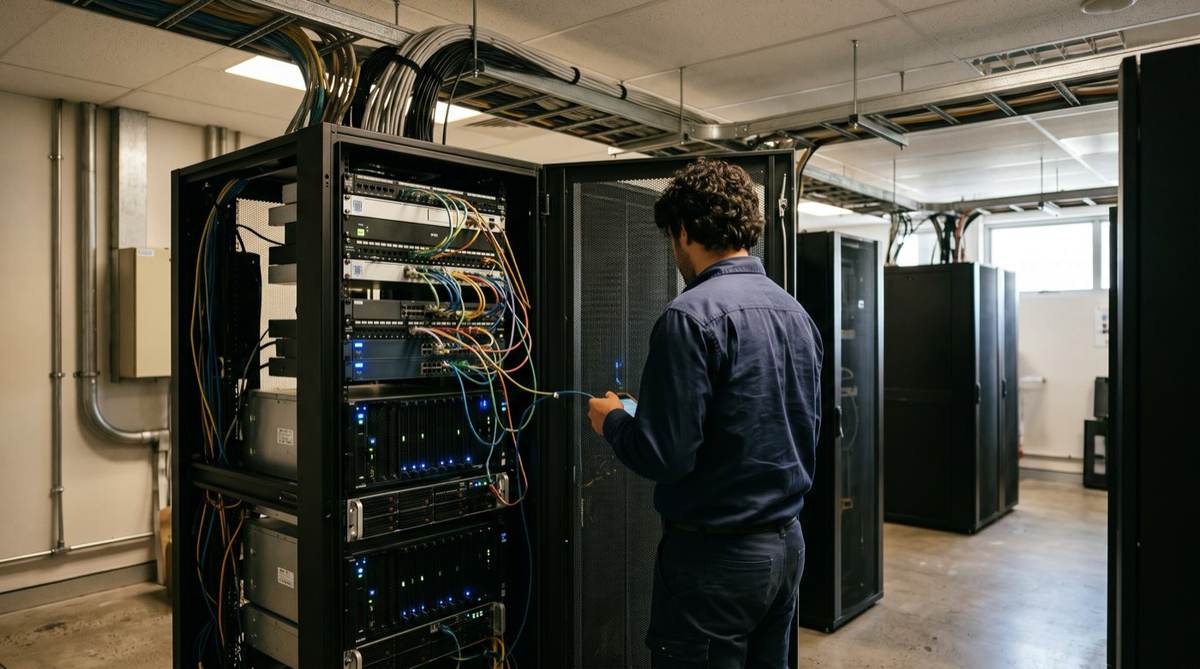
Ollama vs Claude is really a choice between running open-weight models yourself and calling a hosted frontier model. Claude (Anthropic) and OpenAI's GPT models lead on complex reasoning, long documents and coding. Ollama runs open models such as Llama, Mistral, Qwen and Gemma on your own hardware, so data never leaves your environment. Most organisations use both, routed by task.
Key takeaways
- Hosted frontier models (Claude, GPT, Gemini) are generally stronger on hard reasoning, long documents and coding than open models you can run locally.
- Ollama keeps data on your machines and has no per-token fees, but you pay for hardware and run it yourself.
- Ollama's cloud option runs larger open models on Ollama's servers, which removes the "data stays with you" benefit.
- For Australian data residency, check exactly where a hosted model processes data, including any cross-region processing.
- Model routing, sending simple tasks to cheap or local models and hard tasks to frontier models, usually gives the best cost and quality balance.
Why do Australian organisations need a model strategy?
New models launch every few months, each claiming to be the best. Picking the wrong one for a workload means:
- overpaying: a frontier model doing simple classification a small local model could handle
- underperforming: a small model struggling with complex reasoning
- data exposure: sensitive data sent to a provider or region that does not meet your obligations
You do not need one model for everything. You need a model strategy: which model handles which task, where it runs, and how you switch when something better arrives.
How do Ollama, Claude and OpenAI compare?
| Factor | OpenAI (GPT models) | Anthropic (Claude models) | Ollama (open-weight models) |
|---|---|---|---|
| Best for | General tasks, voice, vision, broad tool ecosystem | Long documents, coding, careful writing, complex instructions | Private processing, offline use, high-volume simple tasks |
| Context window | Large | Large | Depends on model and hardware |
| Where it runs | OpenAI, or Microsoft Azure (including Australian regions) | Anthropic, or cloud platforms such as AWS Bedrock and Google Cloud | Your laptop, servers or cloud VMs (or Ollama's cloud) |
| Privacy | Strong on business and enterprise terms; avoid consumer accounts for business data | Strong on business and enterprise terms | Data stays on your hardware when run locally |
| Cost model | Per token | Per token | Hardware and running costs, no per-token fee locally |
| Compliance | Provider certifications plus your configuration | Provider certifications plus your configuration | Entirely your responsibility |
Is Ollama as good as Claude?
For hard tasks, generally no. The strongest Claude and GPT models outperform open models small enough to run on typical business hardware on complex reasoning, multi-step instructions, long-document analysis and difficult coding.
For many everyday tasks, open models are good enough: classification, extraction from consistent documents, summarising short texts, redacting personal information, routing requests and drafting simple replies. Larger open models narrow the gap further but need serious GPU memory.
The practical answer is to test on your own data. Take 50 to 100 real examples of the task, run them through a local model and a frontier model, and compare accuracy, speed and cost.
Ollama cloud vs Claude: what is the difference?
Ollama started as software for running models locally. It now also offers cloud access to larger open models running on Ollama's infrastructure. That makes big open models easy to try without buying GPUs, but your prompts are processed on someone else's servers, just as with Claude or OpenAI. If the reason you chose Ollama was keeping data in your environment, use it locally or on servers you control in Australia.
Compared with Claude, Ollama's cloud gives you open models instead of a proprietary frontier model. Choose it for open-model flexibility, and Claude for frontier capability.
When should you use OpenAI GPT models?
Use for: general-purpose assistants, voice and image understanding, workflows built on OpenAI's tool and agent ecosystem.
Strengths: a mature developer platform with tools for retrieval, function calling and agents; strong multimodal features; extensive documentation and community support.
Australian data residency: do not put business data into consumer ChatGPT accounts. Use business or enterprise offerings, or Azure OpenAI in an Australian region, and confirm the data processing location settings and that data is not used for training.
Typical uses: internal knowledge assistants, email drafting, meeting summaries, customer-facing chat with human handoff.
When should you use Anthropic Claude models?
Use for: long documents, contracts, coding, technical writing and complex multi-step instructions.
Strengths: large context windows for whole contracts or reports, natural writing, strong instruction following and coding ability.
Australian data residency: Claude is available directly from Anthropic and through cloud platforms such as AWS Bedrock and Google Cloud. Check which models are available in Australian regions and whether any cross-region processing sends data offshore.
Typical uses: contract review and clause extraction, technical documentation, code review, long report summaries, tender responses.
When should you use Ollama and open-weight models?
Use for: highly sensitive data, offline or isolated environments, high-volume simple tasks and cost-sensitive workloads.
What is Ollama?
Ollama is open-source software that runs AI models on your own hardware: a laptop, server or cloud VM. Run locally, no data leaves your environment.
Strengths:
- data stays with you: models run entirely on your infrastructure
- no per-token fees: pay for hardware or compute instead
- customisable: fine-tune open models on your data
- works offline: no internet connection needed once models are downloaded
- no external rate limits: throughput is limited only by your hardware
What hardware does Ollama need?
| Model size | Approximate memory | Typical hardware | Use case |
|---|---|---|---|
| 3-8B parameters | 8-16GB | Modern laptop or small GPU | Simple tasks, testing |
| 12-32B parameters | 16-48GB | Workstation GPU | General production tasks |
| 70B+ parameters | 64GB+ GPU memory | Data-centre GPUs | Complex reasoning on open models |
Quantised models need less memory at some cost in quality. For more detail, see our guides to running Ollama locally and offline AI for corporate use.
When is self-hosting cheaper?
Hosted APIs are cheapest at low volume because you pay only for what you use. Self-hosting becomes attractive at sustained high volume, when the same GPU capacity would otherwise sit idle, or when data rules make hosted models impractical. Compare a year of API spend at your expected volume against hardware or reserved compute, plus the engineering time to run it.
| Hosted API | Self-hosted open model | Impact | |
|---|---|---|---|
| Low or spiky volume | Usually cheaper | Hardware sits idle | Hosted |
| Sustained high volume of simple tasks | Token costs add up | Fixed cost spread over volume | Self-hosted |
| Complex reasoning | Frontier quality | May need large models and GPUs | Usually hosted |
| Data that cannot leave your environment | Not an option | Required | Self-hosted |
Typical uses: health record processing, government and defence work, redacting personal information before anything goes to a cloud model, high-volume document classification, privileged legal documents.
What is model routing?
Well-designed AI systems use several models, each for what it does best.
- RequestUser or system sends a task
- RouterSmall model classifies the task
- Local modelSimple tasks stay on your servers
- Frontier modelComplex tasks go to Claude or GPT
- ResponseChecked, logged and returned
For example: "What time does the office open?" is classified as a simple FAQ and answered by a small local model. "Review this 50-page lease and identify risky clauses" goes to a frontier model with a long context window.
- Share of requests handled by small or local modelsOften the majority
- Spend on frontier model tokensReduced
- Sensitive data sent offshoreMinimised
- Quality on hard tasksMaintained
Which model should you use for which task?
What does your AI workload require?
- Strictly confidential data (health, defence, legal privilege)Open model via Ollama on your own infrastructure
- Long documents, coding, complex writingClaude (or another frontier model)
- Native voice or real-time visionOpenAI GPT models
- General tasks, cost-sensitiveSmaller hosted models or a local open model
- Data sensitivity: can this data leave your environment? If not, use a self-hosted open model.
- Task complexity: does it involve long documents, code or complex reasoning? If so, use a frontier model in an approved region.
- Capability: need voice or vision? Choose the provider strongest there.
- Otherwise: use the cheapest model that passes your accuracy tests.
What should you check for Australian compliance?
| Requirement | Hosted (OpenAI or Claude via cloud) | Ollama (self-hosted) |
|---|---|---|
| Data processed in Australia | Check region and cross-region settings | Yes, if your servers are in Australia |
| No training on your data | Confirm in business or enterprise terms | Not applicable |
| Security certifications | Provider attestations plus your configuration | Your responsibility |
| Privacy Act (APP 8 cross-border) | Assess if any processing is offshore | Not triggered for local processing |
| Logging and audit | Configure provider and application logs | Build your own |
Our guides to AI data sovereignty and Privacy Act compliance for AI go deeper.
How do you avoid lock-in?
Build an abstraction layer so your application calls a common interface, not one provider's API. Then you can switch models when prices or capabilities change, and add fallbacks: if one provider is down, route to another, or to a local model for critical functions.
How Solve8 can help
Our consultants and engineers design model stacks that route each task to the right model, run sensitive workloads on your infrastructure in Australia, and keep you free to switch providers. See our private AI infrastructure and custom AI development services, or talk to us.
Related reading: AI model selection guide, technical guide to LLMs for CTOs, build vs buy AI decision framework, self-hosted AI quoting agent.