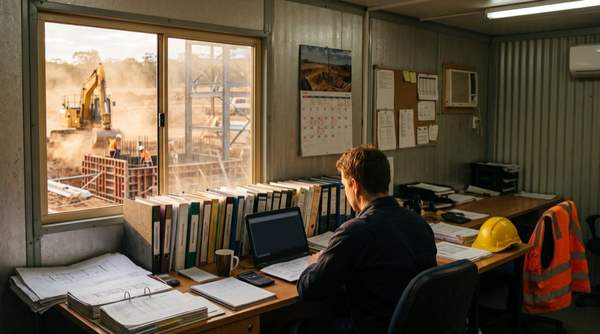
AI for commercial cleaning contractors automates the administration that runs a multi-site operation: rostering hundreds of shifts across client sites, checking pay against the Cleaning Services Award, tracking contract renewals, verifying service with digital inspections, and reordering supplies. Supervisors approve rosters and pay. The AI does the first pass and flags exceptions.
Key takeaways
- The margin killers in commercial cleaning are administrative: rostering changes, timesheets, award interpretation, contract tracking and site reporting.
- The Cleaning Services Award 2020 (MA000022) plus criminal penalties for intentional underpayment since 1 January 2025 make pay accuracy a board-level risk.
- Facilities managers increasingly expect digital, verifiable service records. Photo and GPS evidence protects both client and contractor.
- Most value comes from connecting rostering, time and attendance, payroll and contract data, so nobody retypes between systems.
- Start with the biggest bottleneck, usually rostering and timesheets, before adding inspections and supply automation.
Why is admin the biggest problem for commercial cleaning contractors?
Consider a hypothetical contractor with 300 cleaners across 120 client sites in two states. Rosters change daily as people call in sick at 5am. Timesheets arrive late and inconsistent. Contract renewal dates sit in spreadsheets, and every site manager reports quality differently. Operations staff spend their week chasing information.
Commercial cleaning runs on tight margins and high staff turnover, so each new cleaner adds onboarding, induction and roster changes. AI targets the paperwork around the work, which is what burns out office and supervisory staff.
Why does automation matter for cleaning contractors now?
Cleaning Services Award complexity
The Cleaning Services Award 2020 (MA000022), administered by the Fair Work Ombudsman, sets rates and conditions including casual loading, part-time arrangements, overtime, shift penalties, weekend and public holiday rates. Across full-time, part-time and casual staff on early-morning, evening and weekend shifts at many sites, manual calculation invites errors.
Since 1 January 2025, intentional underpayment of wages has been a criminal offence under the Fair Work Act, alongside existing civil penalties. Pay accuracy is now a governance issue. See our guide to Fair Work compliance automation.
Margin pressure
Award increases flow through to labour costs while contract prices are often fixed for the term. Cutting administrative overhead is one of the few levers that touches neither service quality nor wages.
Client expectations
Facilities managers want to see when cleaners arrived, what was completed and evidence of quality.
| Older practice | Current expectation | Impact | |
|---|---|---|---|
| Service verification | Monthly paper report | Time-stamped check-in with photos | Daily visibility |
| Issue reporting | Phone call next day | Instant mobile notification | Same-day response |
| Contract reviews | Annual meeting | Portal or report with live KPIs | Continuous feedback |
| Invoice backup | Paper timesheets | Verified digital attendance records | Audit-ready |
Which automation opportunities work for commercial cleaners?
1. Contract management and renewal tracking
Commercial cleaning contracts commonly run one to three years. Miss a renewal window and a competitor is already talking to the facilities manager.
- Contract signedTerms, scope, rates and dates captured
- Renewal alertReminder well before expiry
- Renewal draftProposal drafted from scope and performance data
- ApprovalAccount manager reviews and sends
AI can extract key terms from signed contracts (scope, frequency, KPIs, escalation clauses, rise-and-fall provisions), alert account managers ahead of renewal, calculate price adjustments under each contract's CPI or award clause, and draft renewal proposals that cite actual service performance. A person approves anything that goes to the client. See contract review AI for key terms and risks.
2. Staff rostering and shift optimisation
Rostering leaks the most time. Availability changes weekly, sites have different requirements, and someone always calls in sick before dawn.
AI-assisted rostering can propose assignments based on:
- Proximity to sites, reducing travel
- Site requirements such as inductions, security clearances or specialist training
- Award rules, so overtime and penalties are visible before the roster is published
- History, such as which cleaners know which sites
What is your biggest rostering challenge?
- Chasing staff to fill shiftsAuto-offer open shifts with mobile acceptance
- Award complianceRostering connected to payroll with award rules
- Last-minute absencesAI-ranked replacement suggestions for the supervisor
- Multi-site coordinationProximity and qualification-based scheduling
Platforms such as Deputy and specialist cleaning operations software provide rostering and attendance. Value multiplies when they connect cleanly to payroll and your finance system through system integration, so timesheets flow to pay without rekeying.
3. Quality inspection and digital reporting
An area manager driving between sites with a clipboard does not scale across a large portfolio. Digital checklists completed on a phone, with photos for nominated tasks and time-stamped check-in, give a verifiable record.
Look for:
- Checklists configurable by site and service type
- Mandatory photos for specific tasks
- Real-time completion visible to supervisors
- Automatic client summaries
- Exception flags when tasks are missed
- Task completionCleaner marks done + photo
- AI reviewPhoto checked against the standard
- Dashboard updateClient report shows status
- Exception alertSupervisor notified of issues
Photo verification works best when cleaners see it as protection: if a client disputes a task, the time-stamped photo is proof. Explain its purpose clearly, follow state workplace surveillance laws on notification, and keep it separate from performance management unless staff are told otherwise.
4. Supply ordering
Running out of supplies at a client site is disruptive. Overstocking ties up cash. Par levels per site, with usage tracked against service frequency, can trigger reorders automatically for a supervisor to approve, and consolidate orders across sites for better supplier terms.
5. Multi-site communication
Across hundreds of staff and many sites, messages get lost. Centralised communication provides targeted notifications, task allocation with read receipts, issue reporting routed to the right supervisor, and induction and safety material on mobile. Staff who feel connected tend to stay longer, which matters in a high-turnover industry.
How long does it take to automate a cleaning operation?
- Week 1-2DiscoveryMap rostering, timesheet, payroll and contract processes; choose platforms; clean client and staff data
- Week 3-4Core setupConfigure rostering and award rules, build site checklists, connect timesheets to payroll
- Week 5-6PilotRoll out to a region or set of sites, train supervisors and cleaners
- Week 7-8+Scale and refineExtend to all sites, monitor adoption, add inspections and supply automation
What results should cleaning contractors measure?
| Manual processes | What to look for | Impact | |
|---|---|---|---|
| Rostering admin time | Hours each week per region | Reduced, with supervisors approving | Time back |
| Timesheet processing | Manual collection and keying | Attendance flows to payroll | Fewer errors |
| Award calculation errors | Found after pay run or by staff | Flagged before pay is approved | Lower risk |
| Contract renewals | Tracked in spreadsheets | Every renewal alerted in advance | Fewer surprises |
| Unfilled shifts | Discovered when the client calls | Replacement proposed early | Service continuity |
Capture a baseline first. Our manual data entry cost calculator helps estimate the current cost of rekeying.
What does not work well in commercial cleaning?
Generic CRMs without operational data. A CRM can track contracts, but without attendance, inspections and award rules it cannot show service performance. Connect systems instead of forcing one tool to do everything.
Robots as a complete replacement. Autonomous floor scrubbers handle a narrow set of tasks. Most commercial cleaning needs human judgement. Robots complement crews.
AI that needs perfect data. If records are spread across spreadsheets and paper, start by fixing capture at the source and connecting systems.
Where should a cleaning contractor start?
- Measure admin hours for one week across rostering, timesheets, payroll queries, contracts and reporting.
- Pick the biggest bottleneck, usually rostering and timesheets.
- Pilot in one region before rolling out.
- Plan the change. Getting hundreds of cleaners to use a mobile app takes site champions, simple screens and patience in the first month.
How Solve8 can help
We connect rostering, attendance, payroll, contract and finance systems for multi-site service operators, with AI doing the first pass and supervisors approving. See our field service and facilities work and process automation, or talk to us about your rostering and contract workload.