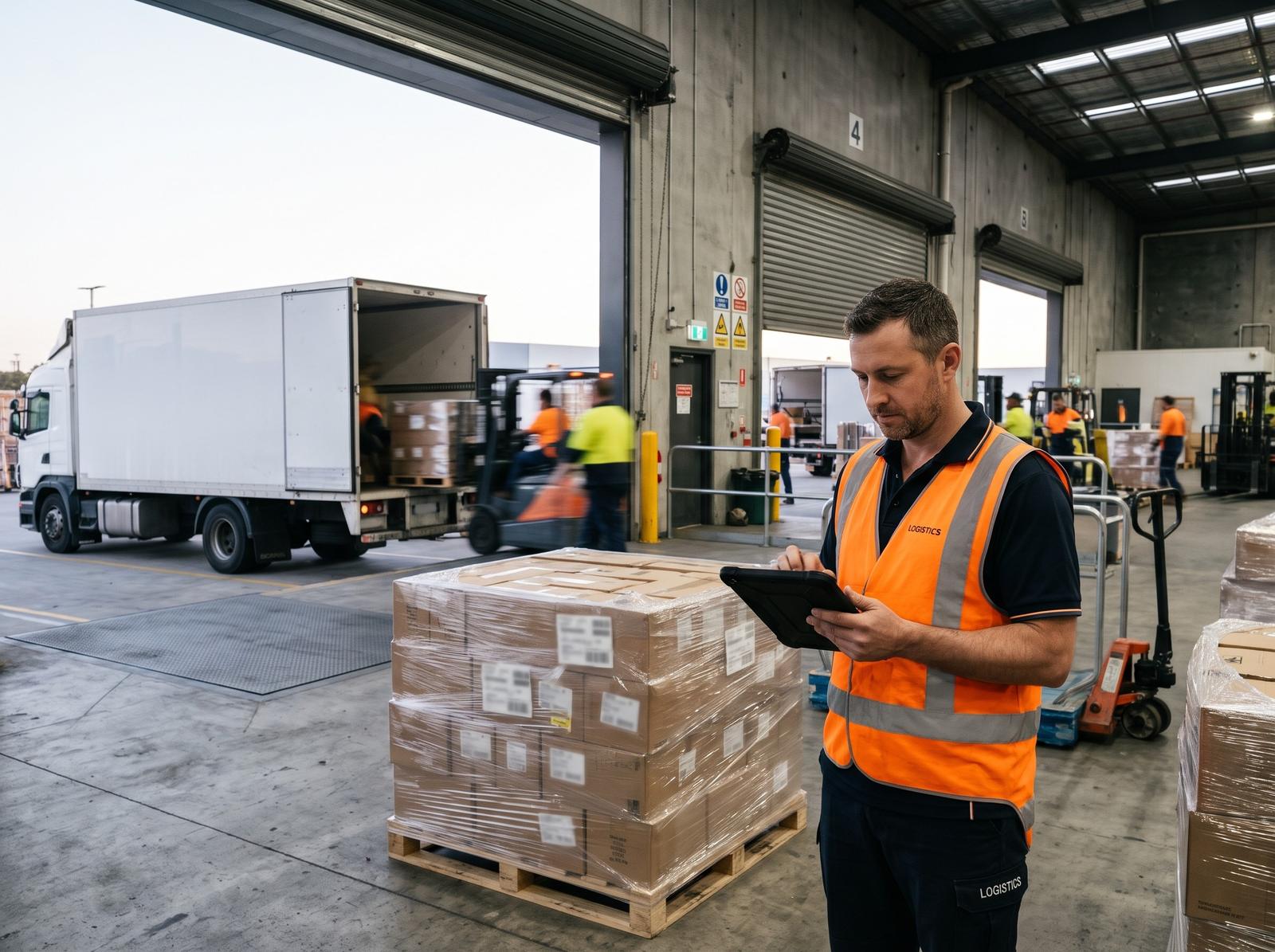
Freight invoice matching
We pay several carriers and suspect fuel levy and cubic weight overcharges, but nobody checks freight invoices against consignments. How do we automate it?
Last updated
Load each carrier's rate card, cubic conversion factor and fuel levy method into a set of rules, then match every invoice line to your own consignment record and recalculate what the charge should have been. Lines within an agreed tolerance go to accounts payable to approve. Lines outside it go to the logistics or finance owner with the evidence attached, ready for a carrier dispute.
Who this is for
This page is for logistics, transport and finance managers at distributors, 3PLs and multi-site organisations that pay several carriers, with consignment data in a warehouse or despatch system and invoices approved in Business Central, Pronto Xi, NetSuite, SAP or Xero. Solve8 builds these checks in fixed-fee phases: discover one carrier's invoices with a measured baseline, prove the checks in shadow mode beside accounts payable, build them into your ERP on your infrastructure in Australia, then support them or hand them over. We work in Sydney, Brisbane, Melbourne, Perth and across Australia and New Zealand.
How automated freight invoice matching works
Collect the contracts
Gather every carrier's current rate card, zones, cubic conversion factor per service, fuel levy method and accessorial charges such as tail-lift, waiting time and residential delivery. Agree a tolerance for each check with finance.
Capture your own consignment data
Pull consignment number, carrier, service, despatch date, origin and destination postcodes, item count, dead weight and dimensions from your warehouse, despatch or ERP system. This record is the evidence every check depends on.
Read the invoices
CSV and EDI invoices are parsed by rules. AI reads PDF invoices and statements from any layout and extracts each line with its consignment number and charge breakdown.
Rate every line
For each line, the check recalculates the expected charge: zone, service, chargeable weight from your dimensions, the fuel levy for that period and any agreed surcharges.
Route by result
Matched lines go to accounts payable for approval. Mismatches go to the logistics or finance owner with your consignment record, the carrier's line and the difference side by side.
Dispute and track
Prepare the claim from the evidence already gathered, record credits received by carrier, and update the rules when a rate card or levy method changes.
Checks that catch most freight overcharges
| Check | What it catches | Evidence needed |
|---|---|---|
| Cubic weight | Dimensions remeasured upward by the carrier, or the wrong conversion factor applied | Your despatch dimensions and the carrier's factor for that service |
| Fuel levy | A percentage that does not match the carrier's published rate for the consignment date, or levy applied to charges the contract excludes | The published rate by period and the contract clause |
| Zone and service | Wrong zone, or express billed when road was booked | Postcodes, booking record and rate card |
| Duplicate charge | The same consignment billed twice, or billed again on a later invoice | Consignment number history |
| Unknown consignment | Charges for consignments your system has no record of | Despatch records |
| Accessorial charges | Tail-lift, futile delivery or waiting time that was not requested or not supported | Booking notes and proof of delivery |
Australian specifics
Fuel levies move often, so the check must use the rate in force on the consignment date, not the rate when the invoice arrives. Team Global Express, for example, publishes fuel surcharges that refresh weekly and indexes its diesel-based surcharges to the AIP national average. Store each carrier's levy history so older invoices are tested against the right period.
Cubic conversion factors differ by carrier and service. Hunter Express publishes a standard conversion of 1 cubic metre to 250 kilograms, with oversized freight of 1.2 metres or more charged at 333 kilograms. Keep the factor for each carrier and service in your contract data rather than one figure for all carriers, and check whether each contract charges on the higher of dead weight and cubic weight.
Groups with New Zealand operations often contract carriers separately there, with their own rate cards and levy schedules, so set up those carriers as separate rule sets.
Limits and when not to use AI
No dimensions at despatch
If you do not record dimensions when goods leave, you cannot challenge a cubic remeasure. Start measuring before automating.
Invoices without consignment detail
Some carriers bill summary totals. Ask for line-level invoice data or a consignment report as a condition of the contract.
Structured carrier files
Where a carrier sends CSV or EDI, rules do the work. AI is only for PDF invoices and unstructured statements.
Unclear contracts
If a rate card is ambiguous, the check cannot decide who is right. Clarify the clause with the carrier first.
Low-spend carriers
A carrier with little volume may not justify a full rule set. Spot-check it instead.
Who should own it
Logistics or transport manager
Owns carrier contracts, rate card updates and disputes.
Finance or accounts payable lead
Owns tolerances, approval of matched lines and credit tracking.
Warehouse manager
Owns dimension and weight capture at despatch.
ERP or application manager
Owns the consignment data feed and invoice import.
Related work
 Purchase orders into ERPAI reads emailed PDF orders and checks them against ERP data before posting.
 Process automationLess retyping, chasing and manual checking across order to cash.
 System integrationERP, finance, warehouse and field systems connected so data is entered once.
 AI for logistics and transportFreight invoices, PODs and delivery enquiries handled with approvals.
Sources
Team Global Express, Fuel surcharge (refresh frequency and index source): https://teamglobalexp.com/fuel-surcharge
Hunter Express, How To Measure Freight (standard cubic conversion): https://hunterexpress.com.au/?p=2290
Questions
What consignment data do we need before we can check freight invoices automatically?
At minimum you need the consignment number, carrier, service, despatch date, origin and destination postcodes, item count, dead weight and dimensions for every consignment. Most of this sits in the warehouse or despatch system. Dimensions are the gap most often found, and without them cubic weight charges cannot be checked.
Can we check freight invoices if our carriers only send PDF invoices?
Yes. AI can read PDF invoices and statements and extract each line with its consignment number and charges, and those lines then go through the same rules as CSV data. Low-confidence reads go to a person. It is still worth asking each carrier for a CSV or EDI file, because structured data is cheaper to check.
How do we dispute a cubic weight remeasure with a carrier?
Send the carrier your recorded dimensions and weight for the consignment, the conversion factor in your contract, your recalculated chargeable weight and the difference. Without your own dimension record from despatch, ideally a photo or scanner reading, a dispute is your word against the carrier's remeasure. Agree a dispute process and response time in each carrier contract.
How often do fuel levy rates need updating in a freight matching system?
As often as each carrier changes them. Team Global Express, for example, refreshes its fuel surcharges weekly, so check each carrier's schedule, store each carrier's rate history with effective dates and test every line against the rate for its consignment date. Assign one person to update the rates on a set schedule and log each change.
Can freight invoice matching allocate freight cost to branches or customers?
Yes, once each invoice line is matched to a consignment, the cost can be allocated to the branch, customer, order or cost centre recorded against that consignment. This gives finance freight cost per customer or per site, which helps with pricing and with deciding whether to recover freight from customers.
Related
- Logistics and transportFreight invoices, PODs and delivery enquiries.
- Customers email us PDF purchase orders and staff retype them into the ERP. Can AI do this reliably?How AI reads emailed PDF purchase orders, checks them against customer, item and price data, routes exceptions to a person, and writes orders to your ERP.
- Process automationLess retyping, chasing and manual checks.
- System integrationConnections between the systems you run.

Have this problem across your branches?
A 30-minute review with a senior consultant. You leave with a written one-page summary you can share internally.
Fixed-fee phases, agreed before we start. Stop after any phase.