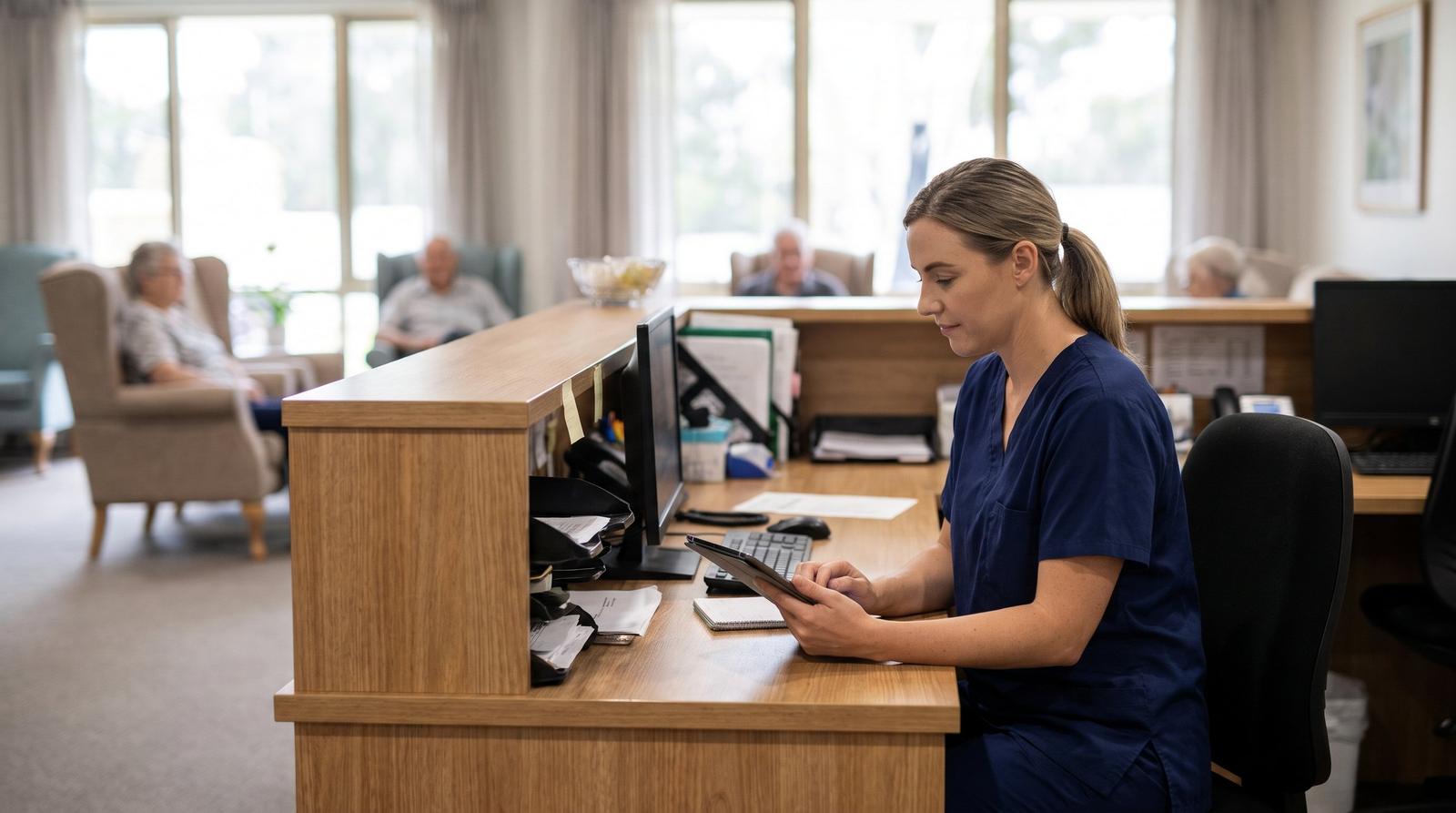
Aged care and NDIS documentation
Can AI draft progress notes and care documentation safely across our aged care or NDIS sites?
Last updated
Yes, if the AI runs on infrastructure the provider controls in Australia and a staff member reviews and signs every note. AI can turn carer voice notes and shift notes into draft progress notes, incident reports and care plan review prompts. The provider stays responsible for every record under the Aged Care Act, the NDIS Practice Standards and the Privacy Act, so prove accuracy in a shadow pilot first.
Who this is for
This page is for clinical care managers, quality and compliance leads, operations managers and IT leads at aged care and NDIS providers running several homes, community programs or support sites, where care workers write progress notes and incident reports after the care is done, often at the end of a long shift.
Solve8 builds private AI for these providers in fixed-fee phases: discovery on one note type at one site with a measured baseline, a shadow pilot on live shifts where your clinical leads set the accuracy bar, a build into your systems on your infrastructure in Australia, then support or handover. Workshops run on site, and builds are done remotely under your access controls.
What AI can draft, and what staff still do
Progress notes from voice or shift notes
A carer records a short voice note or types brief shift notes on a phone. AI turns them into a progress note in your template, keeps the carer's facts and marks anything it could not hear or was not told.
Staff review and sign-off
The carer or a team leader reads the draft, corrects it and signs it. Nothing reaches the care record unsigned, and the system keeps the original voice note, the draft and the signed version.
Incident report drafts
When a note mentions a fall, injury, medication error, unexplained bruising or an allegation, AI drafts an incident report and alerts the clinical lead. A person decides whether it is reportable under the Serious Incident Response Scheme or the NDIS reportable incident rules.
Care plan review prompts
AI reads a resident's or participant's notes over a period and lists changes worth a review, such as more falls, weight loss, new behaviours or repeated refusals, each linked to the notes behind it. A registered nurse or key worker decides what changes.
Public chatbot or private AI for care notes
| Question | Public AI chatbot | Private AI on your infrastructure |
|---|---|---|
| Where resident or participant data goes | To the vendor, under terms each staff member accepted | Stays in your environment in an Australian region |
| Whether data trains a model | Depends on the plan and settings each person chose | No, written into the build and the contract |
| Audit trail | None the provider controls | Voice note, draft, edits and signer logged |
| Fit with your templates | Only as good as each carer's prompt | Built to your note templates and escalation rules |
| Access control | Personal accounts | Your identity system and role permissions |
What the rules expect
Health information is sensitive information under the Privacy Act 1988. The OAIC's guidance on commercially available AI products recommends, as best practice, that organisations do not enter personal information, and particularly sensitive information, into publicly available AI chatbots. It also recommends a privacy impact assessment before adopting an AI product, labelling AI-generated content in records, keeping people overseeing outputs and training staff. If a model service processes health information outside Australia, APP 8 on cross-border disclosure applies.
The Aged Care Act 2024 replaced the Aged Care Act 1997 on 1 November 2025, and the strengthened Aged Care Quality Standards apply from the same date. The registered provider remains responsible for care and for the records that evidence it, whoever produced the first draft of a note.
For NDIS providers, the core module of the NDIS Practice Standards expects each participant's information to be identifiable, accurately recorded, current and confidential, and recorded in an accurate and timely manner. A note drafted from the carer's own words and signed the same shift supports that. A note rebuilt days later in a public chatbot is hard to defend at audit.
How to measure accuracy in a shadow pilot
Pick one note type at one site
For example, daily progress notes in one residential home or one community support team. Measure minutes per note, late notes and recent audit findings.
Set the accuracy bar first
Clinical and quality leads agree what counts as an error, such as a wrong fact, an invented detail or a missed incident, and the rate they will accept before go-live.
Run in shadow
Carers write notes as usual while the AI drafts from the same voice or shift notes. Drafts are not filed.
Compare note by note
A reviewer scores each draft against the signed note for omissions, invented details, wrong names or times and missed incident flags. Every missed flag is investigated.
Decide on the numbers
Go live only when the measured rate meets the bar, then keep sampling signed notes each month.
Limits and when not to use AI
Clinical judgement
AI drafts and flags. Assessment, medication decisions and incident classification stay with qualified staff.
Details nobody recorded
If the carer said nothing about an event, the note should say nothing. Any draft that fills a gap counts as an error.
Recording residents or participants
Recording conversations raises consent and surveillance law questions that vary by state. Start with carers dictating their own notes after the care.
Who should own it
Clinical care manager or director of nursing
Owns note quality, the accuracy bar and incident escalation rules.
Quality and compliance lead
Owns audit evidence, the privacy impact assessment and staff training.
IT lead
Owns hosting, access, logging and data location.
Related work
 Healthcare and aged careClinical documentation and intake automation for multi-site providers.
 Private AI infrastructureAI models running on your own servers or cloud in Australia.
 Staff AI use policyWhat to allow, block and teach when staff already use ChatGPT.
 AI governanceAI inventory, risk ratings, human review controls and board reporting.
Sources
OAIC, Guidance on privacy and the use of commercially available AI products: https://www.oaic.gov.au/privacy/privacy-guidance-for-organisations-and-government-agencies/guidance-on-privacy-and-the-use-of-commercially-available-ai-products
Aged Care Quality and Safety Commission, Strengthened Quality Standards: https://www.agedcarequality.gov.au/providers/strengthened-quality-standards
NDIS Quality and Safeguards Commission, Provider governance and operational management: https://www.ndiscommission.gov.au/rules-and-standards/ndis-practice-standards/provider-governance-and-operational-management
Questions
Who is responsible if an AI-drafted progress note is wrong?
The provider. The staff member who signs the note confirms it is accurate, and the provider remains accountable for its care records as a registered aged care or NDIS provider. Keep the original voice note, the AI draft and the signed version so any error can be traced.
Can care workers use ChatGPT to write progress notes?
Not on public or personal accounts with resident or participant details. The OAIC recommends not entering personal information, particularly sensitive information, into publicly available AI chatbots. Give staff an approved tool that runs in your environment and a policy that says which data may go where.
Will AI-drafted notes stand up to an NDIS Commission or aged care quality audit?
They can, if the staff member who gave the care reviews and signs each note promptly and the system keeps an audit trail. Auditors look at whether records are accurate, current and support the care delivered, so a signed, timely note matters more than how the first draft was produced.
Can AI flag possible serious incidents in progress notes?
Yes. AI can scan each note for falls, injuries, medication errors, unexplained bruising and allegations, and alert a clinical lead the same shift. A person decides whether the incident is reportable and lodges it. Measure missed flags in the shadow pilot before relying on the alerts.
Who can help aged care and NDIS providers set up private AI across Australia?
Look for a provider that will run AI inside your own environment in Australia, measure accuracy on your notes before go-live and hand over the code. Solve8 works with multi-site providers in Sydney, Melbourne, Brisbane and across Australia, with workshops on site and builds under your access controls.
Related
- Healthcare and aged careDocumentation and compliance load.
- Private AI infrastructureAI that runs inside your own environment.
- Staff are already using ChatGPT with company data. What should our AI use policy say?Staff already paste company data into ChatGPT. What an AI use policy should allow, block and teach, using the Australian Government AI policy template.
- AI governance your auditors and board can checkWe find every AI use across your sites, including tools staff use without approval, give each an owner and a risk rating, and set up controls and board reporting your auditors can test.
- Automated decisions and the Privacy Act: getting ready for 10 December 2026What APP 1.7 to 1.9 require, which decisions count, and a six-step checklist for the people who have to make it happen before the deadline. This page is general information, not legal advice.
- Our AI pilot worked in testing but nobody uses it six months later. What went wrong, and should we fund the next phase?Why an AI pilot that worked in testing goes unused months later, how to find the cause, and how to decide whether to fund the next phase, fix it or stop.

Are progress notes eating into every shift?
A 30-minute review with a senior consultant. You leave with a written one-page summary you can share internally.
Fixed-fee phases, agreed before we start. Stop after any phase.