Back to Blog
    Industry Solutions

    Why 40% of Calls to Tradies Go Unanswered (And How to Fix It)
    Jan 06, 2026By Solve8 Team9 min read

    Tradies Missed Calls Why 40 Percent Unanswered

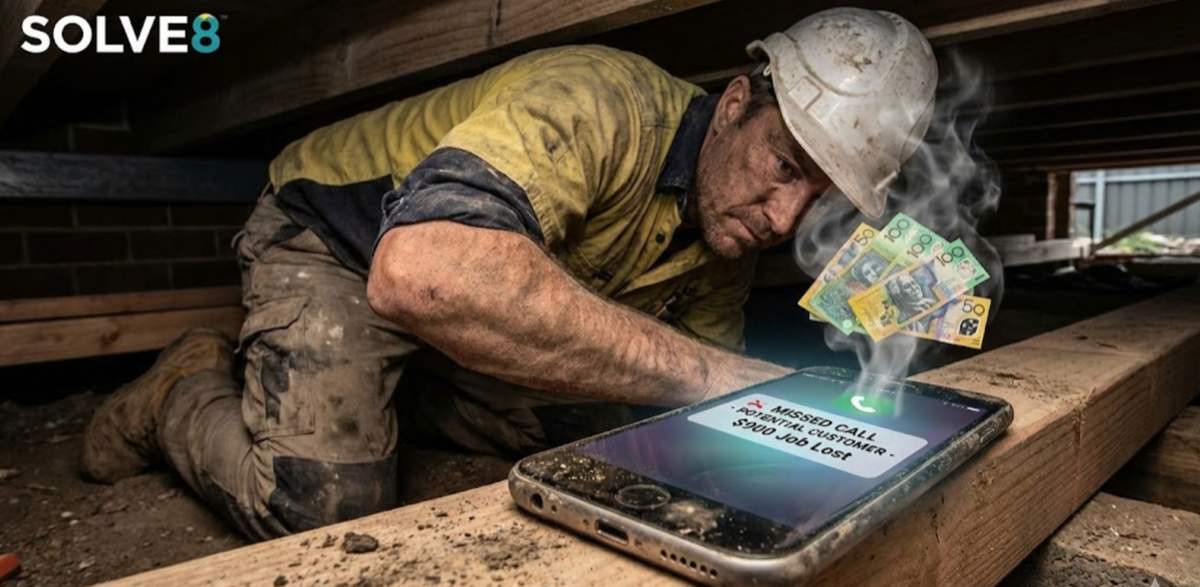
    You Just Lost a $900 Job. You Didn't Even Know They Called.

    Right now, while you're reading this, a homeowner in your suburb has a burst pipe. Water's spraying everywhere. They're panicking.

    They grabbed their phone, Googled "emergency plumber near me," and started dialling. Your number came up first.

    It rang. And rang. And went to voicemail.

    You were under a house fixing another leak. Your phone was in your van. Even if you'd heard it, your hands were covered in PVC cement.

    That customer? They're already dialling the next plumber on the list. Whoever answers first gets the job. That's $400-900 for a weekend emergency callout - gone in 30 seconds.

    This isn't a hypothetical. According to industry research, 60-80% of emergency calls go to whoever answers first. The customer doesn't leave a message. They don't call back later. They call the next tradie.

    The Emergency Call Reality

    Emergency plumbing jobs per weekend2-6 per area
    Average weekend emergency value$400-$900
    Calls going to first responder60-80%

    Source: Industry analysis of Australian tradie call patterns


    Why Tradies Miss So Many Calls (It's Not Your Fault)

    Here's the thing - you're not ignoring calls because you don't care. You're missing them because of the reality of trade work. Let me break down what actually happens during a typical day.

    The Job Site Problem

    You're on a roof. You're under a house. You're up a ladder. You're in a ceiling cavity with insulation falling in your face.

    Your phone might be in your pocket, but answering it? That's dangerous. That's unprofessional to the customer you're currently working for. And half the time, you can't even hear it over the angle grinder.

    The Dirty Hands Problem

    Sparkie rewiring a switchboard. Plumber elbows-deep in a blocked drain. Chippie covered in sawdust. HVAC tech with refrigerant on your fingers.

    You can't just wipe your hands and grab the phone. By the time you could safely answer, it's gone to voicemail. And as we'll see, voicemail is basically a dead end.

    The Driving Problem

    You're in the van between jobs. Phone rings. But you're on a main road, and you know the penalty for using your mobile while driving - $1,000+ in most states, plus demerit points.

    So you let it ring. You'll call them back when you park. Except by then, they've already booked someone else.

    The After-Hours Problem

    Your phone finally stops ringing at 6pm. You have dinner with your family. You watch the footy. You sleep.

    But emergencies don't follow business hours. That hot water system that failed? It failed at 10pm when someone went to shower. They called three plumbers. Two went to voicemail. One answered. Guess who got the job?

    A Customer's 60-Second Decision

    Google Search
    Finds 3 local tradies
    phone
    First Call
    Goes to voicemail
    phone
    Second Call
    No answer
    Third Call
    Someone answers!
    calendar
    Job Booked
    Done in 60 seconds

    What Customers Actually Do When You Don't Answer

    Conversations with hundreds of small business owners confirm this. The data matches what they report: customers today have zero patience.

    According to industry research on Australian small business phone behaviour:

    • 85% of callers won't call back if their first call isn't answered
    • 80% won't leave a voicemail - they assume nobody will listen anyway
    • 78% choose the business that responds first
    • 60% define "immediate response" as under 10 minutes

    Think about your own behaviour. When you need something fixed at your house - an appliance, your car, whatever - do you leave voicemails and wait around? Or do you call the next option?

    Your customers are exactly the same.

    Customer Phone Behaviour: Then vs Now

    Metric
    10 Years Ago
    Today
    Improvement
    Will leave voicemail60-70%20%Massive drop
    Will call back if missed50%+15%Almost never
    Expected response timeSame dayUnder 10 minsInstant expectation
    Will try a competitorEventuallyImmediatelyNo second chances

    The Real Cost (And It's Not Just the Job You Missed)

    Most tradies think about missed calls in terms of the immediate job. "Ah well, missed a $300 callout."

    But that massively understates the damage.

    Calculate what missed calls are actually costing your trade business:

    Missed Calls Calculator

    The Lifetime Value Hit

    That $300 callout? If you'd answered, done a good job, and that customer liked you - what happens next?

    They call you for the next problem. They recommend you to their neighbours. They leave you a Google review. Over 5-10 years, that one customer might be worth $2,000-5,000 to your business.

    When you miss that first call, you're not losing $300. You're losing the entire relationship before it starts.

    The Marketing Wastage

    If you're running Google Ads or paying for lead services, this one hurts.

    Let's say you're spending $1,500 a month on marketing. That generates 60 calls. But if you're only answering 35-40 of them (which is typical for tradies on the job), you're effectively paying $43 per answered lead instead of $25.

    You're paying for leads and then not being available to take them. That's money straight down the drain.

    The Reputation Compound

    One of the warning signs of a bad tradie that customers look for? Not returning calls.

    If someone can't reach you before the job, they assume they won't be able to reach you during or after the job. Your phone going to voicemail isn't just a missed opportunity - it's actively damaging your reputation.

    And industry research shows that 62% of customers share negative experiences with others.

    Annual Cost of Missed Calls (Typical Tradie)

    Calls per week (avg)40-80
    Miss rate on job site35-40%
    Missed calls per week15-30
    Jobs lost (40% conversion)6-12/week
    Annual revenue impact$50,000-$150,000

    Based on industry estimates from Autopilot Genie showing trades/home services miss approximately 35% of calls.


    The After-Hours Blind Spot

    Here's something that doesn't get talked about enough: when do your best leads actually call?

    Think about it from the customer's perspective. When does a homeowner notice their hot water is broken? Usually at 6am when they try to shower, or 10pm when the kids need a bath.

    When do busy professionals have time to research and call tradies? Often during lunch breaks or after work - outside your "business hours."

    According to industry research, 27% or more of customer enquiries come outside traditional 9-5 hours. For emergency trades like plumbing and electrical, it's higher.

    These are the most motivated customers - people with genuine problems who need help now. And if your phone goes to voicemail at 7pm, they're calling your competitor at 7:01pm.

    When Do Emergencies Happen?

    When does your phone ring with the biggest jobs?
    Hot water failures
    → Morning (6-8am) or evening (7-10pm)
    Power outages
    → Often evenings or weekends
    Burst pipes
    → Any time - often noticed after hours
    Air con failures
    → Peak summer - often noticed at night

    What This Looks Like For Different Trades

    The missed call problem hits different trades in different ways. Here's what I see:

    Plumbers

    Weekend emergency calls are where the money is. Water heater replacements run $1,500-3,500. Leak repairs are $200-800. Industry analysis shows missing 1-3 weekend emergency calls per month costs $500-6,000+ in lost revenue.

    And plumbers have it particularly rough - you can't answer the phone when you're under a house with water spraying everywhere.

    Electricians

    Similar problem. You're in a switchboard, or you're up on a pole, or you're in a ceiling. Safety means you can't just grab your phone.

    Plus, electrical emergencies (power out, sparking outlets) are genuinely urgent. Customers aren't going to wait - they need someone NOW.

    HVAC Technicians

    Air conditioning emergencies peak in summer, often in the evening when people get home from work and realise their house is 40 degrees. Your busiest time for calls is also when you've knocked off for the day.

    Builders and Landscapers

    You might not have as many "emergency" calls, but you have long jobs where you're genuinely unreachable for hours. If a potential customer calls for a quote and gets voicemail at 10am, they might try your competitors before you can call back at lunch.

    The Tradie's Dilemma

    On the Job
    Can't answer safely
    Between Jobs
    Can't answer legally
    After Hours
    Phone is off
    Result
    35-40% missed

    Your Options (Honest Assessment)

    So what do you actually do about this? Let me run through the options.

    Option 1: Answer Every Call Yourself

    This is what most tradies try first. Keep the phone on your hip. Duck away from jobs to answer. Call people back on your lunch break.

    Reality: It doesn't work. You can't safely answer when you're working. The customer you're currently with gets annoyed when you're on the phone. And you're exhausted from trying to juggle everything.

    Cost: Your sanity, your family time, and you still miss 20-30% of calls.

    Option 2: Hire a Receptionist

    A full-time Australian receptionist costs $55,000-65,000 per year plus super and leave. They can answer during business hours but not evenings or weekends. When they're sick, on lunch, or on leave - calls go unanswered.

    Reality: Most solo tradies or small teams can't justify the cost. And it still doesn't solve after-hours.

    Cost: $60,000+/year for partial coverage.

    Option 3: Traditional Answering Service

    Virtual receptionist services run $135-400/month. They're humans who answer your phone, take messages, and maybe do basic booking.

    Reality: Mixed quality. They don't know your trade or your pricing. Limited hours (usually 9-5). No calendar integration, so you're still doing manual booking.

    Cost: $135-400/month for business hours only.

    Option 4: AI Phone Receptionist

    This is the newer option. AI answers instantly (24/7), uses a natural Australian voice, can answer FAQs, book appointments directly into your calendar, and texts you summaries.

    Reality: Technology has gotten surprisingly good. Most callers don't realise it's AI. It handles the basics that a receptionist would, but runs around the clock.

    Cost: $49-500/month depending on features and call volume.

    Comparing Your Options

    Metric
    Solution
    Monthly Cost
    Improvement
    Answer yourselfCoverage: Partial$0Not sustainable
    Full-time receptionistCoverage: Business hours$5,000+Expensive, limited hours
    Virtual receptionistCoverage: Business hours$135-400Limited capability
    AI phone receptionistCoverage: 24/7$49-500Always on

    Compare the real costs for your business:

    Cost Comparison Calculator

    What Actually Works (From Experience)

    Working with tradies across Australia implementing different solutions reveals what actually works:

    1. Acknowledge The Problem First

    Most tradies dramatically underestimate how many calls they miss. Pull your phone records. Look at the numbers. The first step is seeing the problem clearly.

    2. Fix After-Hours First

    If you can only solve one thing, solve after-hours. That's when emergencies happen, that's when competitors are also unavailable, and that's where the highest-value jobs come from.

    3. Automate The Basics

    Most calls are asking the same questions: "Do you service my area?" "What are your rates?" "Can you come tomorrow?" An AI system can handle 80% of this and only escalate the complex stuff to you.

    4. Capture, Don't Just Answer

    Answering is only half the battle. You need caller details, what they need, their address, and their urgency level - all captured and organised so you can call back effectively.

    Realistic Implementation Path

    1
    Week 1
    Audit Current State
    Pull phone records, calculate miss rate
    2
    Week 2
    Set Up AI Receptionist
    Configure greetings, FAQs, and calendar
    3
    Week 3-4
    Test and Refine
    Listen to call recordings, adjust scripts
    4
    Ongoing
    Monitor Results
    Track jobs booked vs previous period

    The Bottom Line

    Look, I get it. You got into your trade to do the work - plumbing, electrical, building, whatever. Not to sit at a desk answering phones.

    But every call you miss is money walking to your competitor. Every voicemail that doesn't get returned is a customer who thinks you don't care. Every after-hours emergency you sleep through is a $500-900 job that could have been yours.

    The maths is brutal: miss 15 calls a week, lose 6 jobs (at 40% conversion), and that's $1,500-3,000 weekly just... gone. Over a year, that's $75,000-150,000 in revenue you never even knew you were losing.

    The good news? This is a solvable problem. Whether you use an AI receptionist, a virtual answering service, or some combination - there are options that don't cost an arm and a leg.

    The first step is admitting you've got a problem. The second step is doing something about it.


    Take Action This Week

    Step 1: Check your missed calls from last week. Most smartphones show this in your call log. Count them.

    Step 2: Estimate what those missed calls cost you. Even conservatively - if 30% would have converted at $300 average job value, what's the number?

    Step 3: Explore your options. If you want to see how AI phone receptionists work for tradies, check out CallMate AI - it's specifically built for Australian trade businesses.

    For a broader look at how we help field service businesses solve the missed call problem and other admin headaches, see our solutions page.

    Your phone is ringing right now. The question is whether anyone's answering it.


    Related Resources:


    Research synthesised from industry studies on Australian small business phone behaviour, Autopilot Genie, and conversations with Australian tradies facing these challenges daily.