Back to Blog
    Business Strategy

    The True Cost of Missed Calls for Australian Small Businesses

    Jan 06, 2026By Solve8 Team10 min read

    Missed Calls Cost Australian Small Business

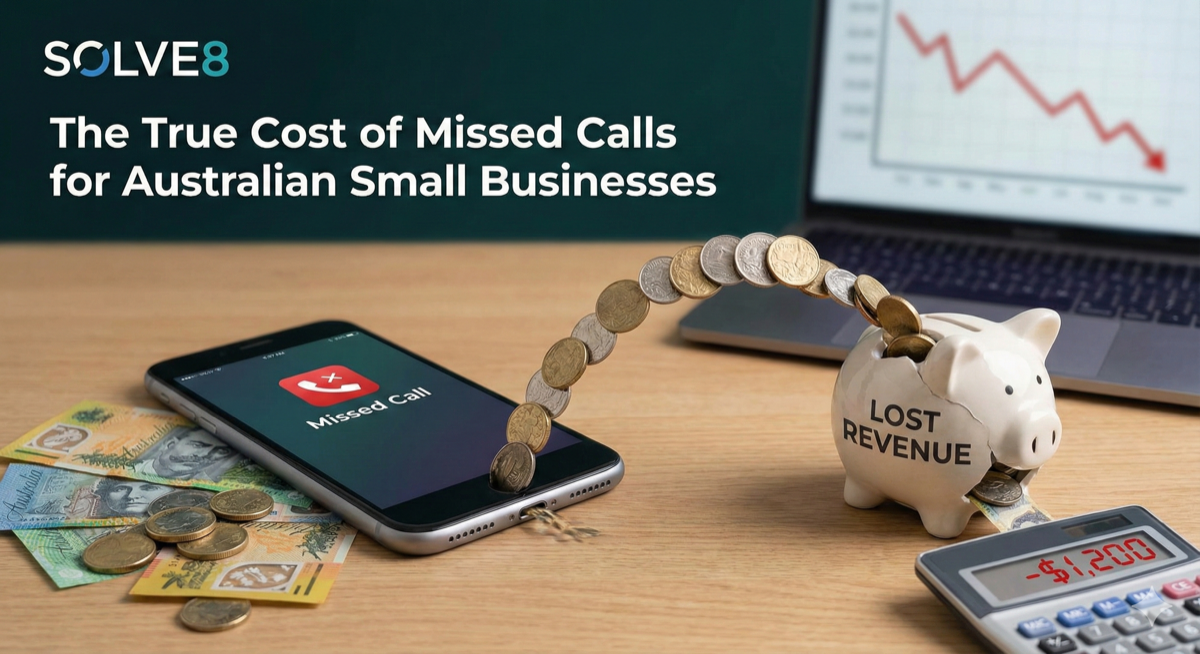
    That Ringing Phone You Missed Just Cost You $1,200

    Consider a dental practice that spends $4,200 on Google Ads in a month. The ads generate 89 phone calls. The front desk answers 52 of them.

    The other 37 calls? Gone. Patients who clicked the ad, dialled the number, heard it ring out, and called the next dentist on the list.

    At an average new patient lifetime value of around $4,000-10,000 (based on industry benchmarks for retained dental patients), those 37 missed calls likely represent somewhere between $150,000 and $370,000 in lost lifetime revenue.

    From a single month. From a single marketing channel.

    Most practice owners have no idea this is happening. They think they're doing fine.

    This is the hidden crisis facing Australian small businesses. Not the economy. Not interest rates. Not rising costs. It is the phone calls you are not answering - and the compounding cost of every customer who never calls back.

    The National Picture

    Annual Australian revenue lost to missed calls$8 billion
    Average SMB annual loss from missed calls$126,000
    Callers who never try again after one missed call85%

    Sources: Autopilot Genie, industry research on Australian small business call behaviour


    Why This Matters Right Now

    In previous decades, customers were more patient. They would leave voicemails. They would call back. They might even drop by in person.

    That era is over.

    Research consistently shows that 90% of consumers now expect an immediate response when contacting a business. For 60% of them, "immediate" means ten minutes or less. And when the phone rings out or goes to voicemail? 80% of callers hang up without leaving a message.

    For service businesses - tradies, dental clinics, law firms, detailing services - the phone remains the primary point of first contact. Industry research shows telephone is still the preferred contact method for 60% of Australian customers, especially for bookings, quotes, and service enquiries.

    Every unanswered ring is not just an annoyance. It is a customer actively deciding to take their money elsewhere.

    How Customer Patience Has Changed

    Metric
    Traditional Expectations
    Today's Reality
    Improvement
    Expected response time24-48 hoursUnder 10 minutesDramatic shift
    Will leave voicemailMost callersOnly 20%80% drop
    Will call back if missedOftenOnly 15%85% don't retry
    Will try competitor nextEventuallyImmediately62% switch

    The Real Cost Breakdown: It Is More Than Lost Sales

    When I work with business owners on this issue, they typically focus only on the immediate lost sale. "I missed a $300 job." But that calculation dramatically underestimates the actual damage.

    1. The Lifetime Value Drain

    That $300 job is rarely a one-time transaction. A new plumbing customer might spend $2,000-5,000 over five years through repeat callouts, referrals, and larger projects. A new dental patient averages $4,000-10,000 in lifetime value. A new legal client could represent $10,000-50,000 in ongoing work.

    When you miss a first-time caller, you are not losing $300. You are losing the entire relationship.

    2. The Marketing Spend Wastage

    Here is what keeps me up at night about the dentist I mentioned earlier. She spent $4,200 on Google Ads to generate those 89 calls. Her cost per call was $47. But since she only answered 52 of them, her effective cost per answered call was $81.

    Nearly half her marketing budget evaporated before she even had a chance to convert those leads.

    Research suggests Australian SMEs waste up to 35% of their digital marketing spend on campaigns that do not deliver results. But how much of that "failure" is simply leads going unanswered?

    Where Your Marketing Dollar Actually Goes

    Marketing Spend
    $5,000 monthly
    Calls Generated
    100 enquiries
    Calls Missed
    40-60 unanswered
    Effective Cost
    $125/answered lead

    3. The Reputation Compound Effect

    A single missed call is frustrating. Two missed calls is a pattern. Three missed calls creates a reputation.

    Industry research shows 62% of customers share negative experiences with others. In an era of Google reviews and social media, one frustrated caller can influence dozens of potential customers.

    Businesses with excellent service can receive one-star reviews simply because the customer could never get through on the phone. The actual service was never experienced - but the damage was done anyway.

    4. The Competitor Gift

    When your phone goes unanswered, your competitor's phone rings next. Research shows 78% of customers choose the business that responds first.

    Every missed call is not just a lost opportunity for you - it is a delivered opportunity for someone else.


    Who Is Most At Risk?

    Industry research shows certain business types suffer disproportionately from the missed call problem.

    Industry Missed Call Vulnerability

    What's your industry?
    Trades (plumber, electrician, HVAC)
    → 35% miss rate - High risk
    Real estate
    → 30% miss rate - High risk
    Healthcare & allied health
    → 28% miss rate - Moderate-high risk
    Hospitality & dining
    → 25% miss rate - Moderate risk
    Hair & beauty services
    → 22% miss rate - Moderate risk

    Source: Autopilot Genie Industry Analysis

    Tradies and Home Services

    Tradies face a fundamental structural problem: they cannot answer the phone while working on a job site. A sparkie rewiring a switchboard cannot pick up. A plumber under a sink cannot take a call.

    Consider a plumbing business missing an average of 15 calls per week. At an average job value of $350, the maths is brutal: over $270,000 in potential annual revenue slipping away.

    Dental and Medical Practices

    Healthcare practices often have one receptionist managing multiple tasks - check-ins, payments, paperwork, phone calls. During peak periods, the phone becomes an afterthought.

    The challenge is amplified because healthcare callers are often anxious, in pain, or dealing with urgent issues. They are not going to wait patiently or leave a friendly voicemail. They are going to find someone who answers.

    Law Firms and Professional Services

    Legal matters are often urgent and emotional. A person calling about a family law issue or a business dispute needs to speak to someone now.

    Industry research found that 35% of law firm calls go unanswered, and 67% of legal clients make hiring decisions based on which firm responds first.

    Small Service Businesses

    Detailing services, cleaning companies, mobile mechanics - any business run by one or two people faces the same challenge. When you are the only person delivering the service, you cannot also be the person answering the phone.


    The After-Hours Blind Spot

    The problem intensifies outside business hours.

    Research consistently shows that 27% or more of customer enquiries come outside traditional 9-5 hours. For trades and emergency services, that figure is even higher.

    Think about it from the customer perspective. When does a homeowner notice their hot water system is broken? Usually at 6am when they are trying to shower, or at 10pm when the kids need a bath. When do busy professionals have time to research and call a dentist? Often during their lunch break or evening commute.

    These are motivated buyers with immediate needs - exactly the customers you want. And if your phone goes to voicemail at 7pm, they are calling your competitor at 7:01pm.

    The After-Hours Reality

    Leads calling outside 9-5 hours27%+
    After-hours callers who leave voicemailUnder 20%
    Average receptionist salary (Australia)$57,952/year
    Can a receptionist work 24/7?No

    Calculating Your Actual Missed Call Cost

    Before diving into the manual calculation, use our interactive calculator to get an instant estimate of your missed call costs:

    Missed Calls Calculator

    Manual Calculation Framework

    If you prefer to work through the numbers yourself, here's the step-by-step approach:

    Step 1: Audit Your Current Call Volume

    Pull your phone records for the past month. Most business phone systems can show you:

    • Total incoming calls
    • Answered calls
    • Missed calls
    • Calls to voicemail
    • After-hours calls

    If you cannot access this data, estimate conservatively. Most small businesses receive 10-30 calls per day.

    Step 2: Calculate Your Miss Rate

    Divide your missed calls by total calls. If you had 400 calls and missed 160, your miss rate is 40%.

    Industry benchmarks suggest 22-62% of small business calls go unanswered - so anything in that range is unfortunately normal (but still costly).

    Step 3: Estimate Average Customer Value

    Consider both immediate transaction value and lifetime value:

    • What is a typical first job worth? ($200? $500? $2,000?)
    • How often do customers return? (Annually? Monthly?)
    • What is a customer worth over 3-5 years?

    For most service businesses, lifetime value is 3-10x the initial transaction.

    Step 4: Apply a Conversion Rate

    Not every call would have become a customer. But what percentage of answered calls typically convert? For most service businesses, phone enquiries convert at 30-60% - these are warm leads who picked up the phone to call you.

    Step 5: Run the Numbers

    Here is an example for a typical trades business:

    Missed Call Cost Calculator: Trades Example

    Metric
    Variable
    Value
    Improvement
    Calls per monthTotal incoming400
    Miss rateIndustry average35%
    Calls missedMonthly140
    Average job valueFirst transaction$350
    Conversion rateIf answered40%
    Lost conversions/month140 x 40%56 jobs
    Monthly lost revenue56 x $350$19,600Ouch
    Annual lost revenuex 12 months$235,200Significant

    Even if you halve these assumptions - a 20% miss rate and 20% conversion - the annual cost is still nearly $60,000.


    The Hidden Costs You Cannot Calculate

    Beyond the direct revenue loss, there are costs that never show up in a spreadsheet:

    Staff stress and burnout. When your team is constantly scrambling to call back missed leads (often unsuccessfully), morale suffers. The "call back" list becomes a source of anxiety rather than opportunity.

    Owner distraction. Small business owners who try to solve this by answering every call personally sacrifice focus on higher-value activities. You cannot scale a business while tethered to your phone.

    Family time erosion. Many tradies miss calls during dinner, on weekends, during their kids' sports games. The phone is always on, but they can never always answer it.

    Referral suppression. Customers who cannot reach you will not refer others to you. Even satisfied customers stop recommending businesses that are hard to contact.


    What This Means for Your Business

    If you have read this far, you probably recognise some of these patterns in your own business.

    The uncomfortable truth is that most Australian SMBs are leaving money on the table every single day - not through pricing mistakes or operational inefficiency, but simply by not answering the phone.

    The solution is not about working harder. You cannot answer calls while you are on a job site, in a client meeting, or having dinner with your family. And hiring a full-time receptionist at $58,000 per year plus super does not make sense for many small businesses - especially when they still cannot cover after-hours or busy periods.

    Businesses that solve this problem effectively typically use some combination of:

    • Call overflow services for busy periods
    • After-hours answering solutions
    • Automated booking systems that capture leads even when nobody answers
    • Technology that ensures every call is captured and followed up

    The specific approach depends on your call volume, budget, and customer expectations. But the first step is simply recognising the size of the problem.


    Taking Action: Where to Start

    If this article has you concerned about your missed call rate, here is what I would suggest as immediate next steps:

    This week: Pull your phone records and calculate your actual miss rate. The number might surprise you.

    This month: Calculate the revenue impact using the framework above. Even rough estimates are illuminating.

    Next quarter: Explore solutions that fit your business model and budget. There are options ranging from basic voicemail-to-text services through to sophisticated AI receptionists that can book appointments and answer FAQs around the clock.

    If you are curious about how AI-powered phone solutions might work for your specific situation, we have built CallMate AI specifically for Australian small businesses facing this exact challenge. It answers calls instantly 24/7, handles common questions, and books appointments - so you never miss another customer.

    But regardless of the solution you choose, the first step is simply acknowledging the problem exists. Most business owners dramatically underestimate how many calls they miss and what those missed calls actually cost.

    The phone is ringing. The question is whether someone - or something - is going to answer it.


    Related Resources:


    Research synthesised from Autopilot Genie, Inside Small Business, and implementation experience across Australian SMBs.