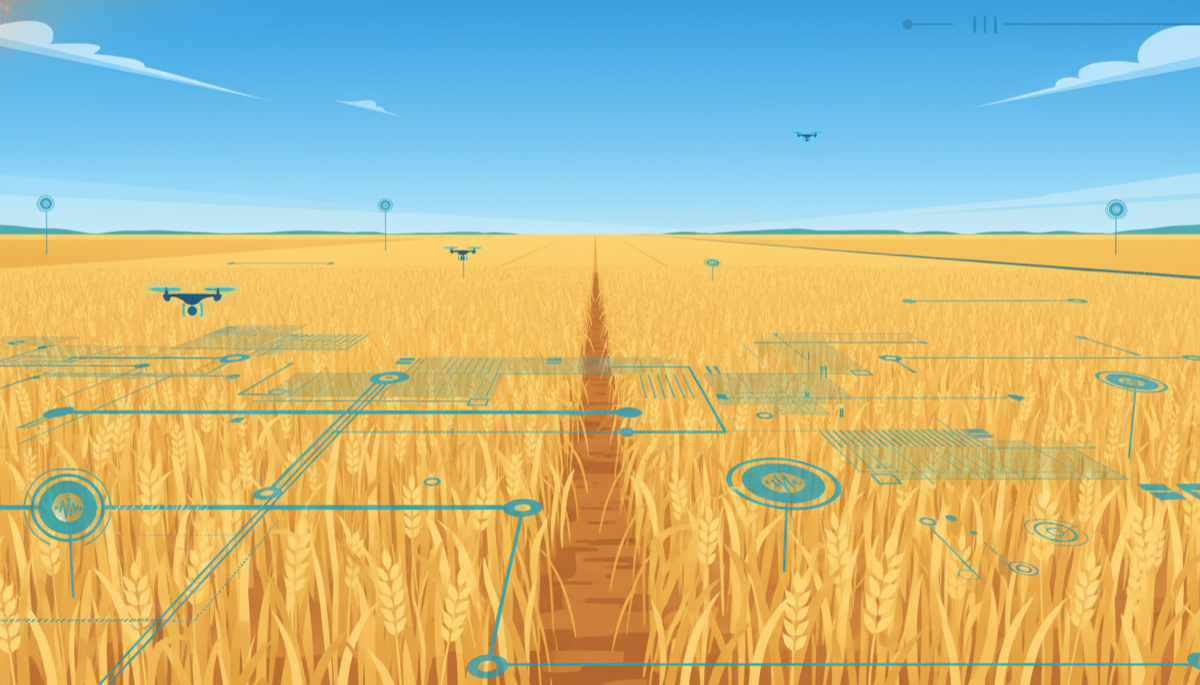
Consider a typical Mallee region vineyard that deploys AI-powered soil moisture sensors to determine exactly when and where to irrigate. Based on industry data, operations like this can slash annual water use by 1.2 million litres - not through rationing or reduced production, but through precision application.
That is 1.2 million litres of water saved, every single year, while maintaining yield. In a country where water is often the difference between profit and bankruptcy, this kind of precision matters.
Australian agriculture is not just adopting AI - it is becoming a global testbed for smart farming technology. According to industry research, 68% of Australian farms now use at least one smart device. The question is no longer whether technology has a place on the farm, but how much value it can deliver.
The numbers are compelling: AI-powered sprayers report 96% herbicide savings while achieving the same yield metrics. Wheat belt farmers in Western Australia have reported 20% increases in crop yields after adopting precision agriculture tools. The Australian precision agriculture market reached USD 261 million in 2024 and is projected to hit USD 623.5 million by 2033 (IMARC Group, 2024).
This is not about replacing farmers with robots. It is about giving farmers superhuman visibility into their land, their crops, and their livestock.
Australian farming operates in conditions that would defeat most agricultural systems. We manage:
| Metric | Traditional Approach | AI-Enabled Approach | Improvement |
|---|---|---|---|
| Crop monitoring | Visual inspection by ute | Satellite imagery covering entire property daily | 100x coverage |
| Irrigation timing | Fixed schedules or gut feel | Soil moisture sensors triggering precise application | 35-45% water saved |
| Pest detection | Walking paddocks, spot checking | Drone imagery detecting issues across thousands of hectares | 24-48hr earlier |
| Livestock tracking | Musters, visual counts | GPS collars and behaviour monitoring | 67% less labour |
| Weather response | React to forecasts | Predictive models integrating multiple data sources | Proactive decisions |
| Input application | Blanket coverage | Variable rate, centimetre-level precision | 15-96% reduction |
The research supports this transition. A 2024 GAO study found farms using IoT-connected systems reduced water waste by 37%. Smart irrigation systems with soil moisture sensors can cut waste by up to 45%.
In 2025, 85% of cropping farms practise stubble retention and 61% of livestock farms use innovative grazing systems (DAFF, 2025). The infrastructure for smart farming is already partially in place.
Here is a breakdown of the technology stack that makes precision agriculture possible.
Modern farm monitoring combines multiple data sources into a layered intelligence system.
Normalised Difference Vegetation Index (NDVI): NDVI measures plant health by comparing how much red and near-infrared light plants reflect. Healthy vegetation absorbs red light and reflects near-infrared; stressed plants do the opposite. AI platforms analyse NDVI maps to:
Thermal imaging: Thermal cameras detect temperature variations that indicate:
Soil moisture sensors: Ground-based sensors at multiple depths provide:
This is where precision agriculture delivers its biggest economic returns.
Traditional farming applies inputs uniformly - the same fertiliser rate across every hectare, the same spray rate everywhere. Variable rate technology (VRT) applies inputs precisely where needed.
In Queensland cropping operations, farmers using satellite imagery and machine learning to map paddock variability and apply fertiliser only where needed have reported significant cost reductions, stabilised yields, and reduced runoff into waterways.
AI livestock management goes far beyond tracking animal location.
| Parameter | Sensor Type | What AI Detects |
|---|---|---|
| Location | GPS collar/ear tag | Grazing patterns, water access, escape |
| Activity | Accelerometer | Lameness, illness, calving onset |
| Temperature | Bolus or ear tag | Fever, heat stress, oestrus |
| Weight | Walk-over scales | Growth rates, health changes |
| Behaviour | Camera + AI | Aggression, isolation, distress |
Early disease detection: Sick animals change behaviour before showing clinical symptoms. AI systems detect:
Detecting illness 24-48 hours earlier than visual inspection allows faster treatment, reduces spread, and improves outcomes.
Calving alerts: Calving monitors track cow behaviour patterns that precede labour:
Alerts sent to farmer mobile phones reduce calf losses and allow intervention when assistance is needed.
Grazing optimisation: GPS tracking combined with paddock mapping shows:
Water is the limiting factor in most Australian agricultural systems. AI-powered irrigation delivers the most immediate and measurable ROI.
The AI weighs multiple factors to optimise irrigation:
Real-time inputs:
Forecast integration:
Crop requirements:
System constraints:
The result: irrigation only when plants need it, in the amount they need, at the time that maximises uptake.
Here is a realistic roadmap for implementing AI on an Australian farm.
Before any smart technology works, you need connectivity. This is the biggest barrier for most Australian farms.
Options for rural connectivity:
Government support: The On Farm Connectivity Program has issued $13.8 million in rebates covering up to 50% of hardware costs, with Round 3 adding another $20 million through late 2025. Queensland's Drought Preparedness Grants provide up to $50,000 per farm.
Start with one high-value application based on your operation's biggest cost driver.
After one season:
Mature deployments integrate multiple systems:
Here are honest numbers for Australian agricultural operations.
Soil moisture monitoring:
Satellite monitoring subscription:
Variable rate technology:
Comprehensive livestock monitoring:
Fully integrated smart farm:
These estimates align with industry data showing digital agriculture can lift gross production value by 25%, representing $20.3 billion in nationwide upside according to market research (Ken Research, 2024).
| Metric | Before AI | After AI (12 months) | Improvement |
|---|---|---|---|
| Water usage | 100% baseline | 55-65% of baseline | 35-45% reduction |
| Fertiliser costs | $140/ha | $105-120/ha | 15-25% reduction |
| Herbicide usage | 100% baseline | 4-40% of baseline | 60-96% reduction |
| Yield (wheat) | 2.8 t/ha | 3.1-3.4 t/ha | 10-20% increase |
| Labour (livestock checks) | 15 hrs/week | 5 hrs/week | 67% reduction |
Plenty of precision agriculture implementations fail. Here is how to avoid common mistakes.
Smart sensors that cannot transmit data are expensive paperweights.
Solution: Test connectivity thoroughly before purchasing sensors. Consider LoRaWAN gateways that create local networks independent of cellular coverage. Ensure systems store data locally when connectivity fails.
Ground sensors get damaged by livestock, machinery, and weather. Unmaintained sensors give bad data.
Solution: Budget for annual sensor maintenance. Create protocols for post-harvest reinstallation. Choose ruggedised sensors designed for agricultural environments.
Having data is not the same as using data. Many farmers subscribe to platforms, look at them twice, then forget.
Solution: Start with one decision the platform will inform (when to irrigate, where to apply more fertiliser). Get comfortable acting on that data before adding complexity.
The fanciest system is not always the best system. Complex installations that require specialist support create dependency.
Solution: Prioritise systems you can troubleshoot yourself. Ensure local support is available. Start simple and add complexity only when justified by clear ROI.
Australian agriculture has always been about working smarter in challenging conditions. AI precision farming is the logical evolution of that pragmatic approach.
The farmers implementing now are building data histories that will compound in value over years. They are developing expertise in technology-augmented decision-making. They are positioning their operations to survive droughts, floods, and market pressures that will defeat less efficient competitors.
The technology is proven. The ROI is documented. The question is whether you will be among the early adopters who capture advantage, or among those who adopt later when it becomes merely table stakes.
Ready to explore AI for your farming operation? Contact us for a practical assessment of where technology can add value on your property.
Related Reading:
Sources: Research synthesised from IMARC Group precision agriculture market analysis (2024), Department of Agriculture Fisheries and Forestry snapshots (2025), Ken Research AI in Agriculture analysis (2024), Mordor Intelligence agricultural machinery reports, GAO IoT study (2024), and Farmonaut industry documentation. All cost estimates in AUD based on Australian vendor pricing.

With 40% of providers still missing Care Minutes targets and the new Aged Care Act now in force, Australian aged care faces unprecedented compliance.

How an AI HR agent handles employee policy questions, automates leave approvals with Fair Work compliance, and runs onboarding checklists — so your HR team can focus on people, not paperwork.

How an AI reconciliation agent handles Xero bank matching, invoice reconciliation, expense categorisation, and BAS prep — step by step, with human approval on every journal entry.