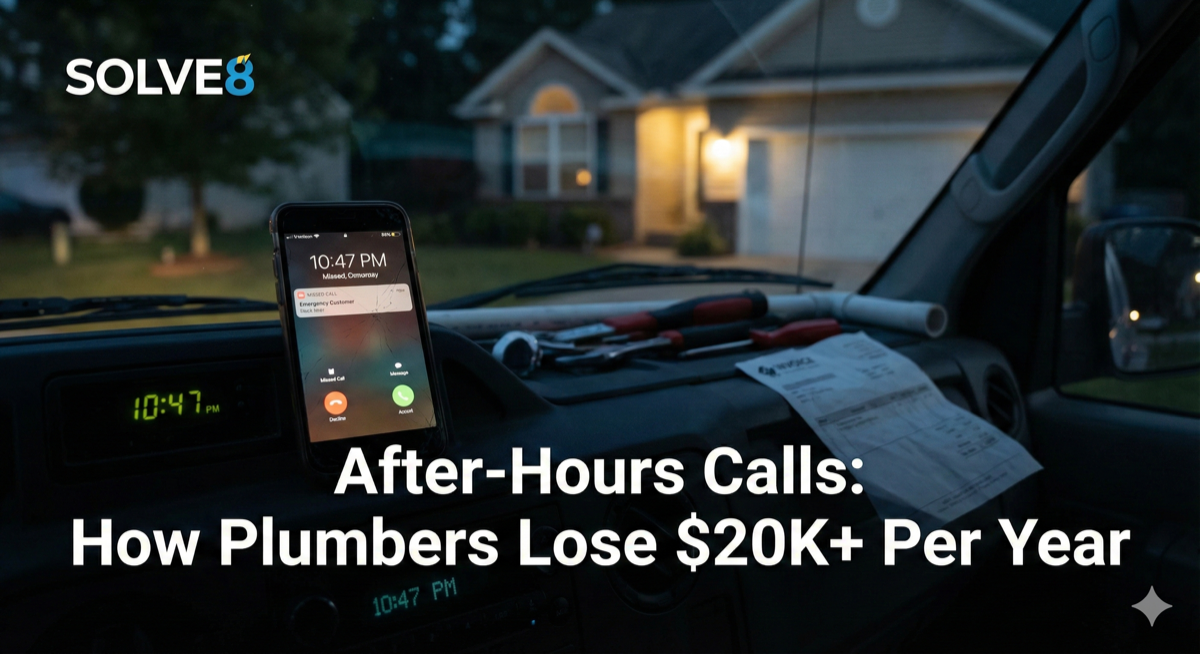
It is 10:47pm on a Tuesday. A homeowner in Blacktown has water pouring through their ceiling. The hot water system has burst. They are panicking.
They Google "emergency plumber Sydney." Your business shows up. They call.
Your phone rings five times. Voicemail.
By 10:48pm, they have called the next plumber on the list. By 10:52pm, that plumber has confirmed they are on their way. By 11:30pm, that plumber has completed an $800 emergency callout - $350 callout fee plus parts and labour.
You wake up the next morning, see a missed call, and think "someone probably just had a question."
That missed call was $800. And that customer will call that other plumber again. And again. For the next ten years.
I have worked with plumbing businesses across Sydney, Melbourne, and Brisbane. This scenario plays out every single night. The maths is brutal, and most plumbers do not even realise how much money they are leaving on the table.
Let me be direct: emergency plumbing calls do not happen during business hours.
Think about when plumbing emergencies occur:
The peak hours for emergency plumbing calls are 5pm-10pm on weekdays and all day Saturday and Sunday. These are the exact hours when you are having dinner, watching the footy, or trying to spend time with your family.
Here is the uncomfortable reality: if you only answer calls during 8am-5pm Monday to Friday, you are potentially missing more than half your emergency work.
Let me walk through the calculation with realistic Australian figures, showing my working at every step.
According to Trusted Tradie Network, All Needs Plumbing, and MCN Plumbing, emergency plumbing rates in 2025 look like this:
Based on industry data from Priority1 Plumbing and Sewer Surgeon:
| Emergency Type | Typical Cost |
|---|---|
| Blocked drain (basic) | $150-300 |
| Blocked drain (complex) | $400-600 |
| Burst pipe repair | $500-1,500 |
| Hot water system failure | $300-800 (repair) |
| Hot water replacement | $1,200-4,500 |
| Gas leak detection/repair | $400-800 |
For emergency after-hours work, we can conservatively estimate an average job value of $500-700.
Now let us do the maths for a typical suburban plumber:
| Metric | Factor | Calculation | Improvement |
|---|---|---|---|
| After-hours calls/week | Conservative estimate | 4-6 calls | |
| Calls missed (voicemail) | Industry average 60%+ | 3-4 missed | |
| Average emergency job value | After-hours premium | $550 | |
| Weekly lost revenue | 3.5 x $550 | $1,925 | |
| Annual lost revenue | x 50 weeks | $96,250 | Conservative |
That is nearly $100,000 per year. Even if you halve the assumptions - 2 missed calls per week at $400 average - you are still losing over $40,000 annually.
But that is just the immediate transaction value. The real cost is much higher.
Here is what the maths above does not capture: customer lifetime value.
Industry research on Australian trades reveals brutal statistics about customer behaviour:
When someone has a burst pipe at 10pm, they are not going to:
They are going to call every plumber in the Google results until someone - anyone - answers. The first plumber to pick up wins the job.
And here is the kicker: when that competitor does a good job, they have earned a customer for life. That one missed call at 10pm just cost you ten years of repeat business.
Let me show you what a single plumbing customer is actually worth over time:
When you miss that 10pm emergency call, you are not losing a $500 job. You are losing a $6,000-12,000 customer relationship.
This is why the annual loss figure of $20,000+ is actually conservative. Factor in lifetime value and referrals, and the true cost of after-hours missed calls could be $50,000-100,000+ per year for an established plumbing business.
Let me break down exactly what types of calls you are missing after hours, based on my experience working with plumbing businesses:
According to Proflush and Optimised Plumbing, hot water replacements cost $1,200-4,500 depending on the system type.
These calls almost always come in early morning. Someone gets up at 6am, discovers there is no hot water, and needs it fixed before they go to work. If you are not answering at 6:30am, that $2,000+ job goes to whoever does.
Burst pipe repairs range from $500-1,500 according to Priority1 Plumbing. These often happen overnight when pipe pressure builds and temperatures drop.
The customer wakes up to water damage. They are panicking about their floors, walls, and belongings. They need someone now - not in six hours when your office opens.
Basic blocked drains cost $150-300, complex ones up to $600. According to Quintessential Plumbing, CCTV inspections add another $200-300.
Weekend blocked drains happen when the whole family is home using the bathroom. Saturday morning, three kids have had showers, and suddenly the drain backs up. Mum wants it fixed before the in-laws arrive for lunch. If you do not answer on Saturday at 9am, someone else will.
Let me paint a realistic picture of what a plumber might miss in a typical week:
Add up just those five calls: $1,700-3,250 in a single week. Over a year, that is $88,400-169,000 in potential revenue - all going to competitors because you could not answer the phone.
Here is what makes the after-hours problem even worse: your competitors know about this.
According to IBISWorld, there are over 28,600 plumbing businesses in Australia. Competition is fierce, and the market is fragmented - no single player has more than 5% market share.
The plumbers who are winning are the ones who answer every call. Industry data from studies of over 1,200 contractors shows the average small contracting business loses $45,000-120,000 per year to unanswered calls.
The businesses that solve this problem gain a significant competitive advantage. If you answer at 10pm and your competitor does not, you win. It is that simple.
"But I have voicemail set up - customers can leave a message."
Here is why that does not solve the problem:
| Metric | What You Think Happens | What Actually Happens | Improvement |
|---|---|---|---|
| Customer leaves voicemail | Most callers | Only 20-25% | 75% hang up |
| You call back next morning | 8-9am | 4+ hours later | Too late |
| Customer is still waiting | Appreciative | Already booked | 67% gone |
| Job is still available | Likely | Very unlikely | Lost revenue |
Research from HouseCall Pro shows that 67% of customers who leave voicemails have already booked with a competitor by the time you call back. The average callback delay is 4.2 hours - and for an emergency plumber, that is an eternity.
A homeowner with a burst pipe at 10pm is not going to leave a voicemail and hope you call back by breakfast. They need someone now.
Here is the uncomfortable truth that every plumber faces: you physically cannot answer every call.
This is not a willpower problem. This is a structural problem. You are one person (or a small team) trying to provide 24/7 availability. The maths does not work.
Hiring a dedicated after-hours receptionist costs $57,000+ per year in Australia based on current market rates. For most plumbing businesses, that expense does not make sense - especially when call volumes are unpredictable.
The businesses that solve this problem effectively use technology to capture calls when they cannot answer personally. Whether that is an answering service, an AI phone system, or some combination - the point is ensuring every call gets answered, captured, and followed up.
Let me bring this back to the headline figure. Is $20,000+ per year in lost revenue realistic?
Use this calculator to see what missed calls are costing your plumbing business:
Here is the most conservative calculation I can construct:
Even with extremely conservative assumptions - just 3 after-hours calls per week, only 60% missed - the annual loss is over $40,000.
For plumbers with more after-hours call volume, or higher average job values, or worse miss rates, the losses are proportionally higher. $20,000 is actually at the low end for most established plumbing businesses.
If you have read this far, you probably recognise some of these patterns in your own business.
The uncomfortable truth is straightforward: if customers cannot reach you after hours, they will reach your competitor. And that competitor will keep them for years.
The solution is not about working harder or sacrificing more family time. It is about ensuring every call gets answered - whether you are personally available or not.
Some plumbers solve this with a partner or apprentice handling after-hours calls. Some use traditional answering services. Increasingly, plumbing businesses are turning to AI-powered phone systems that answer instantly, 24/7, with natural conversation in an Australian accent.
If you are curious about how AI can solve the after-hours problem for your plumbing business, we have built CallMate AI specifically for Australian trades businesses. It answers calls instantly around the clock, understands natural language, books appointments, and sends you instant notifications - so you never miss another emergency callout.
The maths is clear. The question is what you are going to do about it.
Related Resources:
Research and pricing data sourced from IBISWorld, Australian plumbing industry surveys, and direct research with Australian plumbing businesses. All prices in AUD and current as of January 2026.