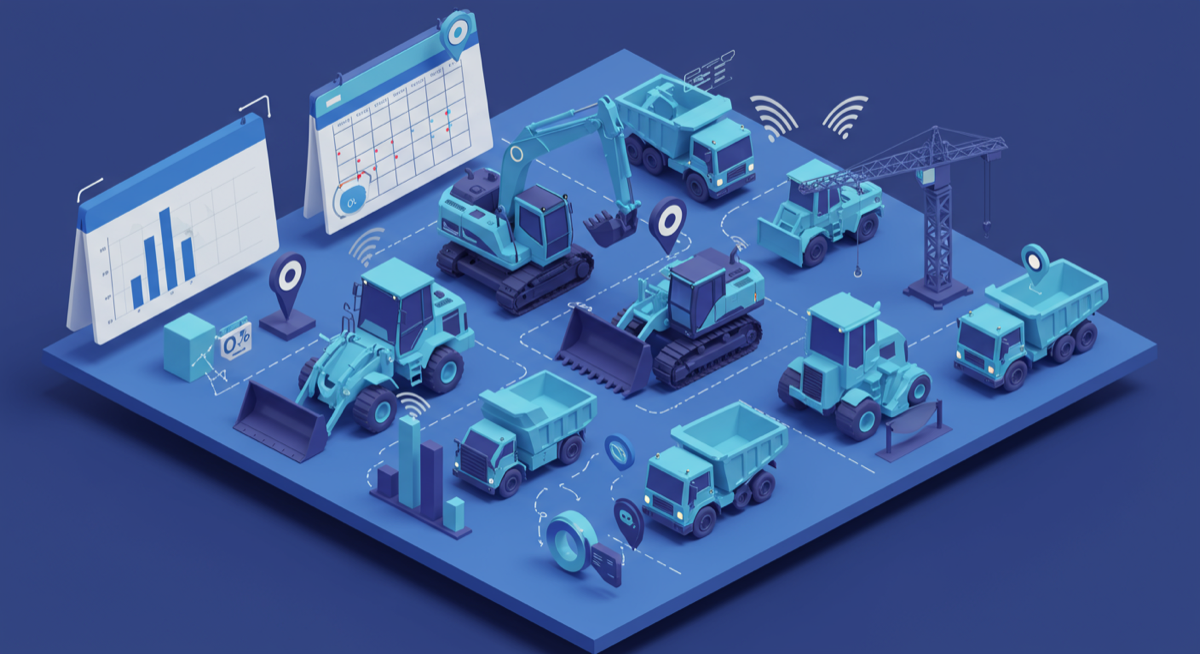
Here is a number that should keep every equipment hire business owner awake at night: the industry average fleet utilisation rate sits at just 55-60%.
That means for every $1 million worth of equipment in your yard, roughly $400,000 of it is sitting there earning nothing on any given day.
I have worked with hire companies across Queensland and NSW, and the pattern is remarkably consistent. A business owner will tell me, "We are always busy," yet when we dig into their utilisation data, we find mini excavators sitting idle while customers are turned away because "we do not have any available."
The problem is not usually equipment shortage. It is visibility.
According to the 2025 State of Tech in the Equipment Rental Industry report, only 16% of rental operators have achieved fully integrated systems. The remaining 67% operate with partially integrated setups requiring manual data transfers between 3-4 disconnected systems. Seven out of ten companies report losing valuable time to these inefficient processes.
This is where AI changes the game for Australian hire businesses, not through sci-fi robots, but through practical tools that finally give you visibility and control over your fleet.
The numbers tell an interesting story. According to Research and Markets, the Australian construction equipment rental market is worth approximately USD 910 million in 2024, growing at 4.6% annually to reach USD 1.16 billion by 2030.
But here is the uncomfortable truth: 83% of rental operators face critical staffing shortages, yet 67% waste precious human resources on tasks that modern technology could handle in seconds.
The broader machinery and scaffolding rental market sits at $12.2 billion, with the construction equipment segment alone comprising 2,089 businesses employing roughly 1,700 people across the country.
Growth drivers include the renewable energy boom (utility construction hit a 15-year high, reaching $40 billion in 2023/24) and ongoing infrastructure projects. But there is a catch: Infrastructure Australia warns of a 229,000-worker shortfall facing our $230 billion infrastructure pipeline.
You cannot hire your way out of this problem. You need to do more with less.
After implementing AI solutions across equipment hire businesses, I have learned that most vendors oversell and underdeliver. Let me share what genuinely works, with realistic expectations.
The Problem: Your branch manager "knows" what is available, but that knowledge lives in their head. When they are off sick, chaos ensues. Equipment sits in one yard while another branch turns away customers.
How AI Helps: AI systems analyse historical booking patterns, seasonal trends, weather forecasts, and local construction activity to predict demand. Instead of guessing, you get data-driven recommendations like:
Real-World Example: Kennards Hire implemented their EasyTRAK platform across 120,000 assets and 180+ branches. The system aggregates data from vehicles, plant equipment sensors, wearables, and environmental sensors into a unified platform accessible by branch staff, call centres, and customers.
The result? Improved asset utilisation through better visibility, and the ability to reallocate underused equipment before it becomes a problem.
Realistic Expectations: Companies investing in integrated fleet technology report 43% increased utilisation rates and 57% decreased missed rentals, according to Quipli's research. A 10-percentage-point improvement in utilisation (say, 55% to 65%) can boost gross profit by 20% or more.
The Problem: A generator fails on a customer's site at 6 AM. You scramble to swap it out, lose the day's rental revenue, and damage your reputation.
How AI Helps: IoT sensors on equipment monitor vibration, temperature, pressure, and runtime hours. Machine learning algorithms learn what "healthy" looks like and flag anomalies 30-60 days before failure.
According to research from Volpis, predictive maintenance typically delivers:
Implementation Reality: Initial investment ranges from $100,000-$500,000 depending on fleet size and complexity, with payback typically in 12-18 months. AI accuracy improves from around 70% at three months to 95% at twelve months as the system learns your specific equipment.
The Honest Caveat: Predictive maintenance works brilliantly for high-value, frequently-used equipment (excavators, generators, access equipment). For lower-value, low-utilisation items? The ROI often does not stack up. Focus your sensor investment on your top 20% of assets by revenue.
The Problem: Phone rings at 5:30 PM on Friday. Customer needs a telehandler for Monday. Your staff have gone home. You lose the booking to a competitor.
How AI Helps: AI-powered chatbots and virtual assistants can:
Real-World Example: CanLift Equipment in Canada deployed "Clive" (CanLift Intelligent Virtual Expert), an AI chatbot providing 24/7 online support. Results included instant web inquiry response times, faster quote turnaround, and AI-powered call routing that reduced missed calls.
What Works in Practice:
What Still Needs Humans:
The Problem: You charge the same daily rate year-round, leaving money on the table during peak season and losing bookings when competitors undercut you in quiet periods.
How AI Helps: AI analyses historical data, local events, weather patterns, competitor pricing, and market conditions to recommend optimal rates. Think airline pricing, but for equipment.
The Opportunity:
The Risk: According to BlackBall Logistics, a 2024 case saw a rental firm lose 10% of its customer base after aggressive AI-driven price hikes were perceived as exploitative. Dynamic pricing requires careful implementation and customer communication.
"AI relies entirely on data. If your current systems operate in silos or lack historical records, the accuracy of AI insights can be compromised."
I have seen this repeatedly. A hire company wants predictive maintenance, but their equipment records are scattered across spreadsheets, a legacy system from 2008, and the maintenance manager's notebook. Before you buy any AI tool, audit your data.
Minimum requirements for AI success:
Your experienced yard manager has 20 years of knowledge in their head. Tell them an AI will "optimise" their decisions and you will face resistance.
The solution? Frame AI as amplification, not replacement. CanLift established an "AI Club" where staff collaborates on new AI applications. As one of their rental coordinators put it: "We've been able to take an active role in shaping how AI is used on the team, and the tools we've helped implement to automate repetitive tasks have made my work more rewarding."
The 2025 rental technology report found that 30% of firms faced integration issues during AI adoption. Most hire companies run HirePOS, Hire HQ, Prism, or similar systems. Check AI vendor compatibility before purchasing.
Several platforms serve the Australian hire market with varying AI capabilities:
HirePOS: Australia's longest-running hire software (since 2005), widely used across builder/landscape equipment, scaffolding, party hire, and access equipment. Basic automation features.
Hire HQ: According to industry reports, Hire HQ is embedding AI technologies including DocAI for automated document processing, paving the way for predictive maintenance and demand forecasting.
International Options: InTempo, Point of Rental, and Quipli offer AI-powered features but may require local implementation support.
Telemetry/IoT: Kennards' success with Telstra Purple's EasyTRAK demonstrates that custom IoT solutions, built on Microsoft Azure, can integrate with existing systems for larger operations.
Based on what actually works for Australian hire businesses, here is a 12-month implementation approach:
The Australian equipment hire industry is ripe for AI transformation, but success requires realistic expectations.
AI will not magically fix a poorly-run hire business. What it will do is give well-managed companies superpowers: the ability to see equipment issues before they become breakdowns, capture bookings at 2 AM, and finally answer the question "Why is that excavator sitting in the yard when we turned away three customers this week?"
The companies that figure this out first will have a significant advantage as the industry consolidates. United Rentals' acquisition of Shore Hire in August 2024 signals that well-capitalised players are positioning for growth through technology-enabled efficiency.
For independent operators, AI is not about competing with the nationals on scale. It is about competing on responsiveness, uptime, and customer service, the things that still matter in hire.
Talk to us about AI implementation for your hire business
Related Resources:
Sources: Research synthesized from Quipli 2025 State of Rental Report, Research and Markets Australia Construction Equipment Report, Telstra Purple Kennards Hire Case Study, Volpis Predictive Fleet Maintenance Guide, and CanLift AI Implementation.