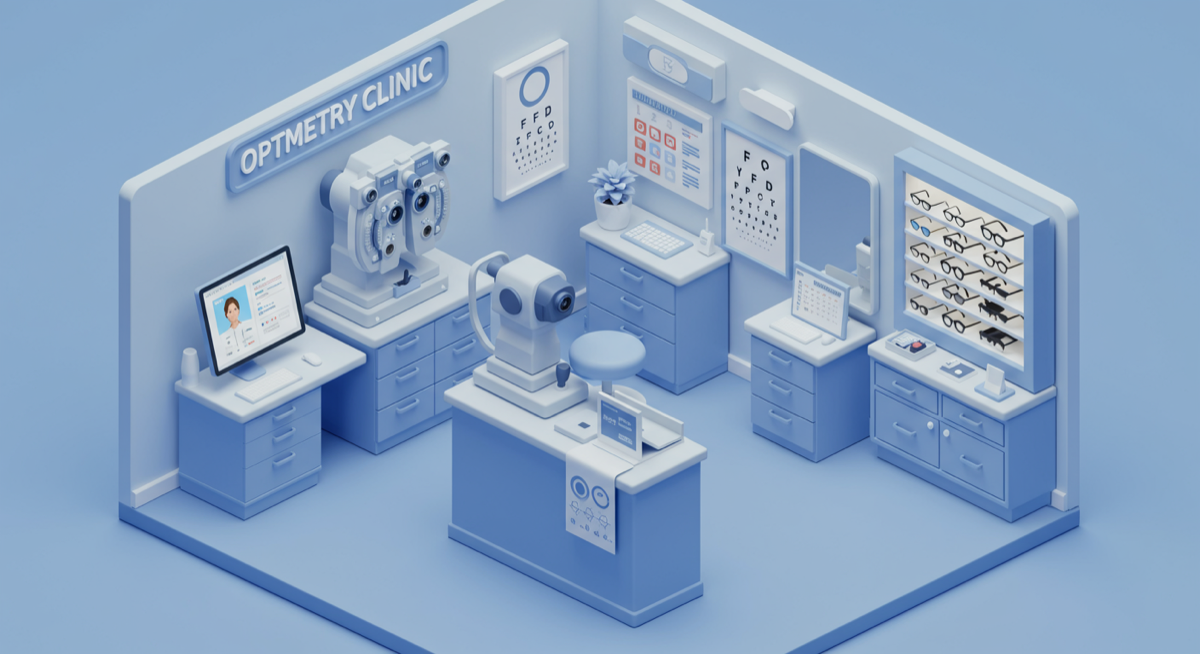
Picture a busy Sydney optometry practice on a Monday morning. The phone hasn't stopped ringing since 8am - recall patients wanting to book their annual exam, contact lens reorders, insurance queries, and patients trying to reschedule. Meanwhile, three patients are waiting at the counter, and the practice manager is still processing Friday's Medicare claims.
Sound familiar?
The economics of optometry in Australia are challenging. Around 94% of optometric consultations are bulk-billed - one of the highest rates among all health professions - yet the gap between Medicare rebates and the actual cost of providing quality care continues to widen. For a profession where 40-60% of revenue comes from optical retail rather than clinical services, every minute your staff spends on administrative tasks is a minute not spent helping patients choose the right frames or explaining lens options.
Here's what I've learned from implementing automation across Australian optometry practices: the technology is ready, the ROI is real, and the practices that move now will have a significant advantage over those that wait.
Optometry Australia recently released a position statement on AI in optometry, emphasising that "AI should complement, not replace, the clinical judgment and expertise of optometrists." That's exactly right - and it's why practice automation makes so much sense for the profession.
The administrative burden in optometry is substantial. Consider a typical day:
Each of these stages has automation opportunities. The key is knowing which ones deliver genuine ROI and which are still more hype than substance.
Research shows that 48% of patients won't proactively schedule their next appointment. For optometry, where annual eye examinations are recommended and many conditions require regular monitoring, this represents both a public health issue and a significant revenue gap.
According to DoctorConnect, practices implementing systematic automated recall programs see up to 40% increases in patient return rates. One US eye care practice using automated messaging achieved a 65% increase in recall responses and generated $2.2 million in revenue from their recall program alone.
The mathematics for Australian practices are compelling:
Let me be specific about current capabilities, because vendor marketing in this space ranges from accurate to wildly optimistic.
What it is: Online booking systems with automated SMS/email confirmation, reminder sequences, and recall campaigns.
Australian solutions:
Optomate.Net - The most widely used practice management system in Australia and New Zealand has recently introduced Iris, their AI assistant, with voice-to-text AI transcription for clinical examinations. It integrates with Medicare Web Services, health funds via CBA Smart Health Hub, Xero accounting, and major optical equipment manufacturers including Topcon, Nidek, and Zeiss.
Ooptify - Built in Melbourne specifically for optometrists, with AI-powered features and a modern cloud-based approach that requires no hardware integration.
What automation handles:
What it doesn't handle:
Realistic expectation: Online booking typically captures 30-50% of appointments for established practices. The real value is capturing after-hours enquiries and reducing phone volume for routine bookings.
Cost: $50-300/month depending on practice size and features.
What it is: AI that listens to consultations and generates clinical notes automatically.
Eye care-specific solutions:
Doctora - An AI scribe specifically designed for optometry that listens to eye exams and writes notes directly into your EHR. Claims to save 2+ hours daily and potentially allow practices to see 4-6 more patients per day with faster documentation.
Barti AI Scribe - Designed for eye care providers, captures clinical findings for anterior and posterior segments, including CD ratio assessment, conjunctiva and sclera examination, and lens evaluation. Claims 96%+ accuracy and 2.5x more detailed charts.
General healthcare scribes used in optometry:
What it handles:
What it doesn't handle:
Real results: According to a 2023 pilot study, ophthalmologists using AI scribes save an average of 1 hour per day on documentation. Over 40% of ophthalmologists are now adopting AI medical scribes in their practice.
Important caveat: AI-generated notes require review. AHPRA requirements for health records state they must be "accurate, up-to-date, factual and legible." Treat AI notes as a first draft requiring professional verification.
Cost: Free tier to $100/month per user.
What it is: AI-assisted interpretation of OCT scans, fundus images, and other diagnostics.
Australian research context:
UNSW Sydney's School of Computer Science and Engineering, the Australian Institute for Machine Learning at the University of Adelaide, Menicon, and the Brien Holden Vision Institute are developing AI platforms to help optometrists improve diagnosis accuracy, management, and referral decisions.
Available tools:
Altris AI - Automates selection of pathological OCT scans and detects over 70 retina pathologies and biomarkers, including rare conditions. Offers severity detection, retina layer thickness analysis, layer segmentation, and pathology detection.
General AI imaging platforms - Various platforms offer AI-assisted interpretation of fundus photography for diabetic retinopathy, age-related macular degeneration, and glaucoma screening.
What it handles:
What it doesn't handle:
The honest assessment: Optometry Australia's position statement identifies risks including "potential deskilling of practitioners" and "reinforcement of existing biases." AI diagnostic tools are genuinely useful as a second pair of eyes, but they're designed to complement, not replace, optometric expertise.
Cost: Varies significantly - from per-scan pricing to monthly subscriptions ($200-500/month).
What it is: Streamlined claiming processes that reduce manual data entry and accelerate payments.
How it works with Australian systems:
Optomate.Net processes Medicare and DVA bulk-billed claims and real-time patient claims via Medicare Web Services through a single PRODA account. Private health insurance claims process online via CBA Smart Health Hub and Terminal.
Cutting Edge Software offers electronic claiming to Medicare, DVA, and private health funds with automated bulk bill claims paid directly to providers by direct deposit.
Zanda Health provides direct Medicare connection for bulk billed or patient claims without third-party intermediaries.
What automation handles:
What it doesn't handle:
The efficiency gain: Practices that integrate claiming with their practice management system report reducing claiming time by 60-70%. For a practice processing 50 claims daily, that's potentially 2+ hours of staff time recovered.
What it is: AI that analyses facial features to recommend suitable frames, improving the patient selection experience.
How it works:
Platforms like GlassesUSA's Pairfect Match AI analyse key facial features - jawline, eye height, cheekbones, and nose bridge - using face-mapping technology. The AI compares facial geometry against thousands of frame styles to deliver recommendations in seconds.
Virtual try-on technology allows patients to see how frames look before trying them physically, with AI replicating face shape and features accurately.
Application for practices:
While primarily B2C technology, some practice management systems are integrating similar capabilities. The real opportunity is in:
Current status: Still emerging in the Australian practice context, but worth watching as the technology matures.
AHPRA requires all registered health practitioners to maintain health records that are "accurate, up-to-date, factual and legible." For AI-generated documentation, this means:
If using AI scribes that record audio of consultations:
AHPRA currently audits optometrists on compliance with CPD, recency of practice, and criminal history requirements. While AI-specific audits aren't yet standard, Optometry Australia recommends alignment with the Australian Alliance for AI in Healthcare recommendations and ensuring AI applications comply with TGA regulations where applicable.
Non-compliance consequences: Fines of up to $120,000 and potential registration restrictions. The investment in proper compliance is far less than the risk of cutting corners.
Based on implementing these systems across Australian optometry practices, here's what works.
Before adding any AI, your practice management basics need to be solid.
Audit your current state:
Key decision: If your current system doesn't integrate with modern booking and communication tools, consider whether migration makes sense. Optomate.Net, Ooptify, and other modern platforms offer capabilities that legacy systems simply can't match.
Implement online booking:
Configure automated communications:
Set up recall campaigns:
Track results: Measure no-show rate, phone call volume, and after-hours bookings before and after. You need baseline data to prove ROI.
Start with one or two optometrists:
Configure for optometry-specific needs:
Review protocol:
Streamline Medicare claiming:
Health fund integration:
Only consider diagnostic AI if:
Based on implementations across Australian healthcare practices:
| Metric | Manual Process | With AI Automation | Improvement |
|---|---|---|---|
| No-show rate | 11-15% | 5-8% | 40-50% reduction |
| Phone call volume | 80+ calls/day | 50 calls/day | 35-40% reduction |
| Documentation time per patient | 15-20 min | 5-8 min | 60% reduction |
| Medicare claim rejections | 5-8% | 1-2% | 75% reduction |
| After-hours bookings captured | Minimal | 15-25% | Net new revenue |
| Recall response rate | 25-35% | 45-55% | 60% improvement |
ROI timeline:
St. Louis optometry practices implementing lab integration automation achieved full ROI within 3-4 months for a 2-doctor practice, with larger practices seeing payback in as little as 6-8 weeks.
Important caveat: Practices that fully commit to automation rather than maintaining parallel manual processes see the best results. Partial implementation extends the payback period and reduces total savings by up to 40%.
Practices that jump straight to fancy diagnostic tools without fixing their scheduling and documentation workflows get poor results. The technology stack needs to build on solid foundations.
Optometry serves patients across all age groups. Older patients may prefer phone bookings; younger patients expect digital everything. Configure your systems for both - don't force patients into channels they won't use.
Dropping new technology on staff without training leads to resistance and poor adoption. Budget 2-4 weeks for proper onboarding and expect a 30-60 day learning curve before seeing full benefits.
For many optometry practices, optical sales represent 40-60% of revenue. Don't focus exclusively on clinical automation while ignoring opportunities to improve frame selection, lens education, and the retail experience.
AI tools improve with feedback and configuration. Practices that review performance monthly and refine their setup get significantly better results than those who set it once and walk away.
If administrative burden, no-shows, or inefficient claims processing are hurting your practice, start here:
Step 1: Calculate your current no-show rate and recall return rate. This is your baseline for measuring improvement.
Step 2: Audit your patient contact data - particularly mobile numbers. SMS campaigns fail if your data is stale.
Step 3: Add online booking to your website if you haven't already. Modern practice management systems make this straightforward.
Step 4: Implement automated SMS reminders - 48-hour and 2-hour sequences with easy reschedule links.
Step 5: Once booking is smooth, trial an AI scribe with your most tech-comfortable optometrist. Review notes carefully for the first month.
The technology is mature enough to deliver genuine value. As Optometry Times noted for 2026, "AI-powered diagnostics will become a standard part of the patient experience, making care faster, smarter, and more accurate."
But the technology works best when it supports good optometric practice - not when it tries to replace it.
Ready to explore AI automation for your optometry practice? We've helped healthcare practices across Australia implement practical solutions that actually work. Book a free 30-minute assessment - we'll review your current workflows and give you an honest recommendation on where automation makes sense for your practice.
When your reception team is busy with patients at the counter and the phone keeps ringing, calls go unanswered. Patients needing to book their annual eye exam, reorder contact lenses, or ask about their glasses call someone else instead.
We built AdminAgent specifically for optometry practices that cannot afford to miss patient calls. Our AI phone receptionist:
Try AdminAgent Free for 7 Days →
Related Reading:
Sources: Research synthesised from Optometry Australia position statements on AI (2025), AHPRA health record requirements, Optomate.Net and Ooptify documentation, Optometry Times 2026 trends report, DoctorConnect patient recall research, Solutionreach eye care case studies, Altris AI optometry research, Medicare Benefits Schedule for optometrists, and implementation experience across Australian healthcare practices.