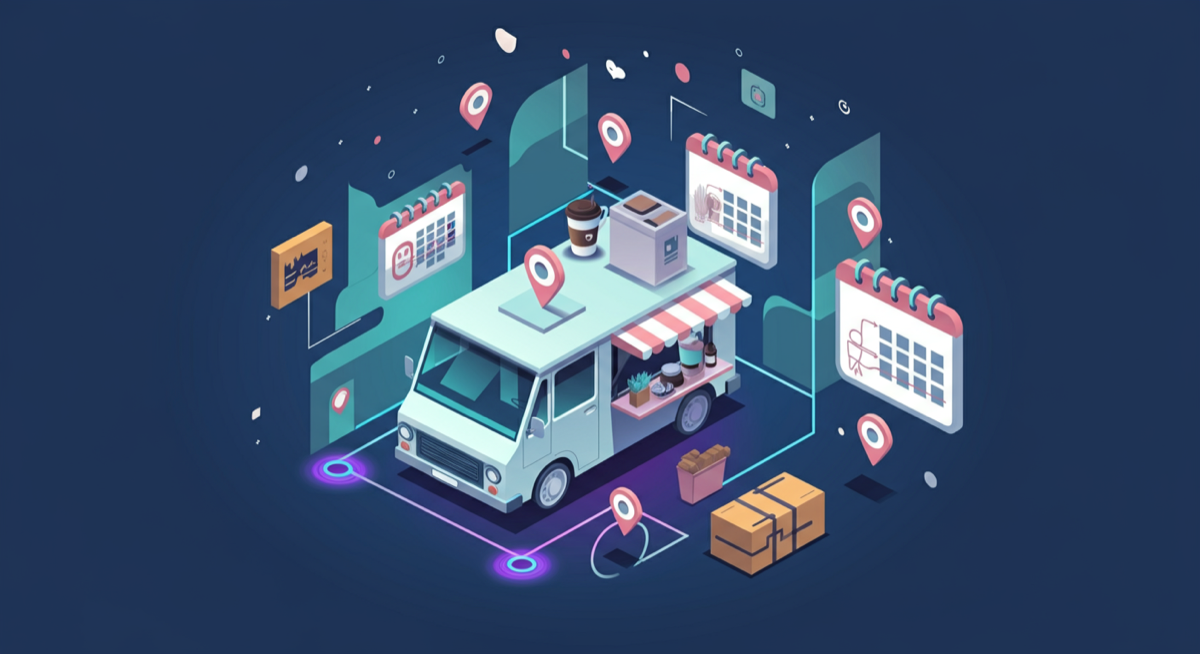
It is 5:47 AM. You are loading the van, checking bean levels, and your phone buzzes. A construction site PM wants to confirm your arrival time. Then another message: a corporate office wants to add an extra stop tomorrow. Meanwhile, you are trying to remember if you moved that cancelled market booking from Saturday.
Welcome to running a mobile coffee business in Australia, where the paperwork happens in a van while you are making flat whites.
The Australian mobile food sector is now worth over $2.5 billion annually, according to industry research from Lazygrid Digital. Mobile coffee specifically has exploded, with operators servicing construction sites, corporate offices, markets, and events across every major city. But while the coffee itself has never been better, the operational side remains stuck in spreadsheets and sticky notes.
Research shows that businesses implementing digital ordering and route optimisation see 40-60% increases in daily sales and 15-25% higher average transaction values. Yet most mobile baristas are still planning routes the night before, manually tracking inventory, and hoping they can answer booking calls between orders.
Sources: Lazygrid Digital 2025, Dobby field service research
Before diving into automation solutions, it is worth understanding why standard cafe software rarely works for mobile operators. The challenges are fundamentally different.
A fixed cafe has one address. A mobile coffee van might service a construction site in Parramatta on Monday, a corporate park in Macquarie on Tuesday, and a farmers market in Mosman on Saturday. Your POS system, inventory, and customer records need to work across all of them without assuming you are in one place.
According to Food Standards Australia New Zealand, mobile food businesses face unique challenges because weather events directly impact both safety and revenue. A wet Wednesday means your outdoor construction stop becomes a write-off. A heatwave might double demand at your beach location. Fixed cafes rarely need to rebuild their daily schedule based on the morning forecast.
When you are pulling shots at a busy corporate stop, you physically cannot answer your phone. Research suggests that 62% of calls to small businesses go unanswered, with each missed call potentially costing between $100 and $1,200 depending on industry. For a mobile coffee operator, a missed call about a catering booking or corporate event could represent hundreds or thousands in lost revenue.
| Metric | Fixed Cafe | Mobile Coffee | Improvement |
|---|---|---|---|
| Location | Single address | 10-20 stops weekly | Route planning needed |
| Scheduling | Set hours | Variable by location | Dynamic scheduling |
| Weather impact | Minimal | Critical | Forecast integration |
| Phone availability | Staff can answer | Often unavailable | Automation essential |
After researching dozens of mobile food technology implementations across Australia and New Zealand, four automation categories consistently deliver genuine ROI for coffee van operators.
Let me walk through each one with practical implementation guidance.
For most mobile coffee operators, route planning is where automation delivers the fastest payback. According to Dobby, a platform built specifically for coffee and vending services, smart routing software that considers traffic, technician availability, and customer locations can dramatically reduce drive time.
Modern route optimisation goes far beyond Google Maps directions. These systems consider:
Research from Televend shows their AI algorithms can lower operational costs by up to 40% through optimised routing. The system creates routes "based on urgency, predicted loss, and total drive and service time with just one click."
The bread and butter of most Australian mobile coffee businesses is the regular corporate or construction stop. These locations provide predictable revenue, but they require reliable scheduling.
Consider a typical Brisbane mobile coffee operation servicing 15 regular locations. Without automation, the owner manually sequences stops each night, often based on gut feel rather than data. With route optimisation, the system learns patterns: which sites are busiest on Mondays, which PMs prefer earlier arrival, which locations can flex by 30 minutes if traffic is bad.
Software options for route planning:
| Platform | Best For | Pricing (AUD) |
|---|---|---|
| Dobby | Coffee/vending specific | Custom quote |
| Route4Me | General field service | From $65/month |
| Upper | Small fleets | From $50/month |
| SmartRoutes | European-based, AU support | From $80/month |
This is where AI-powered routing becomes genuinely useful. Rather than manually checking the BOM forecast and reshuffling your day, smart systems can:
According to research from the University of Sydney, extreme weather events increasingly disrupt Australian supply chains and food businesses. Having automated contingency planning is no longer optional for mobile operators.
Beyond regular stops, most mobile coffee businesses supplement income with events: weddings, corporate functions, markets, and festivals. Managing these bookings manually is where operators consistently lose revenue.
Research shows that the average lead response time in service industries is measured in hours, not minutes. For event venues, 50% of couples book with the first venue that responds. The same psychology applies to event catering.
When someone enquires about your coffee van for their corporate event or wedding, they are likely contacting multiple vendors. If you are mid-service and cannot respond for four hours, you have probably lost the booking.
Modern booking systems for mobile vendors should handle:
The Australian Mobile Food Vendors Group (AMFVG) offers event management services that handle many of these elements for members, including "managing mobile food vendors' legal requirements, event marketing and promotion" through their network.
Markets present a particular challenge: regular weekly commitments with variable revenue depending on weather, foot traffic, and competing vendors. Automation can help by:
Coffee inventory management is "especially critical because most ingredients have a short shelf life," according to research from Supy. For mobile operators with limited storage, the margin for error is even smaller.
A fixed cafe can keep three weeks of beans in the storeroom. A mobile coffee van might have space for three days. Running out of oat milk at 10 AM on a construction site is not a minor inconvenience - it means lost sales and frustrated regulars.
According to Toast POS research, effective inventory automation can "optimise reordering for essential items, predict future needs using sales trends, and leverage inventory data to negotiate better deals with suppliers."
The most practical approach for mobile operators combines:
Research from Shopventory suggests coffee shops using their platform "save on average 1 hour per day per location" through automation features like barcode scanning and automatic purchase orders.
For a typical Australian mobile coffee operator, a realistic inventory setup might include:
Loyalty programs work exceptionally well for mobile coffee because you are building relationships with regulars at the same locations week after week. The construction crew who sees you every Tuesday morning is far more likely to participate than a random cafe visitor.
The old paper stamp card has a fundamental problem for mobile operators: customers forget them, lose them, or have multiple cards across different vans. Digital loyalty programs solve this by tying rewards to the customer, not a piece of paper.
According to Stamp Me, an Australian loyalty platform, their digital stamp card system has a 4.9 rating on app stores because "customers will get the hang of it in no time." Features like Birthday Club, Lapsed Customer reminders, and automated push messages create engagement without requiring manual intervention.
For mobile coffee specifically, look for loyalty platforms that offer:
| Platform | Key Feature | Pricing (AUD) |
|---|---|---|
| Stamp Me | Digital stamp cards, AU-based | From $49/month |
| Loopy Loyalty | Apple/Google Wallet cards | From $30/month |
| Preferred Patron | White-label, SMS/email built in | Custom quote |
| Yollty | Coffee-specific templates | From $25/month |
If you are a mobile coffee operator looking to automate, here is a practical sequence that minimises disruption while building capability.
If you are not already on a modern POS system, this is your starting point. Both Square and Lightspeed offer food truck specific solutions with offline capability (critical for mobile operators).
According to Square, their Australian pricing runs 1.6-2.2% per transaction depending on payment method, with no monthly fees. Lightspeed starts at $119/month but offers lower transaction fees at 1.3%.
Launch a digital loyalty program while your POS data is fresh. This gives you baseline metrics on customer frequency before you start optimising routes.
With 4-6 weeks of sales data by location, you can now make informed decisions about route optimisation. Trial a platform for 30 days before committing.
Once routes are stable, implement inventory automation. By this point, you have sales patterns by location and day, making forecasting far more accurate.
Here is the reality of running a mobile coffee business: you cannot answer the phone while you are making coffee. And you are making coffee for most of your working hours.
Research from Ringover shows that 85% of callers will not call back if their first call goes unanswered. And 80% would rather contact a competitor than leave a voicemail. For a mobile coffee operator getting booking enquiries, each missed call could represent a $500-2,000 event booking.
The traditional solution - hiring someone to answer calls - does not make economic sense for most mobile operators. According to SEEK, a full-time receptionist costs $55,000-65,000 annually in Australia. Even a virtual receptionist service runs $300-800/month.
Ready to Stop Missing Event Booking Calls?
We built AdminAgent specifically for service businesses that cannot afford to miss customer calls. Our AI phone receptionist:
For mobile coffee operators, AdminAgent handles the booking enquiries you cannot answer while pulling shots. It gathers requirements, checks your calendar, and sends you a summary so you can confirm bookings during your next break.
Try AdminAgent Free for 7 Days
Based on industry research and typical implementations, here is what mobile coffee operators can expect from comprehensive automation:
| Metric | Manual Operations | With Automation | Improvement |
|---|---|---|---|
| Route planning time | 4-6 hrs/week | 30 min/week | 90% reduction |
| Booking response time | 2-6 hours | Under 2 minutes | Instant |
| Inventory stockouts | 2-3/month | Near zero | Eliminated |
| Customer retention | Guesswork | Data-driven | 15-25% lift |
Based on industry benchmarks for mobile food operators implementing digital ordering, route optimisation, and booking automation. Individual results will vary based on operation size and location mix.
If you are ready to start automating your mobile coffee business, here are the practical first steps:
Audit your current tech stack - What POS do you use? How do you track inventory? Where do booking requests come in?
Identify your biggest time sink - Is it route planning, inventory ordering, or chasing bookings?
Pick one automation to trial - Do not try to implement everything at once. Start with the area causing the most pain.
Set a 30-day benchmark - Track time spent and revenue before and after implementation.
Talk to other operators - The Australian Mobile Food Vendors Group and local food truck associations often share insights on what technology works.
For a consultation on which automation stack makes sense for your specific operation, book a free strategy call with our team.
Related Reading:
Sources: Research synthesised from Lazygrid Digital food truck technology report (2025), Dobby field service research, Televend route optimisation data, Stamp Me loyalty platform, Food Standards Australia New Zealand mobile food guidelines, Australian Mobile Food Vendors Group, Square and Lightspeed POS documentation, and IBISWorld cafe industry statistics (2025-2026).