Back to Blog
    Industry Solutions

    AI Phone Receptionist + AI Agent: Why Your Service Business Needs Both

    Feb 27, 2026By Solve8 Team13 min read

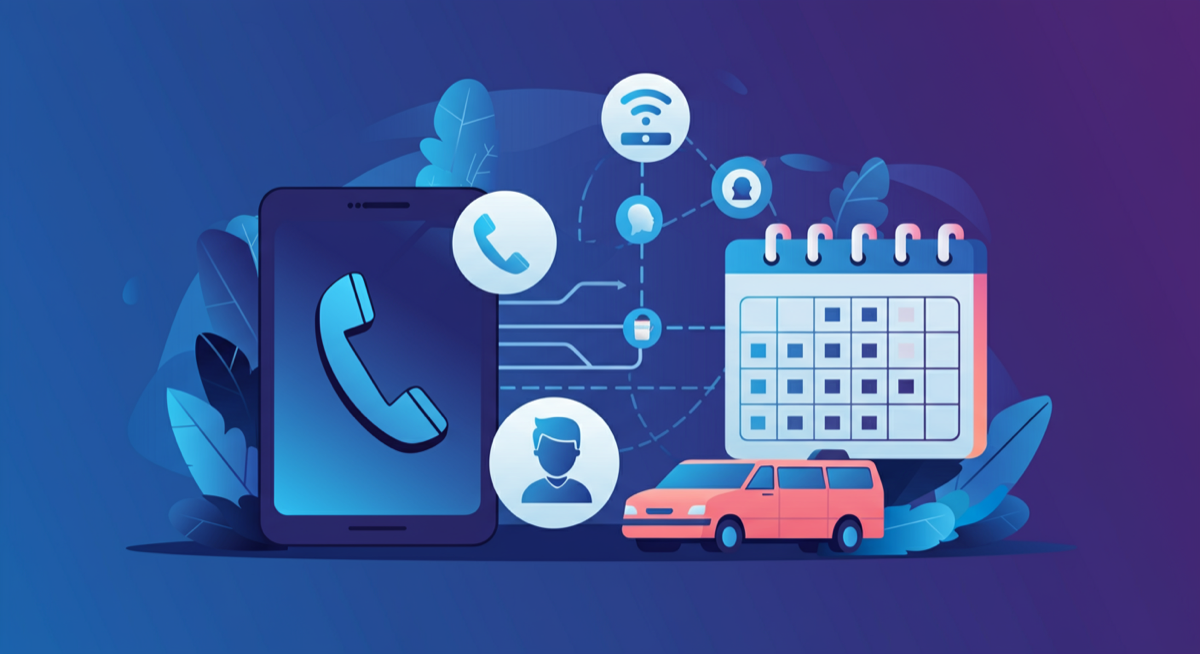
    AI phone receptionist connecting customer calls to automated dispatch, scheduling calendar, and service van

    This is Part 7 of our 10-part AI Adoption Journey series. Previously: Part 6 -- Give Your Business a Brain.

    A Customer Calls Your Plumbing Business at 7:42 PM. What Happens Next?

    If you run a service business -- plumbing, electrical, HVAC, locksmith, security -- you already know the answer. The phone rings. Nobody picks up. The customer hangs up and calls your competitor. You wake up to a voicemail you might return tomorrow, if you remember.

    This is not a small problem. Research shows that home service companies miss up to 62% of inbound calls, and Australian tradies specifically leave around 40% of calls unanswered during work hours (Australian Communications Consumer Action Network, 2025). At an average job value of $350-$800, every missed call is money walking out the door.

    The $126,000 Problem According to industry research, the average Australian small business loses approximately $126,000 per year from missed calls -- factoring in lost revenue, wasted marketing spend, and customer churn (Autopilot Genie, 2025).

    Most business owners who start looking into this problem discover AI phone receptionists -- systems that answer calls, capture details, and book jobs. That solves half the problem. But what happens after the call ends? Who dispatches the technician? Who creates the invoice? Who sends the confirmation SMS?

    That is where a second layer of AI comes in: the AI agent. And the real power comes when you connect both systems together.


    Two Types of AI, Two Very Different Jobs

    The terms "AI receptionist" and "AI agent" get thrown around interchangeably, but they do fundamentally different things. Understanding the distinction is the first step to building a system that actually works.

    The AI Phone Receptionist (Customer-Facing, Real-Time)

    An AI phone receptionist handles inbound calls with a natural voice -- answering in real time, just like a human would. Its job is entirely customer-facing and synchronous:

    • Answers every call instantly -- 24/7/365, no hold music, no voicemail
    • Speaks naturally -- with an Australian accent, not a robotic monotone
    • Captures job details -- name, address, job type, urgency level
    • Books appointments -- checks calendar availability and confirms times
    • Sends SMS confirmations -- to the customer and to your team
    • Escalates emergencies -- transfers to an on-call number when needed

    Think of it as your front desk. It is the voice your customers hear.

    The AI Agent (Back-Office, Asynchronous)

    An AI agent operates behind the scenes. It is not talking to anyone -- it is processing data, making decisions, and triggering workflows. Its job is internal and asynchronous:

    • Processes job data -- reads the intake form and enriches it with customer history
    • Dispatches technicians -- assigns jobs to the nearest available tech based on skills, location, and workload
    • Generates quotes and invoices -- creates draft invoices in Xero or MYOB
    • Manages scheduling conflicts -- rearranges the calendar when jobs run over time
    • Runs follow-up sequences -- sends review requests, warranty reminders, maintenance nudges
    • Produces reports -- tracks revenue per tech, average job value, response times

    Think of it as your operations manager. It is the brain that processes what the receptionist captured.

    AI Receptionist vs AI Agent: Side-by-Side

    Metric
    AI Phone Receptionist
    AI Back-Office Agent
    Improvement
    Primary roleAnswer calls, capture leadsProcess data, automate workflowsDifferent
    Customer-facing?Yes - real-time voiceNo - works behind the scenesComplementary
    SpeedSynchronous (instant)Asynchronous (seconds to minutes)Both fast
    Key outputJob details + bookingDispatch + invoice + reportsEnd-to-end
    Works alone?Yes, but creates manual follow-upYes, but needs structured inputBetter together
    Example productAdminAgentDespatchyIntegrated

    How They Work Together: The Complete Call-to-Cash Flow

    The real transformation happens when these two systems are connected. Here is how the end-to-end flow works for a typical service business.

    Customer Call to Job Completion: The Integrated AI Flow

    Customer Calls
    AI receptionist answers instantly, 24/7
    Job Captured
    Name, address, issue, urgency recorded
    Agent Processes
    AI dispatch agent reviews job requirements
    Tech Dispatched
    Nearest qualified tech assigned automatically
    Confirmations Sent
    SMS to customer and technician
    Invoice Created
    Draft invoice generated in Xero/MYOB

    Step 1: The call comes in (7:42 PM) The customer's hot water system has failed. They call your business. The AI receptionist picks up on the first ring: "G'day, you've reached Smith Plumbing. I'm here to help. Can I get your name and the address we're coming to?"

    Step 2: Details captured (7:44 PM) The receptionist collects the customer's name, address, phone number, job type (hot water system -- emergency), and preferred time window. It checks the calendar and confirms a morning slot.

    Step 3: AI dispatch agent takes over (7:44 PM) Within seconds, the back-office agent receives the structured job data. It checks which technicians are qualified for hot water systems, who is closest to the suburb, and who has availability tomorrow morning.

    Step 4: Technician assigned (7:45 PM) The agent assigns the job to Dave, who is 12 minutes away and has a hot water certification. Dave gets an SMS with the job details and address.

    Step 5: Customer confirmed (7:45 PM) The customer receives an SMS: "Thanks, Sarah. Dave from Smith Plumbing will be at your address between 8-10 AM tomorrow. Reply CONFIRM to lock in."

    Step 6: Invoice drafted (7:46 PM) The agent creates a draft invoice in Xero with the customer details, job type, and estimated pricing. After the job is complete, Dave marks it done in his app, the agent finalises the invoice, and the customer receives it by email.

    Total elapsed time from call to fully dispatched job: under 4 minutes. No human touched it.


    Why Service Businesses Need Both (Not Just One)

    It is tempting to think an AI receptionist alone solves the problem. It does solve the missed call problem. But it creates a new bottleneck: all those captured jobs still need a human to dispatch, schedule, invoice, and follow up.

    Consider a typical 5-person plumbing business handling 30 calls per day. If the AI receptionist captures every call perfectly, someone still needs to:

    • Review and triage 30 new job requests
    • Check technician availability and assign jobs
    • Send confirmation messages
    • Create invoices after each job
    • Chase follow-ups and collect reviews

    That is 2-3 hours of admin work per day -- work that pulls a technician off the tools or requires hiring an office manager at $55,000-$65,000 per year (SEEK Salary Insights, 2026).

    The AI dispatch agent eliminates that bottleneck. It takes the structured data from the receptionist and runs the entire back-office workflow automatically.


    What Does This Cost? Let's Do the Maths

    Before we run the numbers, calculate what missed calls are currently costing your specific business.

    Missed Calls Calculator

    Now let's compare the three most common staffing models for a service business.

    Annual Cost Comparison: Three Staffing Models

    Metric
    Human Receptionist
    AI Receptionist + AI Agent
    Improvement
    Annual salary/subscription$55,000-$65,000$1,800-$3,60094-97%
    Superannuation (12%)$6,600-$7,800$0100%
    Leave & training$4,000-$6,000$0100%
    After-hours coverage$15,000+ (agency)Included100%
    Dispatch & schedulingManual (2-3 hrs/day)Automated100%
    Invoice creationManual (30 min/day)Automated100%
    Total annual cost$80,000-$95,000+$1,800-$3,60095-98%

    ROI for a Typical 5-Person Trade Business

    Human receptionist + admin (current)$82,000/yr
    AI receptionist + dispatch agent$3,000/yr
    Revenue recovered from missed calls (15-20% more jobs)+$45,000/yr
    Admin time returned to billable work (3 hrs/day)+$36,000/yr
    Net annual benefit$160,000

    These figures are based on industry benchmarks. A typical trade business charging $150/hour for technician time, handling 30 calls/day, with 3 billable technicians. AI receptionist pricing based on mid-tier platforms at $150-$300/month (AI Receptionist Cost Guide, 2026). Actual results vary by business size and call volume.


    The Compliance Side: ACMA and Privacy Act Requirements

    Running AI phone systems in Australia is not a "set and forget" exercise. The Australian Communications and Media Authority (ACMA) has clear requirements that apply to AI-powered calls.

    Mandatory disclosure: Your AI receptionist must identify itself as an automated system. A compliant greeting sounds like: "G'day, you've reached Smith Plumbing. I'm an AI assistant -- I can help book your job or transfer you to the team."

    Key ACMA requirements for inbound AI reception:

    • The system must clearly identify itself as AI/automated
    • The business name must be stated
    • There must be a clear option to speak to a human
    • All call recordings require appropriate consent notices
    • Outbound marketing calls from AI require documented consent

    Privacy Act 1988 compliance:

    • Customer data captured during calls must be stored securely
    • Customers have a right to know what data is being collected
    • Data must be hosted in Australia or in a jurisdiction with equivalent protections
    • Retention policies must be documented

    Compliance Note: Australian businesses using AI phone systems must comply with the Privacy Act 1988 and ACMA's Telecommunications (Telemarketing and Research Calls) Industry Standard. Penalties for non-compliance can reach $2.78 million per contravention for Do Not Call Register violations, and up to $50 million for serious Privacy Act breaches (ACMA, 2025).

    Having worked on data governance frameworks at companies like BHP and Rio Tinto, I can confirm that getting compliance right from day one is far cheaper than retrofitting it later. The architecture of your AI system should include consent logging, data retention controls, and audit trails from the start.


    What Does Your Business Actually Need?

    Not every service business needs the full integrated system on day one. Here is a framework for deciding where to start.

    What Does Your Service Business Need?

    Where is your biggest pain point right now?
    Missing calls (especially after hours)
    → Start with AI receptionist (AdminAgent) -- solves 80% of the problem immediately
    Calls answered but dispatch is chaotic
    → Start with AI dispatch agent (Despatchy) -- automate scheduling and assignment
    Both -- missed calls AND manual dispatch
    → Deploy both together -- the integrated system delivers the biggest ROI
    Low call volume (<10/day), simple scheduling
    → Online booking form + calendar integration may be sufficient for now
    High volume (30+/day), multiple techs, urgent jobs
    → Full AI receptionist + dispatch + Xero integration is the clear path
    Cost Comparison Calculator

    Implementation Roadmap: From First Call to Full Automation

    The good news is that you do not need to build everything at once. The most successful implementations follow a staged approach.

    Implementation Roadmap: AI Receptionist + Dispatch Agent

    1
    Week 1
    AI Receptionist Go-Live
    Configure greeting, call flow, FAQ responses. Set up SMS notifications. Forward your main number to the AI receptionist. Test with 20-30 real calls.
    2
    Week 2
    Refine and Expand
    Review call transcripts, adjust responses, add common job types. Enable after-hours coverage. Connect calendar for basic booking.
    3
    Week 3-4
    Deploy Dispatch Agent
    Connect technician roster. Set up skills-based routing (e.g., gas-certified for gas jobs). Configure Xero/MYOB integration for auto-invoicing.
    4
    Week 5-6
    Full Integration
    Connect receptionist output to dispatch agent input. Enable end-to-end automation: call to dispatch to invoice. Set up reporting dashboard.

    Week 1: AI Receptionist -- Quick Win

    This is where you see immediate results. An AI receptionist can be live in a single day:

    1. Record or configure your greeting -- include business name, AI disclosure, and key services
    2. Set up call routing -- emergencies go to on-call, routine jobs get booked, general enquiries get answered
    3. Forward your number -- calls route to the AI receptionist first, overflow to your mobile
    4. Test it -- call your own number after hours. Verify the experience is professional

    Most businesses capture 15-20% more jobs in the first week simply by answering calls they were previously missing.

    Weeks 2-4: AI Dispatch Agent -- The Multiplier

    Once the receptionist is capturing jobs reliably, layer in the dispatch agent:

    1. Import your technician roster -- names, skills, certifications, locations, availability
    2. Define dispatch rules -- closest tech, skill match, emergency priority, workload balance
    3. Connect your accounting system -- Xero or MYOB for auto-invoicing
    4. Run parallel for one week -- AI dispatches alongside your manual process to validate accuracy

    According to field service industry research, 59% of organisations now use AI to automate scheduling and dispatching, and those that do see repair times improve by approximately 39% and first-time fix rates approach 86% (Salesforce Field Service Management Guide, 2025).

    Weeks 5-6: Full Integration -- The End Goal

    Connect the receptionist and dispatch agent so data flows automatically:

    • Receptionist captures job details in a structured format
    • Dispatch agent receives the data via API or webhook
    • Assignment, confirmation, and invoicing happen without human intervention
    • Exception handling routes genuinely complex issues to your office

    Expected Results: What Industry Benchmarks Tell Us

    Businesses that implement both an AI receptionist and a back-office dispatch agent typically see results across three areas.

    Typical Results After 90 Days (Industry Benchmarks)

    Metric
    Before (Manual)
    After (AI Receptionist + Agent)
    Improvement
    Calls answered58-60%100%40-42% more
    After-hours coverageVoicemail onlyFull AI reception24/7
    Time from call to dispatch2-8 hoursUnder 5 minutes96-99%
    Daily admin time2-3 hours15-20 minutes85-90%
    Invoice turnaround1-3 daysSame day (auto-generated)70-90%
    Customer satisfactionVariableHigher (faster response)24% retention lift

    Research by Salesforce indicates that organisations using AI-powered dispatch achieve approximately 21% higher repair accuracy and approach 86% first-time fix rates (Salesforce FSM Guide, 2025). Separately, businesses that provide 24/7 reception see customer retention rates improve by 24% or more (B2B HQ Industry Research, 2025).


    The AI Adoption Journey: Where This Fits

    If you have been following this series, you will recognise that the AI phone receptionist and AI dispatch agent sit at different points on the AI adoption maturity curve.

    The AI receptionist is one of the fastest wins any service business can deploy. It requires minimal integration, delivers immediate ROI, and your customers experience the benefit from day one.

    The AI dispatch agent is a process automation layer that requires more setup -- technician data, scheduling rules, accounting integration -- but delivers compounding returns as it handles more of your back-office.

    Together, they represent the kind of connected AI system that separates businesses still doing everything manually from those operating at a fundamentally different level of efficiency.

    The AI Adoption Journey — Full Series

    PartTopicStatus
    1IT Support Agent: Real Deployment StoryPublished
    2The 7 Business Functions AI Agents Are TransformingPublished
    3The AI Bookkeeper: Xero Reconciliation AgentPublished
    4The AI HR Agent: Policy, Leave, and OnboardingPublished
    5The AI Email Agent: Brand Voice RepliesPublished
    6Building a Client-Facing Knowledge GPTPublished
    7AI Phone Receptionist + AI Agent (this post)You are here
    8The BI Agent: Plain English DashboardsPublished
    9Building Your AI Agent EcosystemPublished
    10AI Agent Governance: Data, Privacy, Human OverridePublished

    Getting Started This Week

    Here is your action plan:

    1. Calculate your missed call cost -- use the calculator above or estimate: (missed calls per week) x (average job value) x 52 = annual revenue lost
    2. Deploy an AI receptionist first -- AdminAgent can be live in under a day, answering calls with a natural Australian voice for less than $5/day
    3. Layer in dispatch automation -- once calls are captured reliably, connect Despatchy to automate technician assignment, scheduling, and invoicing
    4. Book a free walkthrough -- schedule a 30-minute call with our team to map the right architecture for your business

    The businesses that will win in 2026 and beyond are not the ones with the most technicians -- they are the ones that never miss a call and never waste time on admin that a machine can handle.


    Ready to Stop Losing After-Hours Calls?

    We built AdminAgent specifically for service businesses that cannot afford to miss customer calls. Our AI phone receptionist:

    • Answers every call instantly -- 24/7, including emergency calls
    • Speaks with a natural Aussie accent -- not a robotic voice
    • Captures all the details -- name, location, job type, urgency
    • Books the job or texts you -- integrates with your calendar or sends SMS
    • Costs less than $5/day -- compared to $15,000+ for a human receptionist

    Try AdminAgent Free for 7 Days -->


    Related Reading:

    Sources: Research synthesised from ACMA Telecommunications Standards (2025), Salesforce Field Service Management Guide (2025), SEEK Salary Insights (February 2026), Australian Communications Consumer Action Network (2025), AI Receptionist Cost Guide (2026), Autopilot Genie missed call research (2025), and field service industry benchmarks.