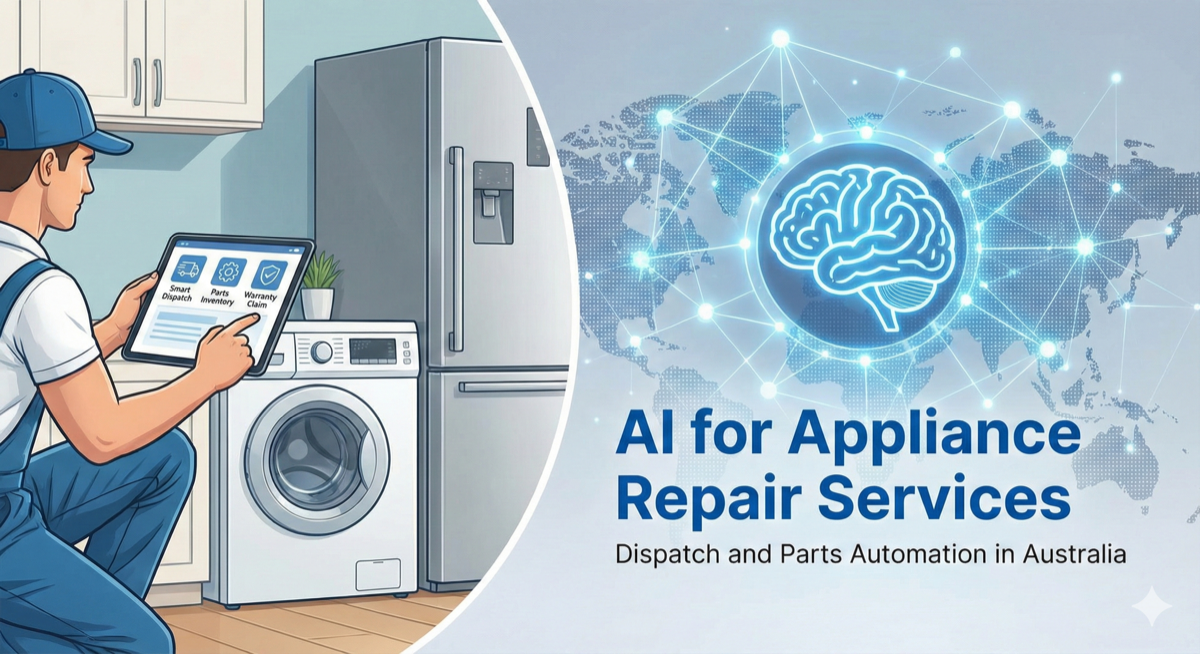
It is 7:30 AM on a Saturday in suburban Melbourne. A family's washing machine has just flooded their laundry. Three kids need school uniforms by Monday. The homeowner grabs their phone and starts calling appliance repair services.
Your phone rings while you are already halfway through a fridge compressor replacement in Dandenong. By the time you check voicemail at 9 AM, the customer has already booked someone else - a competitor who answered on the first ring.
That emergency callout? Worth $200-350 for a pump replacement. The ongoing relationship with a household that owns a 10-year-old Samsung washer, LG fridge, and Westinghouse oven? Potentially thousands in lifetime value.
This scenario repeats across the $2.1 billion Australian appliance repair industry every single day.
Based on industry data showing service businesses miss 27-40% of inbound calls while on job sites.
Calculate what missed calls are costing your appliance repair business:
The Australian domestic appliance repair and maintenance industry is valued at $2.1 billion in 2026, with approximately 2,645 businesses competing for work. According to IBISWorld, the industry has experienced a compound annual growth rate of 1.7% between 2018 and 2023.
But here is the reality that industry statistics do not capture: the appliance repair sector faces a perfect storm of challenges that make automation essential for survival.
Jobs and Skills Australia reports that technician and trade occupations have a fill rate of just 57%, meaning nearly half of advertised roles remain unfilled. The appliance service sector requires Certificate III in Appliance Service (UEE32120) qualifications, with additional licensing for refrigeration (ARCtick) and electrical work.
Finding qualified technicians who can work across Samsung, LG, Electrolux, Bosch, and Fisher & Paykel is increasingly difficult. Training a new apprentice takes 3-4 years.
Unlike a specialist plumber or electrician, appliance repair technicians must maintain authorisation and training across multiple manufacturers:
| Manufacturer | Authorisation Requirements | Typical Renewal |
|---|---|---|
| Samsung | Product training + portal access | Annual |
| LG | LG Academy certification | 12-24 months |
| Electrolux | Factory training modules | Annual |
| Fisher & Paykel | F&P Service Network | Annual |
| Bosch/Siemens | BSH Training Portal | 12 months |
Miss a certification renewal, and you cannot perform warranty work for that brand. For businesses serving as authorised service agents, this directly impacts revenue.
Appliance repair is fundamentally different from other trades because diagnosis often cannot be completed until the technician is on-site. A washing machine "not draining" could be a $15 pump filter, a $180 pump motor, or a $350 control board.
Major parts distributors like Statewide Appliance Spares and Stokes Appliance Parts stock over 100,000 SKUs. Knowing which parts to carry in the van versus order on demand is a constant balancing act.
Let me cut through the vendor marketing and explain what AI automation actually delivers for appliance repair operations.
When a customer calls and says "my fridge is making a clicking noise and not cooling," an AI system can:
This is not magic. It is pattern matching across thousands of similar service calls. A clicking noise in a 5-year-old Samsung fridge with no cooling typically indicates a compressor relay or start capacitor issue. An AI system trained on historical job data can suggest this with 70-80% accuracy.
The practical benefit? Your technician arrives with the right parts in the van instead of needing a return visit. First-time fix rates improve from the industry average of 65-70% to 80-85%.
| Metric | Traditional Booking | AI-Assisted Booking | Improvement |
|---|---|---|---|
| Information captured | Name, address, appliance type | Full fault symptoms, model, age, warranty status | Complete |
| Parts prediction | None - tech diagnoses on-site | 70-80% likely parts identified | Pre-loaded |
| First-time fix rate | 65-70% | 80-85% | 15-20% better |
| Return visits | 30-35% of jobs | 15-20% of jobs | 50% reduction |
AI inventory management for appliance repair addresses the unique "long tail" problem: you need hundreds of different parts, but each one might only be used a few times per year.
What AI inventory actually does:
Appliance repair dispatch is more complex than standard field service because:
AI dispatch systems factor in:
| Factor | What AI Considers |
|---|---|
| Location | GPS distance, traffic patterns, parking availability |
| Skills | Brand certifications, specialty areas |
| Parts | Van stock vs warehouse availability |
| Warranty | Manufacturer authorisation requirements |
| Workload | Fair distribution across team |
For a typical 4-technician operation, intelligent dispatch can reduce total driving time by 25-35% and increase jobs per technician per day from 4-5 to 5-7.
This is where AI delivers immediate ROI for authorised service agents.
Warranty claims for major manufacturers involve:
An AI system can automate 70-80% of this process:
Under Australian Consumer Law, consumers have statutory guarantees that do not have a specific expiry date. This means appliance repair businesses regularly handle warranty-adjacent claims where the manufacturer's warranty has expired but ACL consumer guarantees still apply. AI systems can flag these situations and suggest appropriate responses.
For businesses holding authorisations across multiple manufacturers, tracking certification expiry is critical. Miss a renewal, and you lose the ability to perform warranty work.
AI certification tracking:
The field service management market offers numerous options, but not all are suited to appliance repair's unique requirements.
Best for: 1-4 technician operations focused on domestic repairs
Best for: 5-15 technician operations with inventory needs
Best for: 15+ technicians, multiple branches, heavy warranty work
| Solution Type | Monthly Cost | Setup Cost | Best For |
|---|---|---|---|
| AI Phone + Basic FSM | $150-400 | $500-1,500 | 1-4 techs |
| Mid-Range FSM | $300-800 | $2,000-5,000 | 5-15 techs |
| Enterprise FSM | $800-2,000+ | $5,000-15,000 | 15+ techs |
Here is a realistic timeline for implementing AI-powered automation in an appliance repair business.
Key activities:
Common gotchas:
Key activities:
Key activities:
Key activities:
Based on field service management research and industry benchmarks, here is what appliance repair businesses typically see after implementing AI automation.
| Metric | Before Automation | After Automation | Improvement |
|---|---|---|---|
| Call answer rate | 65-75% | 99%+ | 30%+ more captured |
| First-time fix rate | 65-70% | 80-85% | 15-20% better |
| Jobs per tech per day | 4-5 | 5-7 | 25-40% more |
| Admin time per job | 15-20 mins | 5-8 mins | 60% reduction |
The appliance repair industry is at an inflection point. Labour shortages are not going away. Customer expectations for instant response continue to rise. Manufacturers are increasingly pushing warranty work through digital portals.
Businesses that automate now will capture market share from those still running on paper job cards and voicemail.
Your action plan this week:
Ready to Stop Losing After-Hours Calls?
We built AdminAgent specifically for service businesses that cannot afford to miss customer calls. Our AI phone receptionist:
Try AdminAgent Free for 7 Days
Related Reading:
Sources:
Research synthesised from IBISWorld Domestic Appliance Repair and Maintenance Industry Report (2025), Jobs and Skills Australia Occupation Shortage Report (March 2025), ServiceTasker Average Rates of Appliance Repairs in Australia (2026), ACCC Warranties and Consumer Guarantees guidance, and field service management industry benchmarks from ServiceTitan and Workiz.