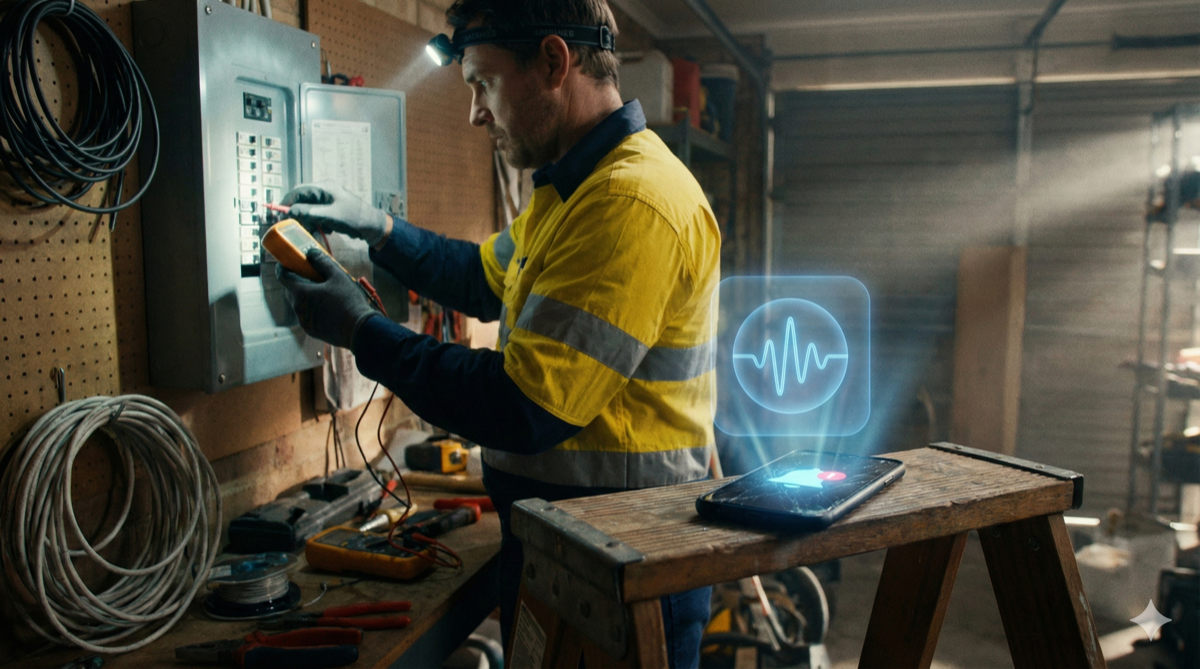
You are three metres up on a tile roof in Western Sydney. The afternoon sun is brutal. You are aligning a high-gain antenna for a customer in a reception black spot, and the signal meter is finally showing solid bars.
Your phone buzzes in your pocket. Then again. Then a third time.
By the time you are safely back on the ground, you have missed three calls. Two went to voicemail (neither left a message). The third caller has already booked your competitor who answered on the first ring.
That missed call? A new home build needing full antenna installation plus six TV points throughout the house. A $600-900 job. Gone in 45 seconds.
This scenario plays out daily across Australian antenna installation businesses. According to industry research, home service businesses miss approximately 27% of inbound calls. For antenna installers working solo or in small teams, that percentage climbs higher during peak periods when everyone is on a roof somewhere.
Based on industry research from Invoca and HouseCall Pro showing home service call patterns.
The TV antenna installation market in Australia presents specific challenges that make traditional phone-and-paper operations increasingly difficult to sustain.
Australians are cutting cable subscriptions and returning to free-to-air television. The global TV antenna market is projected to grow at 6.4% annually, driven by consumers seeking alternatives to expensive streaming subscriptions. When you can watch ABC, SBS, Seven, Nine, and Ten for free with a properly installed antenna, suddenly that $40-100/month in streaming fees becomes optional.
This means more antenna installation enquiries. More competition for those enquiries. And customers who expect the same instant booking experience they get from Uber and Deliveroo.
Unlike a plumber who knows every blocked drain is roughly similar, antenna installation requires location-specific assessment. Signal strength varies dramatically across Australian suburbs.
Apps like Antenna Mate store data on 6,899 TV transmitters across Australia, covering 591 broadcasting sites and 2,792 digital transmitters. The app uses GPS to estimate signal strength and shows the correct polarisation for each location.
For installers, this means every job requires pre-assessment:
An AI booking system that incorporates location-based signal data can pre-qualify jobs, recommend appropriate equipment, and set accurate customer expectations before you arrive.
A modern home antenna job is rarely just one antenna. The customer typically wants:
Coordinating these requirements across scheduling, quoting, and inventory creates administrative overhead that consumes hours every week.
| Metric | Manual Operations | With AI Automation | Improvement |
|---|---|---|---|
| Missed calls during jobs | 25-35% | Under 5% | 85% reduction |
| Quote turnaround | Same day to 48 hrs | Instant on-call | 95% faster |
| Signal assessment | On-site only | Pre-qualified via app | Saves site visits |
| Warranty tracking | Paper/memory | Automated reminders | Zero missed follow-ups |
Effective automation for antenna installers addresses five interconnected areas. Each delivers standalone value, but the compound benefit emerges when they work together.
The most immediate pain point for antenna installers is missed calls. When you are on a roof, you cannot answer the phone. When you are driving between jobs, you should not be answering the phone (penalties start at $1,000+ in most Australian states).
An AI phone receptionist solves this by:
The critical difference from a traditional answering service is intelligence. A basic message service says "leave your details and someone will call back." An AI system can say "Based on your address in Penrith, you are in a moderate signal zone. A standard antenna with an amplifier would typically work well. I have availability on Thursday afternoon - would that suit?"
Here is where AI creates genuine efficiency gains beyond basic call answering.
Australian signal strength varies dramatically by location. According to ACMA data integrated into apps like Antenna Mate:
An AI system can access this data automatically when a customer provides their address:
For a customer in Sydney CBD: "Based on your location, you should receive strong signal from the Gore Hill transmitter. A standard UHF antenna would typically provide excellent reception. For a two-storey home with four TV points, installations in your area usually run between $350-$500 including materials."
For a customer in the Blue Mountains: "Your address is in a weaker signal zone, approximately 70km from the Gore Hill transmitter. Installations in this area typically require a high-gain antenna with a masthead amplifier. For reliable reception, expect investment between $500-$750 depending on roof access."
This pre-qualification saves site visits, sets accurate customer expectations, and demonstrates expertise before you even meet the customer.
Antenna jobs are rarely one-and-done. A typical residential installation involves:
Each component affects job duration. An AI scheduling system can:
For businesses handling multiple jobs daily, this prevents the cascading delays that frustrate customers and burn goodwill.
Traditional approach: Book all jobs for "morning" or "afternoon," hope for the best, call customers to delay when running behind.
Automated approach: AI calculates job duration (2-hour antenna install + 4 TV points = 3.5-4 hours), schedules appropriately, sends customer precise ETA updates when technician is en route.
Most quality TV antennas come with 5-10 year warranties. Quality cabling and components have similar warranty periods. Yet most antenna installers have no system to track which customer has what equipment and when warranty periods expire.
This represents missed opportunity on multiple levels:
Customer service: Proactively contacting customers before warranty expiration demonstrates professionalism and builds loyalty.
Repeat business: An antenna installed in 2020 may need inspection by 2025. A customer who had a positive experience is likely to use you again - if you remind them.
Preventive maintenance: Coastal installations corrode faster. Properties with tree proximity need periodic cleaning. Automated reminders capture this maintenance work before customers notice problems.
Warranty management software like Expiration Reminder or integrated field service platforms can automatically:
Modern TV installation increasingly includes streaming device configuration. Customers want their antenna, yes - but they also want:
According to Fetch TV, users can access Netflix, Disney Plus, Apple TV Plus, Amazon Prime Video, Paramount Plus, Stan, Britbox, Hayu, and more through a single interface. Binge pricing ranges from $10-$22 per month depending on video quality and simultaneous streams.
An AI booking system can:
This upselling happens naturally within the booking conversation, increasing average job value without aggressive sales tactics.
Understanding typical pricing helps when configuring AI quoting systems. According to multiple Australian sources, current installation costs vary by city and complexity.
| Metric | Standard Install | Complex Install | Improvement |
|---|---|---|---|
| Sydney | $300-$500 | $500-$800 | Varies by access |
| Melbourne | $250-$450 | $450-$700 | Roof height factor |
| Brisbane | $250-$400 | $400-$650 | Storm damage common |
| Perth | $240-$400 | $400-$600 | Distance to transmitter |
| Adelaide | $200-$350 | $350-$550 | Generally lower costs |
Source: ServiceTasker, Antenna Pros Sydney, Briggs Electrical Melbourne pricing guides 2025-2026.
Additional cost factors to incorporate into AI quoting:
The field service software landscape offers multiple options suited to different business sizes.
ServiceM8 ($29-$149/month Australian pricing) Australian-built, mobile-first platform designed for trade businesses. Handles scheduling, quoting, invoicing, and basic customer communication. Integrates with Xero for accounting.
Best for: Solo antenna installers wanting simple job management without complexity.
Tradify (From $69/month) Another Australian-built option with automatic overdue payment reminders, Google Calendar integration, and automated email/SMS follow-ups. Over 20,000 tradies use the platform.
Best for: Businesses wanting automated customer communication without extensive setup.
Fergus (Custom pricing) Built by tradies for tradies, Fergus offers automated SMS reminders for upcoming jobs and automated payment follow-ups. Strong in the Australian/New Zealand market.
Best for: Businesses transitioning from reactive to proactive operations.
simPRO ($154-$500+/month) Brisbane-headquartered company serving businesses ready to scale. More robust job costing, inventory management, and enterprise-grade reporting.
Best for: Multi-technician operations with complex quoting and inventory needs.
AI phone receptionist services work alongside any field service software:
Implementing automation for an antenna installation business does not require a massive project. Here is a realistic 60-day roadmap.
Before changing anything, measure what you have:
This baseline data proves ROI later.
The highest-impact change is ensuring every call gets answered. Implement AI phone answering:
Expected result: Missed call rate drops from 25-35% to under 5% within the first week.
With calls captured, implement proper job management:
Track these metrics weekly:
Adjust automation rules based on actual performance data.
Let us be honest about what antenna business automation delivers. These figures assume a solo operator or small team in a metropolitan area.
| Metric | Before Automation | After 60 Days | Improvement |
|---|---|---|---|
| Missed call rate | 25-35% | Under 5% | 85% reduction |
| Quote turnaround | Same day to 48 hrs | Often instant | 90% faster |
| Jobs booked per week | 8-12 | 12-18 | 40% increase |
| Admin hours weekly | 10-15 hours | 4-6 hours | 60% reduction |
Based on industry averages for antenna installation job values and typical missed call rates in Australian service businesses.
You do not need to implement everything at once. Here is what to do this week:
Step 1: Count Your Missed Calls Pull your phone records from the last 30 days. Count calls that went to voicemail or were missed entirely during business hours. Multiply by your average job value and 30% conversion rate. That is your baseline cost of the problem.
Step 2: Fix the Phone First If you are missing more than 20% of calls, an AI phone receptionist pays for itself within the first month. Setup takes 1-2 days.
Step 3: Consider Signal Pre-Qualification Download Antenna Mate (iOS) or a similar app. When customers call, using their address to provide signal strength context immediately demonstrates expertise and sets accurate expectations.
Step 4: Plan Your Software Stack Book demos with ServiceM8 (small), Tradify (growing), or simPRO (scaling). Ask specifically about mobile quoting and Xero/MYOB integration.
Ready to Stop Losing Calls While You're on the Roof?
We built AdminAgent specifically for service businesses that cannot afford to miss customer calls. Our AI phone receptionist:
Try AdminAgent Free for 7 Days
Related Reading:
Sources: Research synthesised from ServiceTasker Antenna Installation Cost Guide 2026, Antenna Mate App, Invoca Missed Call Research, Fortune Business Insights TV Antennas Market Report, Fetch TV Features, Tradify Australia, and Australian industry pricing data.